

Liposuction Surgery Devices Market
Liposuction Surgery Devices Market Share & Trends Analysis Report, By Product Type (Stand‑alone Devices, Portable Devices), By Technology (Tumescent, Ultrasound‑Assisted (UAL), Laser‑Assisted (LAL), Power‑Assisted (PAL), Water‑Assisted (WAL), Suction‑Assisted, Radiofrequency‑Assisted (RFAL), Other Techniques), By Application (Body Contouring, Cosmetic Surgery, Fat Grafting/Reconstruction), By End‑User (Hospitals, Ambulatory Surgical Centers, Plastic Surgery Clinics, Dermatology Clinics, Academic & Research Institutes), By Cannula Type (Blunt‑Tip, Open‑Tip, Spatula‑Tip, Internal US Cannula, Laser Cannula, Double Lumen Cannula)– Industry Analysis Report, Regional Outlook, Growth Potential, Price Trends, Competitive Market Share & Forecast, 2025–2033.

Historical Period: 2019-2024
Forecast Period: 2025-2033
Report Code :
CAGR: 12.60%
Last Updated : November 22, 2025
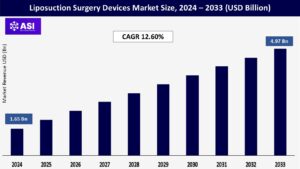
The global liposuction surgery devices market size was valued at approximately USD 1.65 billion in 2024 and is projected to reach USD 4.97 billion by 2033, growing at a CAGR of 12.60% during the forecast period (2025–2033).
The Liposuction Surgery Devices Market consists of medical equipment and technologies designed for the removal of excess fat from specific areas of the body. These devices are primarily used in cosmetic surgery procedures to reshape and contour the body by eliminating stubborn fat deposits that are resistant to diet and exercise.
Common devices include suction cannulas, power-assisted liposuction machines, laser-assisted devices, and ultrasound-based technologies. Liposuction devices are valued for their precision, safety, ease of use, and ability to minimize tissue damage.
Their properties typically include ergonomic design, advanced suction control, compatibility with tumescent techniques, and improved recovery outcomes for patients. They are also used in treating medical conditions like lipedema and gynecomastia.
With rising global awareness of physical appearance, driven by media, fitness culture, and social media influence, more individuals are seeking cosmetic procedures like liposuction.
Increasing disposable incomes, especially in countries like the U.S., South Korea, Brazil, and India, are making elective surgeries more accessible. Liposuction is one of the most popular cosmetic surgeries, and this trend is projected to continue fueling the market.
The development of laser-assisted, ultrasound-assisted, and power-assisted liposuction techniques has significantly improved procedural safety, reduced downtime, and minimized scarring and discomfort. These innovations have made liposuction more appealing to a broader range of patients.
Additionally, real-time fat mapping, improved cannulas, and devices that preserve surrounding tissue further drive market growth by enhancing patient outcomes and surgeon confidence.
Despite growing demand, the potential for adverse outcomes and post-operative complications such as infection, fluid accumulation, blood clots, nerve damage, and skin irregularities acts as a major restraint.
These risks can lead to reluctance among potential patients and create legal challenges for providers. Additionally, strict regulatory approval processes for new devices from authorities like the FDA (U.S.) or CE (Europe) can delay market entry and restrict innovation. Combined, these factors hinder market expansion and increase the costs and time required to bring new technologies to market.
| Report Metric | Details |
|---|---|
| Segmentations | |
| By Product Type |
Stand‑alone Devices Portable Devices |
| By Technology |
Tumescent Ultrasound‑Assisted (UAL) Laser‑Assisted (LAL) Power‑Assisted (PAL) Water‑Assisted (WAL) Suction‑Assisted Radiofrequency‑Assisted (RFAL) Other Techniques |
| By Application |
Body Contouring Cosmetic Surgery Fat Grafting/Reconstruction |
| By End-User |
Hospitals Ambulatory Surgical Centers Plastic Surgery Clinics Dermatology Clinics Academic & Research Institutes |
| By Cannula Type |
Blunt‑Tip Open‑Tip Spatula‑Tip Internal US Cannula Laser Cannula Double Lumen Cannula |
| Key Players |
|
| Geographies Covered | |
| North America |
U.S. |
| Europe |
U.K. |
| Asia Pacific |
China |
| Middle East & Africa |
Saudi Arabia |
| Latin America |
Brazil |
The Liposuction Surgery Devices Market is segmented by Product Type, Technology, Application, End User and Cannula Type. Each factor contributes to the growing popularity of cosmetic and reconstructive procedures, enhancing patient outcomes, and expanding the accessibility of advanced fat removal techniques.
Technological improvements in minimally invasive devices, combined with increasing aesthetic awareness and disposable incomes, are driving the widespread adoption of liposuction treatments.
Stand-Alone Devices These are comprehensive, full-size systems with integrated components like suction pumps, infiltration units, control panels, and energy-assisted modules. They are typically installed in hospitals, surgical centers, or high-volume cosmetic clinics.
These devices support multiple liposuction techniques (UAL, PAL, LAL) and are favored for their precision, reliability, and ability to perform complex or large-volume procedures. They also often support dual cannula systems and simultaneous fat processing (for fat grafting). Portable Devices Designed for mobility and space efficiency, these compact systems are popular in outpatient clinics, dermatology offices, and ambulatory surgical centers.
Though smaller in scale, many portable units now offer advanced features like power assistance and dual-mode operation. They are ideal for localized fat removal procedures and are gaining traction due to lower costs, easy maintenance, and increasing demand for minimally invasive, walk-in body contouring procedures.
Tumescent Liposuction The most widely used technique, involving the injection of a diluted anesthetic solution into fat tissues before suction. It reduces bleeding, enhances fat removal efficiency, and minimizes patient discomfort. Devices in this category are standard and form the entry point for many clinics entering the liposuction market.
Ultrasound-Assisted Liposuction (UAL) This technique uses ultrasonic vibrations to emulsify fat, making it easier to suction, especially in fibrous areas like the male chest, back, or flanks. UAL systems are equipped with specialized cannulas that transmit ultrasound energy.
They are favored for high-definition body sculpting and are often used in male patients or revision liposuction. Laser-Assisted Liposuction (LAL) Utilizes laser energy to liquefy fat cells while simultaneously stimulating collagen production, which helps in skin tightening. These systems are popular in facial liposuction and neck contouring, where precision and skin contraction are critical.
LAL is also associated with faster healing and less bruising. Power-Assisted Liposuction (PAL) Employs a mechanized, vibrating cannula that reduces physical effort by the surgeon and speeds up fat removal. These systems are widely used in large-volume liposuction cases and are preferred for their ergonomic benefits, efficiency, and safety.
PAL is suitable for nearly all body areas and is becoming the preferred method in many clinics. Water-Assisted Liposuction (WAL) Uses a fan-shaped jet of saline solution to loosen fat cells gently, preserving tissue integrity. WAL is ideal for fat harvesting and grafting since it results in high viability of fat cells.
It’s increasingly used in breast augmentation via fat transfer and regenerative procedures. Suction-Assisted Liposuction This traditional method involves direct suction without added mechanical or energy support. Though cost-effective and reliable, it requires more manual effort and can result in more tissue trauma, longer recovery, and increased bruising.
It is still used in budget-sensitive clinics or basic setups. Radiofrequency-Assisted Liposuction (RFAL) Combines traditional suction with RF energy to liquefy fat and tighten skin. It is suitable for patients with moderate skin laxity and is increasingly preferred for areas like the neck, arms, and inner thighs.
RFAL systems offer dual benefits of fat reduction and skin tightening in one session. Other Techniques Includes hybrid systems combining technologies (e.g., PAL + RF), cryolipolysis for pre-treatment, vibro-liposuction, and non-thermal plasma-assisted devices under clinical research. These emerging technologies offer niche solutions and are gaining attention in specialized centers.
Body Contouring The largest application segment, encompassing procedures aimed at reshaping body parts like the abdomen, thighs, hips, arms, and back. Demand is driven by the rise in aesthetic awareness, fitness culture, and post-weight loss surgeries.
Technologies like PAL, WAL, and UAL are commonly used for these applications. Cosmetic Surgery Covers aesthetic enhancements including facial liposuction, chin sculpting, and overall body shaping. LAL and RFAL are especially popular here due to their skin-tightening effects.
The growth of social media and beauty influencers is driving this segment globally. Fat Grafting/Reconstruction This segment includes procedures where extracted fat is processed and reinjected for breast reconstruction (e.g., after mastectomy), buttock augmentation, or facial volume restoration. WAL is the preferred technology here due to higher fat viability. This application is expanding in both cosmetic and therapeutic domains.
Hospitals use liposuction devices not just for aesthetics but also for reconstructive and medical cases, such as treating lipomas, gynecomastia, or lymphedema. They tend to purchase advanced, multi-technology systems to support a wide range of procedures. Ambulatory Surgical Centers ASCs are cost-effective, outpatient centers performing a high volume of elective procedures.
They prefer compact, efficient liposuction systems that are easy to move between rooms. Portable PAL or LAL systems are common in this setting. Plastic Surgery Clinics This is the dominant end-user segment. Clinics often specialize in aesthetic procedures and invest in multiple liposuction technologies (PAL, LAL, RFAL) to provide personalized treatments.
They also adopt the latest cannula types and fat processing systems for competitive advantage. Dermatology Clinics Focus on smaller, superficial fat removal and skin tightening procedures. Devices like laser and radiofrequency-assisted liposuction are commonly used. These clinics prefer non-invasive or minimally invasive systems that offer low risk and rapid patient recovery.
Academic & Research Institutes These institutions focus on testing and validating emerging liposuction technologies, including energy-assisted and robotic liposuction. They contribute to training, protocol development, and regulatory approval processes. Flexible, modular systems are preferred in this segment.
Blunt-Tip Cannula Most commonly used for safe fat removal, especially in areas where vessel and nerve protection is critical. It reduces trauma and bruising and is ideal for large-volume liposuction. Open-Tip Cannula Allows aggressive fat removal and is used in fibrous or dense fat areas such as the back or male breast.
Requires experienced handling to avoid tissue damage. Spatula-Tip Cannula Features a flat end for better maneuverability and precision. Useful for contouring and reaching fat deposits in tight or delicate anatomical areas. Internal Ultrasound (US) Cannula Used in UAL procedures, these cannulas emit ultrasonic energy to emulsify fat.
Suitable for secondary procedures and revision liposuction where fibrotic tissue is present. Laser Cannula Thin fiber-optic tubes used to deliver laser energy during LAL. Besides melting fat, they help promote collagen remodeling, making them ideal for facial and neck areas.
Double Lumen Cannula Equipped with two channels for simultaneous infiltration of tumescent fluid and fat aspiration. Enhances procedural efficiency and reduces operating time. Used in modern PAL and WAL systems.
Dominates the liposuction devices market, driven by high demand for aesthetic procedures, advanced healthcare technology, and strong consumer spending on cosmetic surgery. The U.S. leads globally in procedure volume and innovation in laser- and ultrasound-assisted liposuction devices.
Ranks second, with countries like Germany, France, and Italy embracing cosmetic surgery as a cultural norm. Regulatory approval of advanced technologies and availability of trained professionals support stable market growth. The region also has a growing demand for non-invasive body contouring solutions.
The most dynamic market, with rising beauty consciousness, increasing disposable incomes, and influence from K-beauty trends in countries such as South Korea, Japan, and China. Medical tourism in Thailand and India also fuels demand for liposuction devices.
Especially Brazil and Colombia has a strong cosmetic surgery culture and ranks among the highest in global liposuction procedures. However, economic fluctuations and uneven access to advanced technology can impact consistent market growth.
Sees rising demand, particularly in affluent Gulf nations like the UAE, Saudi Arabia, and Qatar. Cosmetic surgery is gaining popularity, but limited access in lower-income African countries slows the regional market’s overall progress.
The liposuction surgery devices market was valued at USD 1.65 billion in 2024.
The market is projected to grow at a CAGR of 12.60% from 2025 to 2033.
Stand‑alone Devices hold the largest market share.
The North America region is expected to witness the highest growth rate.
Major players include Alma Lasers Ltd., Solta Medical, Inc. and Cynosure, LLC
1.1 Summary
1.2 Research methodology
2.1 Research Objectives
2.2 Market Definition
2.3 Limitations & Assumptions
2.4 Market Scope & Segmentation
2.5 Currency & Pricing Considered
3.1 Drivers
3.2 Geopolitical Impact
3.3 Human Factors
3.4 Technology Factors
4.1 Porters Five Forces Analysis
4.2 Value Chain Analysis
4.3 Average Pricing Analysis
4.4 M & A, Agreements & Collaboration Analysis
5.1 Liposuction Surgery Devices Market, By Product Type
5.1.1 Introduction
5.1.2 Market Size & Forecast
5.2 Liposuction Surgery Devices Market, By Technology
5.3 Liposuction Surgery Devices Market, By Application
5.4 Liposuction Surgery Devices Market, By End-User
5.5 Liposuction Surgery Devices Market, By Cannula Type
6.1 North America Liposuction Surgery Devices Market , By Country
6.1.1 Liposuction Surgery Devices Market, By Product Type
6.1.2 Liposuction Surgery Devices Market, By Technology
6.1.3 Liposuction Surgery Devices Market, By Application
6.1.4 Liposuction Surgery Devices Market, By End-User
6.1.5 Liposuction Surgery Devices Market, By Cannula Type
6.2 U.S.
6.2.1 Liposuction Surgery Devices Market, By Product Type
6.2.2 Liposuction Surgery Devices Market, By Technology
6.2.3 Liposuction Surgery Devices Market, By Application
6.2.4 Liposuction Surgery Devices Market, By End-User
6.2.5 ECG Patch and Holter Monitor Market, By Cannula Type
6.3 Canada
7.1 U.K.
7.2 Germany
7.3 France
7.4 Spain
7.5 Italy
7.6 Russia
7.7 Nordic
7.8 Benelux
7.9 The Rest of Europe
8.1 China
8.2 South Korea
8.3 Japan
8.4 India
8.5 Australia
8.6 Taiwan
8.7 South East Asia
8.8 The Rest of Asia-Pacific
9.1 UAE
9.2 Turkey
9.3 Saudi Arabia
9.4 South Africa
9.5 Egypt
9.6 Nigeria
9.7 Rest of MEA
10.1 Brazil
10.2 Mexico
10.3 Argentina
10.4 Chile
10.5 Colombia
10.6 Rest of Latin America
11.1 Global Market Share (%) By Players
11.2 Market Ranking By Revenue for Players
11.3 Competitive Dashboard
11.4 Product Mapping