

Magnesium Stearate Market
Magnesium Stearate Market & Trends Analysis Report, By Product Type (Pharmaceutical Grade, Food-Grade), By Application (Residential, Powder Form), By Distribution Channel (Offline, Internet)– Industry Analysis Report, Regional Outlook, Growth Potential, Price Trends, Competitive Market Share & Forecast, 2025–2033.

Historical Period: 2019-2024
Forecast Period: 2025-2033
Report Code :
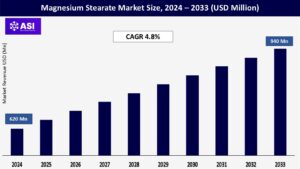
CAGR: 4.8%
Last Updated : March 16, 2026
The global Magnesium Stearate Market size was valued at approximately USD 620 million in 2024 and is projected to reach USD 940 million by 2033, growing at a CAGR of 4.8% during the forecast period.
Magnesium stearate, a fine white powder formed from magnesium and stearic acid, is widely used as a lubricant, anti-adherent, and release agent across several industries including pharmaceuticals, food, cosmetics, and plastics.
Market growth is primarily driven by the expanding pharmaceutical industry, increased consumption of processed foods, and rising demand for cosmetic products. The compound’s inert nature and functional versatility make it a critical additive in tablet manufacturing, food coating, and skincare formulations.
A vital excipient in the pharmaceutical sector, magnesium stearate is utilized extensively as a flow agent, lubricant, and anti-adherent in the production of tablets, capsules, and powders.
It guarantees constant dose homogeneity, easy pill ejection, and keeps contents from adhering to equipment. Pharmaceutical manufacturing is expanding significantly due to the rise in chronic diseases worldwide, the aging of the population, and better access to healthcare in developing nations.
The need for high-purity, pharmaceutical-grade magnesium stearate is being further increased by significant investments being made in pharmaceutical manufacturing facilities by emerging countries such as India, Brazil, and Southeast Asia. Consumption is also increasing as a result of developing trends in over-the-counter (OTC) vitamins and nutraceuticals.
Magnesium stearate is prized in the personal care and cosmetics sector for its abilities to improve product texture, mattify oily skin, increase product adhesion to the skin, and improve spread ability. Products including foundations, eye shadows, lipsticks, and pressed powders frequently contain it.
Growing disposable incomes, urbanization, and consumer demand for natural, multipurpose, and clean-label ingredients are driving the worldwide cosmetics market’s strong expansion.
A major driver is the Asia-Pacific area, especially China, South Korea, and India, where rising middle-class populations and regional beauty preferences are promoting the use of high-end cosmetic formulas including magnesium stearate.
Strict quality and purity requirements apply to magnesium stearate’s use, especially in pharmaceuticals and food supplements, even though regulatory bodies like the US FDA have declared it generally recognized as safe (GRAS).
Strict restrictions on residual solvents, microbiological content, and heavy metals including lead, cadmium, and arsenic are mandated by regulatory agencies such as the European Medicines Agency (EMA) and different national pharmacopeias.
Regional regulatory differences combined with growing demands for clean-label and allergy-free formulations could make product approvals more difficult and result in longer development cycles or increased compliance expenses.
For small and mid-sized enterprises attempting to join highly regulated markets like the US, EU, or Japan, these obstacles are especially important.
Alternative excipients and functional agents including calcium stearate, silicon dioxide, and talc compete with magnesium stearate because they may provide comparable advantages in particular formulations at a cheaper cost or with less regulatory restrictions.
This is particularly true in industrial applications, nutraceuticals, and cosmetics, where innovation and cost sensitivity can lead to substitution.
Moreover, the availability of stearic acid, which comes from vegetable or animal fats, is necessary for the synthesis of magnesium stearate.
This supply chain is susceptible to regional sourcing preferences (such as the need for halal-certified or vegan sources), price volatility, agricultural uncertainty, and geopolitical issues. Price increases or disruptions in the supply of raw materials can have a negative effect on manufacturers’ margins and pricing strategies, especially those with limited
| Report Metric | Details |
|---|---|
| Segmentations | |
| By Product Type |
Pharmaceutical Grade Food-Grade |
| By Application |
Residential Powder Form |
| By Distribution Channel |
Offline Internet |
| Key Players |
|
| Geographies Covered | |
| North America |
U.S. |
| Europe |
U.K. |
| Asia Pacific |
China |
| Middle East & Africa |
Saudi Arabia |
| Latin America |
Brazil |
The Magnesium Stearate Market is segmented by Product Type (Pharmaceutical Grade, Food-Grade), By Application (Residential, Powder Form), By Distribution Channel (Offline, Internet).
Each factor plays a crucial role in enhancing patient safety, increasing the adoption of self-administered anticoagulant therapies, and supporting the development of more convenient, prefilled drug delivery systems that streamline treatment in the management of thromboembolic and cardiovascular conditions.
Pharmaceutical Grade: The Leading Sector
Because it is widely used as a lubricant and flow agent in the manufacturing of tablets, capsules, and powders, pharmaceutical-grade magnesium stearate holds the biggest market share worldwide.
It is essential to the production of pharmaceuticals because of its vital function in maintaining consistent compressibility, avoiding adhesion to machinery, and improving drug stability.
High purity, minimal moisture content, and strict adherence to global standards like the USP (United States Pharmacopeia), EP (European Pharmacopeia), and JP (Japanese Pharmacopeia) are characteristics of this grade.
The demand for pharma-grade magnesium stearate is anticipated to continue to be strong due to the ongoing growth of the worldwide pharmaceutical and nutraceutical sectors, particularly in Asia-Pacific and North America.
Food-Grade
The main applications of food-grade magnesium stearate are as an emulsifier, releasing agent, and anti-caking agent in a variety of processed and powdered food items, such as baking mixes, spices, candies, and dietary supplements. It contributes to better flowability, less clumping, and consistent product texture.
Despite making up a lesser share of the market overall, this segment is steadily expanding in tandem with the growing consumption of packaged and processed foods worldwide, especially in emerging nations.
Food makers are also being prompted to investigate safe, multipurpose chemicals like magnesium stearate that satisfy labeling and regulatory requirements due to the growing demand for clean-label, shelf-stable food items.
The largest application segment is residential.
The market for soft flooring is dominated by the residential sector, which is fueled by widespread use in hallways, living rooms, bedrooms, and nurseries. Carpets and rugs are now commonplace in house interiors due to consumer demand for soft, noise-reducing, and thermally insulating flooring solutions.
Homeowners are now able to customize their homes with digitally printed patterns, modular carpets, and rugs that can be customized, thanks to the rise in home renovation projects, DIY culture, and online interior design tools.
Customers now have easier access to a wide range of soft flooring solutions that are suitable for both classic and modern interiors thanks to the growth of e-commerce flooring platforms.
Form Powder Form (Favorite)
The market is dominated by powdered magnesium stearate because of its superior efficacy in applications such as cosmetic formulations and pharmaceutical granulation, as well as its simplicity of handling and blending.
Pharmaceuticals (Largest Application Area) by Application
Because of its lubricating qualities, magnesium stearate is a necessary excipient that keeps ingredients from adhering to manufacturing machinery. It guarantees steady tablet function and improves medicine stability.
Major Channel Offline
In the market for magnesium stearate, the offline distribution channel continues to be the most popular method of purchase. Large purchasers, such as food processors, pharmaceutical companies, and industrial users, usually make purchases through direct agreements with manufacturers, distributors of specialty chemicals, or approved supply chain partners.
In highly regulated sectors like pharmaceutical and food, this channel guarantees bulk availability, batch consistency, regulatory paperwork, and technical support—all of which are essential.
In areas with well-established industrial infrastructure, such as North America, Europe, and China, where compliance requires long-term supplier connections and quality certifications, offline sales are especially robust.
Internet (New Channel)
Despite being a smaller market at the present, online distribution is growing in popularity, particularly among SMEs, research labs, nutraceutical startups, and cosmetic formulators looking for quick, flexible, and low-volume procurement solutions.
Accessing high-purity magnesium stearate in smaller container formats with comprehensive technical datasheets and compliance certificates is becoming simpler thanks to platforms like manufacturer-direct websites, chemical e-commerce portals, and business-to-business marketplaces.
The online channel is especially appealing in North America and Asia-Pacific, where procurement methods are being reshaped by the digital transformation of supply chains and growing e-commerce comfort in specialized chemicals.
The market for magnesium stearate is presently dominated by North America, with the United States meeting the majority of regional demand. The area has a strong pharmaceutical sector that produces a wide range of prescription and over-the-counter medications, vitamins, and nutraceuticals.
Pharmaceutical-grade magnesium stearate is in high demand due to strict quality and regulatory standards established by organizations like the FDA. Widespread usage in the personal care and food processing sectors also contributes to market expansion.
The area is a stable and profitable market for suppliers of magnesium stearate because of its sophisticated supply chain infrastructure, strong R&D investment, and established manufacturing base.
The expansion of pharmaceutical production centers in China and India, rising demand for processed and convenience foods, and rising consumption of cosmetics and personal care goods are expected to propel the fastest growth in the Asia-Pacific (APAC) region.
Government programs like China’s investments in domestic medication manufacture and India’s Production Linked Incentive (PLI) scheme are encouraging local sourcing and increasing the use of pharmaceutical excipients like magnesium stearate.
Other important demand factors in emerging countries throughout Southeast Asia include rising disposable incomes, more health consciousness, and a burgeoning middle class.
Europe is a well-established and strictly controlled market with steady demand from the food, cosmetic, and pharmaceutical industries. Because of their strong production capacities and emphasis on premium, compatible ingredients, nations like Germany, France, and the United Kingdom are significant consumers.
Sustainability, product traceability, and magnesium stearate derived from plants or plants are highly valued by European consumers, particularly for use in food and personal care products. Innovation in formulations and growing demand for clean-label ingredients are driving continuous growth.
Growing demand in the markets for pharmaceuticals, cosmetics, and nutritional supplements is a major factor in the moderate but consistent growth seen in Latin America and the Middle East.
Due to rising investments in consumer goods manufacturing and healthcare facilities, Saudi Arabia and the United Arab Emirates are important hubs in the Middle East, while Brazil is the leader in Latin America.
However, obstacles such a lack of domestic production, reliance on imports, and inconsistent market regulations can make supply and adoption difficult. However, long-term potential is anticipated to be unlocked by growing healthcare awareness and industry modernization initiatives.
The market size of the Magnesium Stearate is approximately USD 620 million.
The projected CAGR of the Magnesium Stearate market is 4.8%.
Pharmaceutical-grade magnesium stearate in tablet and capsule applications.
Asia-Pacific, driven by pharmaceutical and personal care industry expansion.
1.1 Summary
1.2 Research methodology
2.1 Research Objectives
2.2 Market Definition
2.3 Limitations & Assumptions
2.4 Market Scope & Segmentation
2.5 Currency & Pricing Considered
3.1 Drivers
3.2 Geopolitical Impact
3.3 Human Factors
3.4 Technology Factors
4.1 Porters Five Forces Analysis
4.2 Value Chain Analysis
4.3 Average Pricing Analysis
4.4 M & A, Agreements & Collaboration Analysis
5.1 Magnesium Stearate Market, By Product Type
5.1.1 Introduction
5.1.2 Market Size & Forecast
5.2 Magnesium Stearate Market, By Application
5.3 Magnesium Stearate Market, By Distribution Channel
6.1 North America Magnesium Stearate Market , By Country
6.1.1 Magnesium Stearate Market, By Product Type
6.1.2 Magnesium Stearate Market, By Application
6.1.3 Magnesium Stearate Market, By Distribution Channel
6.2 U.S.
6.2.1 Magnesium Stearate Market, By Product Type
6.2.2 Magnesium Stearate Market, By Application
6.2.3 Magnesium Stearate Market, By Distribution Channel
6.3 Canada
7.1 U.K.
7.2 Germany
7.3 France
7.4 Spain
7.5 Italy
7.6 Russia
7.7 Nordic
7.8 Benelux
7.9 The Rest of Europe
8.1 China
8.2 South Korea
8.3 Japan
8.4 India
8.5 Australia
8.6 Taiwan
8.7 South East Asia
8.8 The Rest of Asia-Pacific
9.1 UAE
9.2 Turkey
9.3 Saudi Arabia
9.4 South Africa
9.5 Egypt
9.6 Nigeria
9.7 Rest of MEA
10.1 Brazil
10.2 Mexico
10.3 Argentina
10.4 Chile
10.5 Colombia
10.6 Rest of Latin America
11.1 Global Market Share (%) By Players
11.2 Market Ranking By Revenue for Players
11.3 Competitive Dashboard
11.4 Product Mapping