

Methanol Market
Methanol Market & Trends Analysis Report, By Feedstock (Natural Gas, Coal-Based Methanol, Renewable Methanol), By Application (Formaldehyde, MTBE and Fuel Blending, DME, Methanol-to-Olefins (MTO)) – Industry Analysis Report, Regional Outlook, Growth Potential, Price Trends, Competitive Market Share & Forecast, 2025–2033.

Historical Period: 2019-2024
Forecast Period: 2025-2033
Report Code :
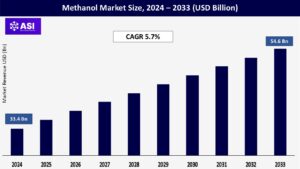
CAGR: 5.7%
Last Updated : March 16, 2026
The global Methanol Market size was valued at approximately USD 33.4 billion in 2024 and is projected to reach USD 54.6 billion by 2033, growing at a CAGR of 5.7% during the forecast period.
Methanol is a highly versatile industrial chemical and alternative fuel, widely utilized in the production of various chemicals and as a cleaner-burning energy source.
Due to its widespread usage in the production of plastics, paints, adhesives, and building materials, formaldehyde production continues to be the principal use for methanol.
Additionally, as companies look for alternatives to naphtha based olefin production in order to increase feedstock flexibility and lower costs, the use of methanol-to-olefins (MTO) technology is rising, particularly in China.
Because of its potential to reduce carbon emissions, methanol is becoming more and more popular in clean fuel applications. In keeping with international decarbonization objectives, its application in fuel cells, gasoline mixing, and marine fuels is growing.
Furthermore, methanol is showing promise as a low-emission fuel substitute and hydrogen carrier for the shipping and automotive sectors.
The main feedstocks for the production of methanol are coal and natural gas. Because of this dependence, producers are vulnerable to fluctuations in the price of raw materials, especially in important production centers like China and the Middle East. Production costs and profit margins can be greatly impacted by abrupt changes in the energy markets.
Methanol is marketed as a fuel that burns cleaner, but traditional production techniques produce significant CO₂ emissions.
Manufacturers are being pressured by increasingly strict international environmental rules to use more environmentally friendly manufacturing methods, like CO₂-to-methanol synthesis and biomass-based methanol, which demand significant financial outlays and technological innovation.
| Report Metric | Details |
|---|---|
| Segmentations | |
| By Feedstock |
Natural Gas Coal-Based Methanol Renewable Methanol |
| By Application |
Formaldehyde MTBE and Fuel Blending DME Methanol-to-Olefins (MTO) |
| Key Players |
|
| Geographies Covered | |
| North America |
U.S. |
| Europe |
U.K. |
| Asia Pacific |
China |
| Middle East & Africa |
Saudi Arabia |
| Latin America |
Brazil |
The Methanol Market is segmented by Feedstock (Natural Gas, Coal-Based Methanol, Renewable Methanol), By Application (Formaldehyde, MTBE and Fuel Blending, DME, Methanol-to-Olefins (MTO).
Each factor plays a crucial role in enhancing patient safety, increasing the adoption of self-administered anticoagulant therapies, and supporting the development of more convenient, prefilled drug delivery systems that streamline treatment in the management of thromboembolic and cardiovascular conditions.
Natural Gas (Largest Share):
Because of its widespread availability, affordability, and lower carbon intensity than coal, natural gascontinues to be the most popular feedstock for the production of methanol, particularly in North America, Europe, and the Middle East.
Coal-Based Methanol:
Predominantly concentrated in China, coal based methanol production continues to play a major role despite increasing environmental concerns and regulatory pressures related to high CO₂ emissions
Renewable Methanol (Fastest Growing):
Derived from CO₂ and green hydrogen, gaining attention for sustainable applications in Europe and North America.
Formaldehyde:
Methanol is a crucial raw ingredient in the consumer goods and building industries since formaldehyde, the largest application segment, is widely utilized in the manufacturing of resins, plastics, paints, and construction materials.
MTBE and Fuel Blending:
Methyl tertiary-butyl ether (MTBE), a high-octane gasoline additive that helps lower engine knocking and pollutants, particularly in markets with strict fuel quality standards, is made from methanol.
DME:
Derived from methanol, DME is a clean-burning fuel substitute for liquefied petroleum gas (LPG) that is utilized in the transportation and domestic cooking industries, especially in Asia.
Methanol-to-Olefins (MTO):
Particularly in China, where it encourages diversification away from petroleum-based olefin, the MTO method is becoming more and more popular as a strategic means of manufacturing ethylene and propylene.
With more than 60% of the world’s methanol consumption, Asia-Pacific leads the methanol market. With significant investments in coal-based methanol production and methanol-to-olefins (MTO) capacity, China leads the area. This is due to the high demand from the fuel and chemical industries.
The construction of shale gasbased methanol plants in the United States and a rise in methanol exports to international markets, particularly Asia and Europe, are driving the market’s steady growth in North America. Focus on renewable methanol as a climate-neutral fuel, especially in maritime.
Europe is stressing the transition to renewable methanol, backed by regulatory assistance for climate-neutral fuels. In line with EU emissions reduction targets, the region is especially focused on the implementation of green methanol in the maritime industry.
Using their vast natural gas reserves, nations like Saudi Arabia and Iran are increasing their capacity to produce methanol. Because of its advantageous geographic location and affordable feedstocks, the area is becoming a major exporter.
the market for methanol in Latin America is expanding moderately thanks to developments in gas-to-liquid (GTL) technologies. Methanol is being investigated as a means for nations with natural gas deposits to profit from their resources and cut back on fuel imports.
USD 33.4 billion in 2024
The projected CAGR of the methanol market is 5.7%.
Asia-Pacific dominates the market.
Methanex, SABIC, Celanese, OCI N.V., Mitsubishi Gas Chemical
1.1 Summary
1.2 Research methodology
2.1 Research Objectives
2.2 Market Definition
2.3 Limitations & Assumptions
2.4 Market Scope & Segmentation
2.5 Currency & Pricing Considered
3.1 Drivers
3.2 Geopolitical Impact
3.3 Human Factors
3.4 Technology Factors
4.1 Porters Five Forces Analysis
4.2 Value Chain Analysis
4.3 Average Pricing Analysis
4.4 M & A, Agreements & Collaboration Analysis
5.1 Methanol Market, By Feedstock
5.1.1 Introduction
5.1.2 Market Size & Forecast
5.2 Methanol Market, By Application
6.1 North America Methanol Market , By Country
6.1.1 Methanol Market, By Feedstock
6.1.2 Methanol Market, By Application
6.2 U.S.
6.2.1 Methanol Market, By Feedstock
6.2.2 Methanol Market, By Application
6.3 Canada
7.1 U.K.
7.2 Germany
7.3 France
7.4 Spain
7.5 Italy
7.6 Russia
7.7 Nordic
7.8 Benelux
7.9 The Rest of Europe
8.1 China
8.2 South Korea
8.3 Japan
8.4 India
8.5 Australia
8.6 Taiwan
8.7 South East Asia
8.8 The Rest of Asia-Pacific
9.1 UAE
9.2 Turkey
9.3 Saudi Arabia
9.4 South Africa
9.5 Egypt
9.6 Nigeria
9.7 Rest of MEA
10.1 Brazil
10.2 Mexico
10.3 Argentina
10.4 Chile
10.5 Colombia
10.6 Rest of Latin America
11.1 Global Market Share (%) By Players
11.2 Market Ranking By Revenue for Players
11.3 Competitive Dashboard
11.4 Product Mapping