

Military Land Vehicles Market
Military Land Vehicles Market Size, Market Share & Trends Analysis Report By Type (Main Battle Tanks, Armored Personnel Carriers, Infantry Fighting Vehicles, Light Protected Vehicles), By Application (Defense and Combat and Logistics and Transportation), By Region (North America, Europe, Asia-Pacific, Middle East and Africa, Latin America) – Industry Analysis Report, Regional Outlook, Growth Potential, Price Trends, Competitive Market Share & Forecast, 2026–2033

Historical Period: 2019-2024
Forecast Period: 2025-2033
Report Code : ASIADR1012
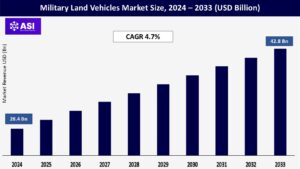
CAGR: 4.7%
Last Updated : April 29, 2026
The global Military Land Vehicles Market size was valued at approximately USD 28.4 billion in 2024 and is projected to reach USD 42.8 billion by 2033, growing at a steady CAGR of 4.7% during the forecast period (2026–2033).
The market is witnessing strong demand driven by increasing geopolitical tensions, modernization of defense forces, and the need for advanced mobility solutions in combat and non-combat operations.
Key growth drivers include the rising focus on military modernization programs, increasing defense budgets in emerging economies, and the development of next-generation armored vehicles with enhanced survivability, mobility, and firepower.
The integration of advanced technologies such as artificial intelligence (AI), autonomous systems, and electric propulsion is also shaping the future of the military land vehicles industry.
The military land vehicles market is experiencing growth due to increasing geopolitical tensions and the subsequent rise in defense spending across the globe. Nations are investing heavily in modernizing their armed forces to enhance operational capabilities and address evolving security threats.
The demand for advanced main battle tanks, armored personnel carriers, and infantry fighting vehicles is particularly high, as these vehicles play a critical role in ground combat operations. The modernization of aging military fleets is a key priority for many countries, especially in regions such as Asia-Pacific, the Middle East, and Eastern Europe.
For instance, countries like India, China, and South Korea are investing in indigenous defense manufacturing capabilities, while NATO members are upgrading their armored vehicle fleets to meet modern battlefield requirements.
Additionally, the increasing focus on asymmetric warfare and counter-insurgency operations is driving demand for light protected vehicles and mine-resistant ambush-protected (MRAP) vehicles.
The performance and operational efficiency of military land vehicles are being greatly improved by advancements in onboard technology, propulsion systems, and vehicle design.
To increase survivability and lessen logistical burdens, manufacturers are concentrating on creating vehicles with modular armor systems, hybrid-electric propulsion, and sophisticated communication systems.
The market for military land vehicles is undergoing a revolution enables the integration of AI and autonomous systems. In order to lower the risk to human personnel, unmanned ground vehicles (UGVs) and remotely operated vehicles are being used more and more for logistics support, surveillance, and logistics support.
Additionally, the need to lower carbon emissions and fuel consumption is driving the development of electric and hybrid-electric military vehicles. The use of advanced sensor systems, 360-degree security cameras, and AI-powered threat detection systems is also improving crew safety and situational awareness. Military land vehicles are becoming more efficient and capable of handling contemporary combat situations thanks to these technological developments.
Despite the advantages of advanced military land vehicles, high development, acquisition, and maintenance costs pose a challenge to market expansion. The incorporation of cutting-edge technologies and the use of high-strength materials significantly increase the overall cost of vehicles, limiting their adoption in budget-constrained regions.
Stricter export controls and regulatory challenges related to the transfer of defense technologies are impacting the global military land vehicles market. Governments are increasingly scrutinizing defense exports to ensure compliance with international arms control agreements, which could hinder market growth.
| Report Metric | Details |
|---|---|
| Segmentations | |
| By Type |
Main Battle Tanks Armored Personnel Carriers Infantry Fighting Vehicles Light Protected Vehicles |
| By Application |
Defense and Combat Logistics and Transportation |
| Key Players |
General Dynamics Corporation BAE Systems plc Rheinmetall AG Lockheed Martin Corporation Oshkosh Corporation Hanwha Defense Nexter Group Textron Inc. Hyundai Rotem Norinco Group |
| Geographies Covered | |
| North America |
U.S. |
| Europe |
U.K. |
| Asia Pacific |
China |
| Middle East & Africa |
Saudi Arabia |
| Latin America |
Brazil |
Main battle tanks dominated the market in 2024 with a share of over 35.6%, driven by their critical role in ground combat operations. Armored personnel carriers and infantry fighting vehicles are gaining popularity due to their versatility and ability to transport troops in high-threat environments. Light protected vehicles are witnessing increased demand for counter-insurgency and peacekeeping missions.
The defense and combat segment dominated the market in 2024 with a share of over 68.5%, driven by the increasing demand for advanced combat vehicles such as main battle tanks, infantry fighting vehicles, and armored personnel carriers.
These vehicles are critical for ground combat operations, providing enhanced firepower, mobility, and protection for troops in high-threat environments. The growing focus on modernizing military fleets and addressing asymmetric warfare threats is further fueling demand in this segment.
The logistics and transportation segment is also witnessing significant growth, accounting for 31.5% of the market share in 2024. This segment includes vehicles such as tactical trucks, mine-resistant ambush-protected (MRAP) vehicles, and utility vehicles, which are essential for transporting troops, equipment, and supplies in both combat and non-combat scenarios.
The increasing emphasis on improving logistical efficiency and ensuring the safe movement of personnel and resources in conflict zones is driving demand for specialized logistics vehicles.
North America accounted for 38.2% of the global military land vehicles market share in 2024, supported by the strong presence of defense contractors such as General Dynamics, Lockheed Martin, and Oshkosh Corporation. The U.S. leads the region, with high defense spending and ongoing modernization programs.
Europe holds a xx% market share, with growing demand for next-generation armored vehicles in countries like the UK, Germany, and France. The region is also focusing on collaborative defense projects under the European Defense Fund (EDF).
Asia-Pacific is projected to witness the highest CAGR of 5.8% during the forecast period, fueled by rising defense budgets in China, India, and South Korea. The region is also witnessing increasing investments in indigenous defense manufacturing capabilities.
The Middle East and Africa are emerging markets, driven by strong demand for armored vehicles in Gulf countries such as Saudi Arabia and the UAE. High defense spending and ongoing conflicts are key contributors to market expansion.
Latin America is seeing steady growth, with Brazil and Mexico leading the market. The region is focusing on upgrading its military fleets to address internal security challenges.
The global military land vehicles market was valued at approximately USD 28.4 billion in 2024.
The market is projected to grow at a CAGR of 4.7% from 2026 to 2033.
Key drivers include rising geopolitical tensions, defense modernization programs, and technological advancements.
The defense sector leads the market, followed by homeland security.
North America holds the largest market share at 38.2%.
The Asia-Pacific region is expected to grow at a CAGR of 5.8% from 2026 to 2033.
Major players include General Dynamics, BAE Systems, Rheinmetall, and Lockheed Martin.
1.1 Summary
1.2 Research methodology
2.1 Research Objectives
2.2 Market Definition
2.3 Limitations & Assumptions
2.4 Market Scope & Segmentation
2.5 Currency & Pricing Considered
3.1 Drivers
3.2 Geopolitical Impact
3.3 Human Factors
3.4 Technology Factors
4.1 Porters Five Forces Analysis
4.2 Value Chain Analysis
4.3 Average Pricing Analysis
4.4 M & A, Agreements & Collaboration Analysis
5.1 Military Land Vehicles Market, By Type
5.1.1 Introduction
5.1.2 Market Size & Forecast
5.2 Military Land Vehicles Market, By Application
6.1 North America Military Land Vehicles Market, By Country
6.1.1 Military Land Vehicles Market, By Type
6.1.2 Military Land Vehicles Market, By Application
6.2 U.S.
6.2.1 Military Land Vehicles Market, By Type
6.2.2 Military Land Vehicles Market, By Application
6.3 Canada
7.1 U.K.
7.2 Germany
7.3 France
7.4 Spain
7.5 Italy
7.6 Russia
7.7 Nordic
7.8 Benelux
7.9 The Rest of Europe
8.1 China
8.2 South Korea
8.3 Japan
8.4 India
8.5 Australia
8.6 Taiwan
8.7 South East Asia
8.8 The Rest of Asia-Pacific
9.1 UAE
9.2 Turkey
9.3 Saudi Arabia
9.4 South Africa
9.5 Egypt
9.6 Nigeria
9.7 Rest of MEA
10.1 Brazil
10.2 Mexico
10.3 Argentina
10.4 Chile
10.5 Colombia
10.6 Rest of Latin America
11.1 Global Market Share (%) By Players
11.2 Market Ranking By Revenue for Players
11.3 Competitive Dashboard
11.4 Product Mapping