

Nano Zinc Oxide Market
Nano Zinc Oxide Market & Trends Analysis Report, By Form (Powder, Dispersion, Other), By Application (Cosmetics & Personal Care, Coatings & Paints, Textiles, Energy & Electronics), By End User (Residential, Commercial, Industrial)– Industry Analysis Report, Regional Outlook, Growth Potential, Price Trends, Competitive Market Share & Forecast, 2025–2033.

Historical Period: 2019-2024
Forecast Period: 2025-2033
Report Code :
CAGR: XX%
Last Updated : February 5, 2026
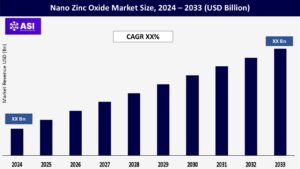
The global Nano Zinc Oxide Market size was valued at approximately USD XX billion in 2024 and is projected to reach USD XX billion by 2033, growing at a CAGR of XX% during the forecast period.
Nano zinc oxide (ZnO) is a multifunctional nanomaterial widely used for its UV-blocking, antibacterial, photocatalytic, and protective properties. It finds extensive applications in personal care products, coatings, electronics, textiles, and healthcare.
Rising demand for transparent UV filters in sunscreens, coupled with sustainable material adoption in industrial and consumer goods, is driving market growth.
Because it provides broad-spectrum UVA/UVB protection without leaving behind the noticeable white residue that conventional zinc oxide does, nano zinc oxide is an essential component of sunscreens and personal care products.
The usage of nano ZnO in skincare, cosmetics, and baby care products is growing worldwide due to the increased demand for natural formulations, safer UV filters, and clean beauty.
Nano ZnO can be used in sensors, varistors, batteries, and solar cells because of its special semiconducting, piezoelectric, and photocatalytic qualities.
It is a crucial component of next-generation energy and electronic systems due to its capacity to increase energy efficiency, durability, and compactness, which is speeding up acceptance in advanced electronics and renewable energy technologies.
In many places, stringent regulatory supervision has resulted from worries about the toxicity, skin penetration, and long-term environmental effects of nanomaterials. Tighter examination is specifically applied to applications connected to food and cosmetics, which could limit market penetration in delicate industries and delay product approvals.
In addition to strict purity requirements, the manufacturing of nano ZnO requires advanced synthesis processes such as sol-gel, hydrothermal, and precipitation procedures. When compared to traditional zinc oxide, these features drastically increase manufacturing costs, which limits its use in price-sensitive
| Report Metric | Details |
|---|---|
| Segmentations | |
| By Form |
Powder Dispersion Other |
| By Application |
Cosmetics & Personal Care Coatings & Paints Textiles Energy & Electronics |
| By End User |
Residential Commercial Industrial |
| Key Players |
|
| Geographies Covered | |
| North America |
U.S. |
| Europe |
U.K. |
| Asia Pacific |
China |
| Middle East & Africa |
Saudi Arabia |
| Latin America |
Brazil |
The Nano Zinc Oxide Market is segmented by Form (Powder, Dispersion, Other), By Application (Cosmetics & Personal Care, Coatings & Paints, Textiles, Energy & Electronics), By End User (Residential, Commercial, Industrial).
Each factor plays a crucial role in enhancing patient safety, increasing the adoption of self-administered anticoagulant therapies, and supporting the development of more convenient, prefilled drug delivery systems that streamline treatment in the management of thromboembolic and cardiovascular conditions.
(Dominant Segment) Powder
Due to its extensive use in sunscreens, cosmetics, coatings, polymers, and plastics, powdered nano zinc oxide has the biggest market share. It is the most widely used form due to its excellent UV-blocking effectiveness, formulation flexibility, and simplicity of handling.
Dispersion
For coatings, inks, and textiles, dispersion-based nano ZnO is the preferred form because it guarantees even dispersion, improved transparency, and easier application. Additionally, dispersions reduce particle agglomeration, enhancing final product performance and consistency.
Other (Surface-Treated & Functionalized Forms)
The use of functionalized and surface-treated nano ZnO is growing in biological, specialized, and advanced electronics applications. Opportunities in high-value industries like medical devices and renewable energy are made possible by these modified forms’ enhanced stability, greater compatibility with various matrices, and customized performance characteristics.
Cosmetics & Personal Care (Largest Segment)
The greatest application segment is personal care and cosmetics, where nano ZnO is widely utilized as a safe and efficient UV filter in sunscreens, skincare products, and cosmetics.
It is highly favored because it offers broad-spectrum UVA/UVB protection without producing a white tint. The dominance of this market is still being driven by growing consumer demand in natural, mineral-based, and clean beauty formulas.
Coatings & Paints
Nano ZnO improves antibacterial qualities, durability, scratch resistance, and UV protection in the paint & coatings sector. It is utilized in industrial, automotive, and construction coatings where enhanced longevity and performance are essential.
Textiles
Antimicrobial, UV-protective, and self-cleaning textiles, such as apparel, outdoor equipment, and medical textiles, are using nano ZnO more and more. It is useful in both consumer and commercial textile applications because of its capacity to increase fabric life and enhance functional qualities.
Energy & Electronics
Nano ZnO’s semiconducting, piezoelectric, and photocatalytic qualities make it useful in solar cells, sensors, transparent conductive films, varistors, and piezoelectric devices. Strong growth in this market is supported by its contribution to improving renewable energy technologies, energy efficiency, and device sensitivity.
Additional uses include packaging, medicines, and environmental cleanup. To increase its market potential, nano ZnO is being researched and used for water purification technologies, active packaging solutions, and medication delivery systems.
Residential
Nano zinc oxide is extensively utilized in domestic goods, cosmetics, sunscreens, and personal care items in the residential market. Strong consumer demand is still being driven by its use as a functional additive, antibacterial agent, and safe UV filter.
Commercial
Nano ZnO offers antimicrobial protection, UV resistance, and improved material durability in a variety of commercial applications, including as retail, healthcare, hospitality, and textiles. It is increasingly being used in skincare products for wellness centers, medical fabrics, and protective coatings for businesses.
Industrial
With widespread use in paints and coatings, electronics, MRO (maintenance, repair, and operations), renewable energy, and infrastructure applications, the industrial segment leads the market. Nano ZnO’s semiconducting, photocatalytic, and protective qualities stimulate demand, making it crucial for a variety of high-performance applications.
Asia–Pacific dominates the nano zinc oxide market, led by China, Japan, South Korea, and India. The region benefits from a strong base in cosmetics and sunscreen manufacturing, rapid growth in the electronics sector, and expanding textile production. Increasing urbanization and consumer demand for advanced personal care products further fuel market expansion.
North America is characterized by high sunscreen usage, strong R&D activities in nanomaterials, and a well-established regulatory framework. Adoption is particularly strong in personal care, healthcare, and electronics applications, with the U.S. leading regional demand.
Europe’s market is influenced by stringent regulations on nanomaterial safety, which encourage innovation toward sustainable, compliant, and eco-friendly formulations. The region has significant adoption of nano ZnO in specialty coatings, advanced cosmetics, and renewable energy applications, with Germany, France, and the UK being major contributors.
These emerging markets are witnessing rising demand for sunscreens, automotive coatings, and healthcare applications. Growth is supported by increasing awareness of UV protection and hygiene products, though adoption is tempered by price sensitivity and limited local production capacities. Long-term potential remains strong as infrastructure and consumer markets mature.
The market size of the nano zinc oxide is approximately USD XX billion.
The projected CAGR of the nano zinc oxide market is XX%.
The Powdered Nano ZnO form dominates the market
The & Energy applications show the highest growth in energy
The Asia–Pacific region is the fastest-growing.
1.1 Summary
1.2 Research methodology
2.1 Research Objectives
2.2 Market Definition
2.3 Limitations & Assumptions
2.4 Market Scope & Segmentation
2.5 Currency & Pricing Considered
3.1 Drivers
3.2 Geopolitical Impact
3.3 Human Factors
3.4 Technology Factors
4.1 Porters Five Forces Analysis
4.2 Value Chain Analysis
4.3 Average Pricing Analysis
4.4 M & A, Agreements & Collaboration Analysis
5.1 Nano Zinc Oxide Market, By Form
5.1.1 Introduction
5.1.2 Market Size & Forecast
5.2 Nano Zinc Oxide Market, By Application
5.3 Nano Zinc Oxide Market, By End User
6.1 North America Nano Zinc Oxide Market , By Country
6.1.1 Nano Zinc Oxide Market, By Form
6.1.2 Nano Zinc Oxide Market, By Application
6.1.3 Nano Zinc Oxide Market, By End User
6.2 U.S.
6.2.1 Nano Zinc Oxide Market, By Form
6.2.2 Nano Zinc Oxide Market, By Application
6.2.3 Nano Zinc Oxide Market, By End User
6.3 Canada
7.1 U.K.
7.2 Germany
7.3 France
7.4 Spain
7.5 Italy
7.6 Russia
7.7 Nordic
7.8 Benelux
7.9 The Rest of Europe
8.1 China
8.2 South Korea
8.3 Japan
8.4 India
8.5 Australia
8.6 Taiwan
8.7 South East Asia
8.8 The Rest of Asia-Pacific
9.1 UAE
9.2 Turkey
9.3 Saudi Arabia
9.4 South Africa
9.5 Egypt
9.6 Nigeria
9.7 Rest of MEA
10.1 Brazil
10.2 Mexico
10.3 Argentina
10.4 Chile
10.5 Colombia
10.6 Rest of Latin America
11.1 Global Market Share (%) By Players
11.2 Market Ranking By Revenue for Players
11.3 Competitive Dashboard
11.4 Product Mapping