

Paints and Coatings Market
Paints and Coatings Market & Trends Analysis Report, By Category (Water-Based Coatings, Solvent-Based Coatings, Powder Coatings, UV-Cured and High-Solid Coatings), By End-Use (Residential Sector, Commercial and Institutional Buildings, Automotive & Aerospace Sector)– Industry Analysis Report, Regional Outlook, Growth Potential, Price Trends, Competitive Market Share & Forecast, 2025–2033.

Historical Period: 2019-2024
Forecast Period: 2025-2033
Report Code :
CAGR: 3.9%
Last Updated : February 5, 2026
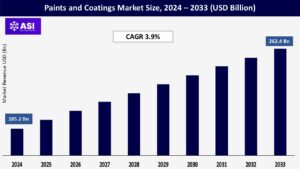
The global Paints and Coatings Market size was valued at approximately USD 185.2 billion in 2024 and is projected to reach USD 262.4 billion by 2033, growing at a CAGR of 3.9% during the forecast period (2025–2033).
The Paints and Coatings Market includes decorative and industrial coating products designed to protect surfaces, improve their aesthetic appeal, and enhance their longevity in residential, commercial, and industrial settings.
These coatings are available in multiple types, such as water-based and solvent-based, along with powder coatings, varnishes, and protective films. Architectural coatings are the largest segment of the market, fuelled by expansion in the construction industry, while industrial coatings cater to sectors like automotive, aerospace, marine, and wood processing.
A number of important factors are driving the growth of the market, including rising urbanization, heightened construction activities, and worldwide infrastructure development, as well as an increasing preference for eco-friendly and low-VOC (volatile organic compound) products.
Additionally, advancements in coating technologies, such as nanocoating’s, self-healing paints, and anti-microbial solutions, are broadening the functional applications of coatings in health and sustainability areas.
The construction industry represents more than 50% of the worldwide demand for paints and coatings, with residential uses accounting for nearly 35–40%. In 2024, the global construction output reached USD 13.5 trillion, and it is projected to rise to USD 15.3 trillion by 2030, according to Oxford Economics.
The rapid urbanization in the Asia-Pacific region, particularly in India and Southeast Asia, is driving the need for decorative coatings for new housing and commercial property projects. Government initiatives such as India’s “Housing for All” and Saudi Arabia’s Vision 2030 are fostering extensive infrastructure development, which in turn is increasing the usage of low-VOC and high-durability coatings.
On a global scale, the automotive paints and coatings sector was valued at more than USD 22 billion in 2023, with projections indicating a compound annual growth rate (CAGR) of 4.1% until 2030. Coatings designed for electric vehicles (EVs) and advanced materials necessitate paint systems that are flexible and lightweight.
At the same time, the aerospace coatings industry is anticipated to expand at a CAGR of 5.8%, fuelled by the growth of the aircraft fleet, particularly in the Asia-Pacific region and the Middle East. High-performance coatings, such as those based on fluoropolymers and polyurethanes, are favoured for their thermal resistance and ability to reduce drag.
The costs of essential raw materials such as titanium dioxide, resins, and solvents are quite unstable, influencing manufacturing expenses and profit margins for coating producers. Essential materials such as titanium dioxide, solvents, and resin monomers (including acrylic, polyurethane, and epoxy) are experiencing price volatility as a result of supply chain issues, geopolitical conflicts, and energy expenses. This situation affects both profit margins and pricing strategies for products.
The manufacturing and promotion of potassium citrate, especially in the pharmaceutical and nutraceutical sectors, are subjected to strict regulatory requirements in different nations. Businesses must comply with quality standards concerning purity, safety, labelling, and clinical effectiveness.
This often requires extensive and expensive testing and approval procedures, particularly for new drug formulations or functional food products. Smaller businesses may find it challenging to penetrate or expand in highly regulated markets, which can impede overall industry growth.
Meeting strict chemical safety regulations necessitates extensive testing, thorough documentation, and appropriate certification. For small and medium-sized enterprises (SMEs), this frequently leads to significant costs and obstacles to entry.
| Report Metric | Details |
|---|---|
| Segmentations | |
| By Category |
Water-Based Coatings Solvent-Based Coatings Powder Coatings UV-Cured and High-Solid Coatings |
| By End-Use |
Residential Sector Commercial and Institutional Buildings Automotive & Aerospace Sector |
| Key Players |
|
| Geographies Covered | |
| North America |
U.S. |
| Europe |
U.K. |
| Asia Pacific |
China |
| Middle East & Africa |
Saudi Arabia |
| Latin America |
Brazil |
The Paints and Coatings Market is segmented by Category (Water-Based Coatings, Solvent-Based Coatings, Powder Coatings, UV-Cured and High-Solid Coatings), By End-Use (Residential Sector, Commercial and Institutional Buildings, Automotive & Aerospace Sector). Each factor plays a crucial role in enhancing patient safety, increasing the adoption of self-administered anticoagulant therapies, and supporting the development of more convenient, prefilled drug delivery systems that streamline treatment in the management of thromboembolic and cardiovascular conditions.
Water-Based Coatings (Largest Segment) 2024 Share (45.3%)
This segment leads the market because of its lower VOC emissions, quick drying time, and adherence to environmental regulations. They are frequently utilized in decorative and interior architectural projects
Solvent-Based Coatings 2024 Share (21.4%)
These coatings remain favoured in industrial settings where rapid drying and a durable finish are essential, although their use is decreasing in developed countries due to VOC regulations.
Powder Coatings 2024 Share (14.9%)
The subsegment is expanding rapidly with a CAGR exceeding 6.5%, fuelled by the demand for automotive parts, household appliances, and metal furniture.
UV-Cured and High-Solid Coatings 2024 Share (18.4%)
Utilizing advanced technologies, these coatings provide rapid curing, high performance, and reduced environmental impact. They are increasingly being adopted in electronics, packaging, and automotive industries.
Residential Sector 2024 Share (33.8%)
The residential sector accounts for a substantial share of the total demand, particularly in developing areas where urban growth and population increase are driving extensive housing projects.
Decorative coatings, which include emulsions, distempers, primers, and enamels, are frequently utilized for visual appeal, wall protection, and durability. In locations such as India, China, Southeast Asia, and Africa, government-supported affordable housing initiatives are boosting consumption.
Trends like DIY (Do-It-Yourself) painting, customization of interior themes, and an increase in disposable income are fuelling substantial demand for high-quality, washable, anti-microbial, odourless, and low-VOC wall paints. Moreover, smart paints with properties for temperature regulation and anti-fungal capabilities are becoming increasingly popular in hot and humid regions.
Commercial and Institutional Buildings 2024 Share (23.7%)
Industrial coatings play vital roles in various settings such as factories, refineries, power generation facilities, chemical processing plants, and storage warehouses. These coatings provide benefits including resistance to corrosion, thermal insulation, protection against abrasion, and resistance to chemical exposure.
Equipment, pipelines, tanks, and metal structures regularly encounter severe conditions and necessitate high-performance coatings to prevent deterioration while ensuring safety and operational efficiency.
Specialty coatings, including epoxy, polyurethane, and zinc-rich primers, are commonly utilized to improve operational resilience. Maintenance painting is a crucial aspect of this sector, particularly for aging infrastructure. The movement towards more sustainable industrial practices is driving the increased use of waterborne and solvent-free industrial coatings.
Automotive & Aerospace Sector 2024 Share (25.4%)
Paints and coatings in this industry are essential for both visual appeal and surface protection. In the automotive sector, coatings are applied to car bodies, frames, engines, and interiors. The main types include electrocoats (e-coats), primers, basecoats, and clearcoats. These coatings provide UV protection, resistance to chipping, scratch resistance, and a glossy appearance.
In the aerospace sector, coatings must fulfil stringent performance standards such as thermal resistance, low drag, anti-static properties, corrosion resistance, and weight reduction. They are utilized on fuselages, interiors, landing gear, and various components.
As electric vehicles (EVs) and lightweight composites become more popular, coatings are adapting to satisfy the requirements of new materials with flexibility, conductivity, and non-toxicity.
An advanced research and development ecosystem, along with a robust regulatory framework, is fuelling innovation. The United States and Canada are pioneers in adopting sustainable coating technologies. Growth is bolstered by home renovations, smart building projects, and vehicle manufacturing.
Focus on sustainability, the circular economy, and product safety. Germany, France, Italy, and the UK are established markets with stringent standards. The EU’s Green Deal is promoting investments in bio-based and recyclable coatings.
The region experiencing the most rapid growth is spearheaded by China and India. This growth is fuelled by urban housing developments, large-scale infrastructure projects, and the expansion of manufacturing sectors. Japan and South Korea play a role through their advancements in smart coatings and functional surfaces.
Fuelled by better economic conditions and investments in urban infrastructure in Brazil, Mexico, and Chile, the demand for mid-range and premium decorative paints is increasing.
The rapid expansion of construction in Saudi Arabia (Vision 2030), the UAE, and Egypt is driving development. The extreme weather conditions necessitate the use of performance coatings that offer thermal insulation, anti-corrosion, and reflective features.
USD 186.2 billion in 2024.
Approximately 3.2% globally.
Architectural coatings, especially waterborne acrylic paints.
Asia-Pacific, due to rapid urbanization and construction growth.
PPG Industries, Sherwin-Williams, AkzoNobel, Asian Paints, Nippon Paint, BASF, among others.
1.1 Summary
1.2 Research methodology
2.1 Research Objectives
2.2 Market Definition
2.3 Limitations & Assumptions
2.4 Market Scope & Segmentation
2.5 Currency & Pricing Considered
3.1 Drivers
3.2 Geopolitical Impact
3.3 Human Factors
3.4 Technology Factors
4.1 Porters Five Forces Analysis
4.2 Value Chain Analysis
4.3 Average Pricing Analysis
4.4 M & A, Agreements & Collaboration Analysis
5.1 Paints and Coatings Market, By Category
5.1.1 Introduction
5.1.2 Market Size & Forecast
5.2 Paints and Coatings Market, By End-Use
6.1 North America Paints and Coatings Market, By Country
6.1.1 Paints and Coatings Market, By Category
6.1.2 Paints and Coatings Market, By End-Use
6.2.1 Paints and Coatings Market, By Category
6.2.2 Paints and Coatings Market, By End-Use
6.3 Canada
7.1 U.K.
7.2 Germany
7.3 France
7.4 Spain
7.5 Italy
7.6 Russia
7.7 Nordic
7.8 Benelux
7.9 The Rest of Europe
8.1 China
8.2 South Korea
8.3 Japan
8.4 India
8.5 Australia
8.6 Taiwan
8.7 South East Asia
8.8 The Rest of Asia-Pacific
9.1 UAE
9.2 Turkey
9.3 Saudi Arabia
9.4 South Africa
9.5 Egypt
9.6 Nigeria
9.7 Rest of MEA
10.1 Brazil
10.2 Mexico
10.3 Argentina
10.4 Chile
10.5 Colombia
10.6 Rest of Latin America
11.1 Global Market Share (%) By Players
11.2 Market Ranking By Revenue for Players
11.3 Competitive Dashboard
11.4 Product Mapping