

Personalized Medicine Market
Personalized Medicine Market Share and Trend Analysis, By Drug Type (Personalized Medicine Diagnostics, Personalized Medicine Therapeutics, Personalized Medical Care, Personalized Nutrition & Wellness), By Application (Oncology, Central Nervous System (CNS) Disorders, Immunology, Respiratory Diseases, Hepatic Disorders, Rheumatology, Others), By End User (Hospitals & Clinics, Diagnostic Laboratories & Testing Centers, Research & Academic Institutes) Industry Analysis Report, Regional Outlook, Growth Potential, Price Trends, Competitive Market Share & Forecast, 2026–2033

Historical Period: 2019-2024
Forecast Period: 2025-2033
Report Code :
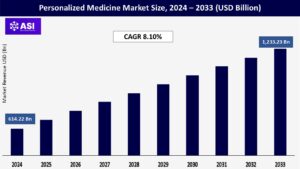
CAGR: 8.10%
Last Updated : April 6, 2026
The global personalized medicine market size was valued at USD 614.22 billion in 2024 and is projected to reach USD 1,233.23 billion by 2033, expanding at a compound annual growth rate CAGR of 8.10% during the forecast period (2025–2033).
Personalized medicine, or precision medicine, applies precise information about an individual’s distinct genetic profile, protein levels, and metabolic processes. This data assists physicians in tailoring prevention regimens, diagnostic screening, and treatments to that individual.
Physicians utilize cutting-edge genetic sequencing, advanced data analysis, and targeted diagnostic testing to identify biological markers that signal disease risk, predict how well a patient is likely to respond to a specific treatment, and calculate the optimal dosage of treatment.
This strategy is applied in the treatment of cancer, inherited rare diseases, autoimmune and other immune disorders, and increasingly, widespread chronic diseases such as heart disease and diabetes. Hospitals and clinics apply these targeted therapies, and diagnostic laboratories perform the required genetic and molecular testing.
Research centers actively advance new targeted therapies. As payers and healthcare systems begin to have greater interest in outcome-based care, personalized medicine holds great promise. It seeks improved health outcomes for patients, fewer detrimental side effects, and lower overall costs through more effective and efficient medical care.
Substantial advancements in genomic and artificial intelligence technologies create a major market driver. Recent years have seen significant reductions in the cost of comprehensive genetic sequencing, so that such information is considerably more readily available. Such democratization makes possible widespread use of genomic profiling in both clinical settings and research studies.
Advancements in platforms for sequencing, such as those facilitating the analysis of individual cells and rare genetic elements, have increased the speed and precision of such methods. In parallel, artificial intelligence and advanced machine learning techniques are becoming crucial.
These technologies analyze large amounts of intricate biological information, pulling out useful patterns that can forecast how patients will react to certain drugs or develop possible side effects. The combination of strong data analysis software with cloud computing also enhances the speedy interpretation of huge genomic sets.
This speeds up the development of tests utilized together with treatments and enhances patient selection for clinical trials. Large technology players keep investing a lot of money in research and strategic partnerships so that innovation goes on uninterrupted.
As a result, the potent mix of ever-more accessible genomic science and powerful artificial intelligence is central to expansion in the market. It is now making extremely directed medical interventions a possibility that were not possible even a few years ago.
The worldwide rise in chronic and rare diseases, along with the support of government initiatives, highly drives the market for personalized medicine. Cancer, heart disease, diabetes, and neurodegenerative diseases are some examples of conditions that are mounting healthcare issues across the globe, primarily driven by demographic and lifestyle factors.
Chronic diseases are increasingly seen as a prime cause of mortality worldwide. Personalized medicine provides promising new methods for early disease identification using biological markers and for developing stratified treatments that enhance effectiveness while reducing harmful reactions.
Furthermore, the growing recognition of numerous rare genetic disorders has motivated governments to implement supportive policies and dedicated funding schemes. Major scale projects, including major programs supported by major national and international agencies, provide huge budgets for genomic research and the development of precision therapies.
Public-private partnerships reduce financing risks for biotechnology companies and promote collaborative development of new diagnostics and medicines. With regulatory systems evolving to make it easier to approve tests associated with targeted treatments, patients gain faster access to these therapies. That immediate access, fueled by changing regulations and public investment, is a leading driver to drive market expansion.
Tailor-made medicine faces high financial barriers despite its therapeutic benefits. The performance of comprehensive genomic profiling, designing individualized molecular tests, and applying artificial intelligence analytics requires substantial investment in advanced laboratory equipment and highly skilled personnel.
The development of targeted therapies and the accompanying companion tests requires substantial research and development investments, lengthy development times, and dealing with complex regulatory hurdles. In addition, geographically inconsistent payment models pose substantial adoption hurdles.
Health insurers often question the long-term economic value of precision diagnostics over traditional means, wondering about their ultimate cost-effectiveness. Limited healthcare budgets in many developing economies limit the adoption of advanced molecular technologies.
Uncertainty relating to billing codes, insurance coverage determinations, and proper pricing discourages further participation, especially for smaller diagnostic firms. The intersection of high startup capital needs and an unpredictable payment environment will remain repressing market growth in targeted areas.
This persists until well established reimbursement schemes on the basis of proven value are diffused and costs related to sequencing and interpretation of genetic information are reduced significantly. Securing increased access involves surmounting these enduring cost and payment barriers.
| Report Metric | Details |
|---|---|
| Segmentations | |
| By Drug Type |
Personalized Medicine Diagnostics Personalized Medicine Therapeutics Personalized Medical Care Personalized Nutrition & Wellness |
| By Application |
Oncology Central Nervous System (CNS) Disorders Immunology Respiratory Diseases Hepatic Disorders Rheumatology Others |
| By End User |
Hospitals & Clinics Diagnostic Laboratories & Testing Centers Research & Academic Institutes Other End Users |
| Key Players |
|
| Geographies Covered | |
| North America |
U.S. |
| Europe |
U.K. |
| Asia Pacific |
China |
| Middle East & Africa |
Saudi Arabia |
| Latin America |
Brazil |
The Personalized Medicine market can be classified into four main drug-type segments: Diagnostics, Therapeutics, Medical Care, and Nutrition & Wellness, each serving a unique role in facilitating precise interventions.
Personalized Medicine Diagnostics, represented by genetic and genomic testing, liquid biopsies, and pharmacogenomic tests, holds the largest market share, fueled by widespread adoption of molecular profiling in oncology and inherited disease panels.
With laboratories and hospitals embracing next-generation sequencing (NGS) and digital PCR platforms, diagnostic revenues go on rising, depicting broad clinical usage and increasing direct‐to‐consumer demand.
Personalized Medicine Therapeutics includes biopharmaceuticals like monoclonal antibodies, gene therapies (e.g., CAR-T, CRISPR-based), and RNA-targeting products; the segment is the most rapidly growing driven by breakthrough approvals and rising R&D spending across orphan and oncology indications.
Personalized Medical Care includes telehealth platforms, clinical decision support systems, and EHR‐aligned precision tools that adapt treatment pathways in real time; hospitals and specialty clinics increasingly bring these services onboard to improve care coordination and outcome monitoring.
Last but not least, Personalized Nutrition & Wellness includes nutrigenomic supplements, microbiome profiling, and lifestyle coaching programs customized to personalized risk factors; increased consumer health awareness and preventive wellness trends drive this new segment.
Collectively, the four segments create a synergistic system, diagnostics provide actionable targets, therapeutics provide targeted treatments, care platforms coordinate patient experiences, and wellness offerings maintain long‐term wellness, highlighting the broad range of precision health.
Personalized Medicine uses range across a disease area continuum, with Oncology the market leader in terms of companion diagnostics, target therapies, and biomarker-based clinical trials; precision oncology solutions support tumor genotyping, liquid biopsy tracking, and personalized immunotherapies, placing this segment at the heart of market expansion.
Central Nervous System (CNS) Disorders then follow, with accuracy targeting Alzheimer’s, Parkinson’s, and epilepsy using genetic risk stratification, neuroimaging biomarkers, and individually optimized pharmacotherapy regimens to meet unmet neurological demands.
Immunology applications, including rheumatoid arthritis, psoriasis, and inflammatory bowel disease, are aided by cytokine profiling and personalized biologics choice, eliminating trial-and-error treatment cycles.
Respiratory Diseases particularly chronic obstructive pulmonary disease (COPD) and severe asthma, are served by genomic and proteomic markers that guide biologic agent use and inhaled therapy optimization.
Hepatic Disorders, including non-alcoholic fatty liver disease (NAFLD) and viral hepatitis, utilize metabolomic and genetic screening to stratify patients for emerging targeted treatments. Rheumatology beyond immunology, such as lupus and scleroderma, employs multi-omic diagnostics to predict flares and therapeutic response.
The “Others” segment reflects applications in metabolic, cardiovascular, and orphan genetic conditions, where bespoke interventions spanning from gene silencing to personalized nutrition are picking up steam.
In all segments, the intersection of high-throughput –omics, analytics driven by artificial intelligence, and real-world evidence marks a trend away from one-size-fits-all medicine toward highly personalized healthcare solutions.
The landscape of Personalized Medicine operates to serve a wide range of end users, headed by Hospitals & Clinics, which is the biggest revenue group since they incorporate precision diagnostics and target therapeutics into typical care pathways; academic medical centers and tertiary care facilities lead molecular tumor board and pharmacogenomic consult services, driving adoption.
Diagnostic Testing Centers & Laboratories are the second significant segment, providing centralized liquid biopsy, NGS, and companion diagnostic testing to hospital clients as well as direct-to-consumer channels; reference laboratories differentiate on the basis of high-throughput platforms, quick turnaround, and in-house bioinformatics support.
Research & Academic Institutes comprise a vital component dedicated to early‐stage discovery, biomarker validation, and clinical trial design; translational consortia in partnership with the industry expedite translation of new precision technologies, while university hospitals drive pilot implementations.
The Other End Users segment consists of specialty pharmacies that deliver gene and cell therapies, CROs performing stratified clinical studies, and digital health firms that create consumer-oriented precision wellness apps; such stakeholders leverage specialized services like tele‐genetics, remote monitoring, and AI-assisted risk assessments.
As intergroup collaboration between end-users heightens via shared data networks, value-based care models, and cross-sector partnerships, the market’s ability to provide individualized diagnostics, therapeutics, and care management solutions grows larger, making precision health available to patients across settings.
North America dominated the worldwide market with 2023 revenues of USD 261.65 billion due to high R&D spend, availability of major technology providers and supportive regulatory avenues for companion diagnostics.
The U.S. marketplace alone increased to USD 179.66 billion in 2024, courtesy of drives like the Precision Medicine Initiative and fast-tracked FDA approvals for targeted therapies.
Europe accounted for USD 168.91 billion in 2023, supported by EU funding initiatives such as Horizon Europe and strong genomic research clusters in the U.K., Germany, and France. Harmonization of regulations through the European Medicines Agency promotes cross-border clinical trials and the embracement of precision diagnostics.
The Asia Pacific market accounted for USD 104.77 billion in 2023, led by growing Chinese, Japanese, and Indian healthcare infrastructure, increasing government genomics programs, and an increase in chronic disease burden. With a forecasted CAGR equal to that of the world average, the region is a rapidly growing market.
Combined revenues in MEA and Latin America were USD 42.87 billion in 2023. Growth in the market is facilitated by increased expenditure on healthcare, selectively applied molecular testing, and philanthropic initiatives focusing on rare diseases. Reimbursement inconsistencies and the lack of technical capacity restrain expansion.
The global Personalized Medicine Market was valued at USD 614.22 billion in 2024.
The market is projected to grow at a CAGR of 8.10 % from 2025 to 2033.
Oncology hold the largest market share.
The Asia-Pacific region is expected to witness the highest growth rate.
Major players include Illumina, Thermo Fisher, Danaher, GE Healthcare, Biogen
1.1 Summary
1.2 Research methodology
2.1 Research Objectives
2.2 Market Definition
2.3 Limitations & Assumptions
2.4 Market Scope & Segmentation
2.5 Currency & Pricing Considered
3.1 Drivers
3.2 Geopolitical Impact
3.3 Human Factors
3.4 Technology Factors
4.1 Porters Five Forces Analysis
4.2 Value Chain Analysis
4.3 Average Pricing Analysis
4.4 M & A, Agreements & Collaboration Analysis
5.1 Personalized Medicine Market, By Drug Type
5.1.1 Introduction
5.1.2 Market Size & Forecast
5.2 Personalized Medicine Market, By Application
5.3 Personalized Medicine Market, By End User
6.1 North America Personalized Medicine Market, By Country
6.1.1 Personalized Medicine Market, By Drug Type
6.1.2 Personalized Medicine Market, By Application
6.1.3 Personalized Medicine Market, By End User
6.2 U.S.
6.2.1 Personalized Medicine Market, By Drug Type
6.2.2 Personalized Medicine Market, By Application
6.2.3 Personalized Medicine Market, By End User
6.3 Canada
7.1 U.K.
7.2 Germany
7.3 France
7.4 Spain
7.5 Italy
7.6 Russia
7.7 Nordic
7.8 Benelux
7.9 The Rest of Europe
8.1 China
8.2 South Korea
8.3 Japan
8.4 India
8.5 Australia
8.6 Taiwan
8.7 South East Asia
8.8 The Rest of Asia-Pacific
9.1 UAE
9.2 Turkey
9.3 Saudi Arabia
9.4 South Africa
9.5 Egypt
9.6 Nigeria
9.7 Rest of MEA
10.1 Brazil
10.2 Mexico
10.3 Argentina
10.4 Chile
10.5 Colombia
10.6 Rest of Latin America
11.1 Global Market Share (%) By Players
11.2 Market Ranking By Revenue for Players
11.3 Competitive Dashboard
11.4 Product Mapping