

Polyolefin Elastomers Market
Polyolefin Elastomers Market & Trends Analysis Report, By Type (Ethylene-based POE, Propylene-based POE), By Application (Automotive, Packaging, Consumer Goods, Wires & Cables, Others), By End Use (Automotive Industry, Electrical & Electronics, Packaging Industry, Healthcare, Others)– Industry Analysis Report, Regional Outlook, Growth Potential, Price Trends, Competitive Market Share & Forecast, 2025–2033.

Historical Period: 2019-2024
Forecast Period: 2025-2033
Report Code :
CAGR: 5.8%
Last Updated : March 13, 2026
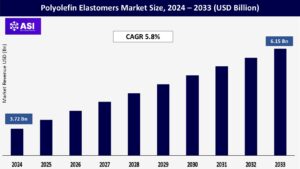
The global polyolefin elastomers (POE) market size was valued at approximately USD 3.72 billion in 2024 and is projected to reach USD 6.15 billion by 2033, growing at a CAGR of 5.8% during the forecast period (2025–2033).
Polyolefin Elastomers are a class of thermoplastic elastomers that offer outstanding flexibility, impact resistance, and low density, making them ideal for applications across automotive, packaging, wire & cable, and consumer goods industries. They are widely adopted as substitutes for traditional rubbers and PVC due to superior processability and recyclability.
Key drivers include increasing demand for lightweight and flexible materials in automotive design, rising use in eco-friendly packaging, and the growing shift towards halogen-free cable compounds. However, market growth may be constrained by competition from other elastomer types and fluctuating raw material costs.
The automotive industry is using polyolefin elastomers (POEs) more and more as automakers look to lighten vehicles and increase fuel economy. Utilizing a special blend of elasticity, impact resistance, and lightweight qualities, POEs are utilized in parts like weather seals, instrument panels, bumpers, and interior trims.
Automobile manufacturers are using POEs to improve vehicle performance while adhering to environmental regulations as regulatory bodies place an emphasis on sustainable mobility and tighten emission standards.
POEs are being adopted by the packaging industry for use in stand-up pouches, stretch films, and seal layers due to the demand for flexible, long-lasting, and recyclable materials. POEs are perfect for high-speed packaging lines because of their superior optical clarity, processability, and seal integrity.
Additionally, their compatibility with polyethylene (PE) makes it easier to create packaging made of just one material, which is more recyclable. This supports circular economy initiatives in both developed and emerging markets and is in line with growing global mandates for sustainable packaging.
The main raw materials used to make polyolefin elastomers are crude oil derivatives, ethylene, and propylene. Because of this, POEs’ production costs are extremely susceptible to changes in the price of crude oil on a worldwide scale.
Cost predictability is impacted by volatile feedstock pricing, which also affects manufacturers’ profit margins and frequently leads to price instability throughout the supply chain. This presents a big problem, especially for applications that are cost-sensitive and have long-term contracts.
Although POEs provide a desirable mix of toughness, flexibility, and processability, other thermoplastic elastomers (TPEs), like styrenic block copolymers (SBCs) and thermoplastic vulcanizates (TPVs), are becoming a bigger threat to POEs.
Certain mechanical, chemical, or thermal performance benefits are provided by these substitutes, contingent on the intended use. It can be difficult for POEs to enter some end-use sectors because the selection of elastomer types frequently depends on factors like cost-performance ratio, processing needs, and regulatory compliance.
| Report Metric | Details |
|---|---|
| Segmentations | |
| By Type |
Ethylene-based POE Propylene-based POE |
| By Application |
Automotive Packaging Consumer Goods Wires & Cables Others |
| By End-Use |
Automotive Industry Electrical & Electronics Packaging Industry Healthcare Others |
| Key Players |
|
| Geographies Covered | |
| North America |
U.S. |
| Europe |
U.K. |
| Asia Pacific |
China |
| Middle East & Africa |
Saudi Arabia |
| Latin America |
Brazil |
The Polyolefin Elastomers Market is segmented by Type (Ethylene-based POE, Propylene-based POE), By Application (Automotive, Packaging, Consumer Goods, Wires & Cables, Others), By End Use (Automotive Industry, Electrical & Electronics, Packaging Industry, Healthcare, Others).
Each factor plays a crucial role in enhancing patient safety, increasing the adoption of self-administered anticoagulant therapies, and supporting the development of more convenient, prefilled drug delivery systems that streamline treatment in the management of thromboembolic and cardiovascular conditions.
Ethylene-based POE (62.3%)
Ethylene-based polyolefin elastomers dominate the market owing to their softness, optical clarity, and outstanding flexibility. These characteristics make them highly suitable for use in flexible packaging, seal layers, film applications, and automotive sealing systems.
Their excellent compatibility with polyethylene (PE) also enables the creation of recyclable mono-material packaging, aligning with sustainability trends in the packaging industry. The growing demand for lightweight, cost-effective, and process-friendly materials continues to boost this segment.
Propylene-based POE (37.7%)
Propylene-based POEs are gaining traction for applications that require higher thermal resistance, improved rigidity, and enhanced dimensional stability. These materials are particularly well-suited for under-the-hood automotive components, household appliance parts, and industrial goods that are exposed to elevated temperatures.
Their ability to retain mechanical performance under thermal stress makes them a preferred alternative to more rigid polymers in high-heat environments.
Automotive (29.6%)
Due to the demand for materials that are affordable, strong, and lightweight, the automobile industry is the main application category for POEs. POEs are widely utilized in dashboard components, gaskets, door trims, bumpers, and sealing systems.
Because of their elasticity, impact resilience, and thermal stability, automakers are able to reduce vehicle weight while still meeting emission and fuel efficiency standards.
Packaging (25.3%)
POEs are being used more and more in flexible packaging, particularly in multilayer recyclable films, stand-up pouches, and seal layers. Their flexibility, clarity, and sealability improve the integrity and look of packages, and their compatibility with polyethylene facilitates the shift to recyclable, mono-material formats in keeping with the objectives of the circular economy.
Consumer Goods (18.2%)
POEs are preferred in the consumer products sector due to their colorability, durability, and soft-touch feel. They provide both visual appeal and mechanical durability and are utilized in a broad range of products, such as tools, toys, home goods, and footwear. They can be produced for the mass market because they are non-toxic and simple to process.
Wires & Cables (16.5%)
POEs have exceptional flexibility, low-temperature performance, and halogen-free flame retardancy, making them dependable jacket compounds and insulation materials for electrical cables.
Their application is growing in fields where environmental compliance, durability, and safety are crucial, including as telecommunications, building infrastructure, and automobile wiring.
Others (10.4%)
Impact modifiers for engineering thermoplastics, adhesives, and parts for medical devices fall under this group. POEs improve flexibility and adhesion in adhesives and increase durability, chemical resistance, and adherence to health regulations in industrial and medical applications.
Automotive Industry (31.4%)
Due to the growing need for materials that are strong, flexible, and lightweight, the automotive sector is the greatest end-use market for POEs. POEs are extensively utilized in impact-resistant parts, sealing systems, interior components, and external trimmings. They are a preferred material for contemporary automakers due to their capacity to increase design flexibility, meet emission regulations, and improve fuel economy.
Electrical & Electronics (18.9%)
POEs are utilized in electronic enclosures, connection seals, and wire and cable insulation in the electrical and electronics sector. Applications in consumer electronics, infrastructure wiring, and automotive electrical systems are supported by their superior dielectric qualities, flexibility, and low-temperature performance.
Packaging Industry (28.7%)
POEs provide clarity, strength, and seal integrity and are widely used in the packaging industry for flexible films, laminates, and sealant layers. Because of its compatibility with PE, mono-material recyclable packaging can be developed, meeting the growing global focus on waste reduction and sustainability.
Healthcare (10.2%)
POEs are frequently utilized in the packaging industry for flexible films, laminates, and sealant layers because they offer strength, clarity, and seal integrity. Its compatibility with PE allows for the development of recyclable packaging made of just one material, satisfying the growing need for sustainability and waste reduction worldwide.
Others (10.8%)
This segment includes applications in construction, industrial manufacturing, consumer goods, and adhesives. POEs enhance impact strength, weatherability, and processability across a range of niche industrial uses.
The largest and fastest-growing region due to booming automotive manufacturing, high demand for consumer electronics, and expanding flexible packaging industries. China, India, South Korea, and Japan lead in both production and consumption.
Growth driven by lightweight vehicle production and sustainability trends in packaging. The presence of major POE producers and technological advancements in polymer chemistry further support market expansion.
Moderate growth driven by regulations pushing recyclable packaging and energy-efficient vehicles. Germany, France, and Italy are key contributors due to their strong automotive sectors.
Demand rising in automotive assembly plants and FMCG packaging. Brazil and Mexico are emerging as manufacturing hubs.
Growth supported by infrastructural development, increasing investment in cable manufacturing, and rising healthcare expenditures in the GCC nations.
The global polyolefin elastomers market size in 2024 was USD 3.72 billion.
The global polyolefin elastomers market is projected to reach a CAGR 5.8%.
The Automotive application segment dominates the market.
The Asia-Pacific region is expected to witness the fastest growth.
Dow, ExxonMobil, SABIC, LG Chem, and Mitsui Chemicals.
1.1 Summary
1.2 Research methodology
2.1 Research Objectives
2.2 Market Definition
2.3 Limitations & Assumptions
2.4 Market Scope & Segmentation
2.5 Currency & Pricing Considered
3.1 Drivers
3.2 Geopolitical Impact
3.3 Human Factors
3.4 Technology Factors
4.1 Porters Five Forces Analysis
4.2 Value Chain Analysis
4.3 Average Pricing Analysis
4.4 M & A, Agreements & Collaboration Analysis
5.1 Polyolefin Elastomers Market, By Type
5.1.1 Introduction
5.1.2 Market Size & Forecast
5.2 Polyolefin Elastomers Market, By Application
5.3 Polyolefin Elastomers Market, By End-Use
6.1 North America Polyolefin Elastomers Market , By Country
6.1.1 Polyolefin Elastomers Market, By Type
6.1.2 Polyolefin Elastomers Market, By Application
6.1.3 Polyolefin Elastomers Market, By End-Use
6.2 U.S.
6.2.1 Polyolefin Elastomers Market, By Type
6.2.2 Polyolefin Elastomers Market, By Application
6.2.3 Polyolefin Elastomers Market, By End-Use
6.3 Canada
7.1 U.K.
7.2 Germany
7.3 France
7.4 Spain
7.5 Italy
7.6 Russia
7.7 Nordic
7.8 Benelux
7.9 The Rest of Europe
8.1 China
8.2 South Korea
8.3 Japan
8.4 India
8.5 Australia
8.6 Taiwan
8.7 South East Asia
8.8 The Rest of Asia-Pacific
9.1 UAE
9.2 Turkey
9.3 Saudi Arabia
9.4 South Africa
9.5 Egypt
9.6 Nigeria
9.7 Rest of MEA
10.1 Brazil
10.2 Mexico
10.3 Argentina
10.4 Chile
10.5 Colombia
10.6 Rest of Latin America
11.1 Global Market Share (%) By Players
11.2 Market Ranking By Revenue for Players
11.3 Competitive Dashboard
11.4 Product Mapping