

Potassium Carbonate Market
Potassium Carbonate Market & Trends Analysis Report, By Grade (Industrial Grade, Food Grade, Pharmaceutical Grade), By Application (Glass Manufacturing, Soap & Detergents, Food & Beverage, Agrochemicals, Pharmaceuticals)– Industry Analysis Report, Regional Outlook, Growth Potential, Price Trends, Competitive Market Share & Forecast, 2025–2033.

Historical Period: 2019-2024
Forecast Period: 2025-2033
Report Code :
CAGR: 5.5%
Last Updated : March 13, 2026
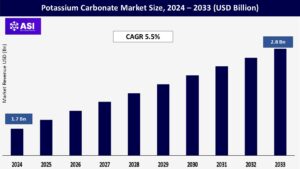
The global potassium carbonate market size was valued at approximately USD 1.7 billion in 2024 and is projected to reach USD 2.8 billion by 2033, growing at a CAGR of 5.5% during the forecast period.
Potassium carbonate is a white, water-soluble inorganic salt with strong alkaline properties. It plays a crucial role across a wide range of industries, including glass manufacturing, soaps & detergents, food processing, agrochemicals, and pharmaceuticals.
Growth is driven by increased demand in specialty glass production, processed food additives, eco-friendly cleaning agents, and as a pH regulator in various formulations.
Because it lowers the melting point and improves the final product’s clarity, durability, and thermal resistance, potassium carbonate is essential to the manufacturing of optical and specialty glass. High-end products, including TV screens, lab glassware, and crystal glass, are frequently made using it.
Potassium carbonate use in the glass sector is steadily rising due to the growing demand for high-performance building materials and premium optical glass, especially in the Asia-Pacific and Europe.
In many processed foods, such as cocoa goods, licorice, instant noodles, and alcoholic beverages like wine, food-grade potassium carbonate is used as a stabiliser, buffering agent, and acidity regulator.
Its adoption is being fueled by the expanding urban population, the increased need for convenience foods, and the drive toward clean-label ingredients. Furthermore, it is a better option than synthetic chemical substitutes in food applications due to its GRAS (Generally Recognised As Safe) classification from the US FDA.
Carbon dioxide and potassium hydroxide are essential inputs in the production of potassium carbonate. Production costs can be greatly impacted by changes in the price of these raw materials, which are frequently caused by disruptions in the supply chain, energy prices, and changes in the worldwide market. Because it affects pricing strategies and tightens profit margins, this volatility presents difficulties for producers, especially in cost-sensitive areas.
Despite being used extensively in many different industries, potassium carbonate is naturally caustic and needs to be handled carefully. Inappropriate use may result in more serious health problems, respiratory distress, or irritation of the skin and eyes.
Because of these safety issues, strict handling procedures and regulatory compliance are required during storage, shipping, and large-scale industrial uses. This could make things more complicated and expensive for end users.
| Report Metric | Details |
|---|---|
| Segmentations | |
| By Grade |
Industrial Grade Food Grade Pharmaceutical Grade |
| By Application |
Glass Manufacturing Soap & Detergents Food & Beverage Agrochemicals Pharmaceuticals |
| Key Players |
|
| Geographies Covered | |
| North America |
U.S. |
| Europe |
U.K. |
| Asia Pacific |
China |
| Middle East & Africa |
Saudi Arabia |
| Latin America |
Brazil |
The Potassium Carbonate Market is segmented by Grade (Industrial Grade, Food Grade, Pharmaceutical Grade), By Application (Glass Manufacturing, Soap & Detergents, Food & Beverage, Agrochemicals, Pharmaceuticals).
Each factor plays a crucial role in enhancing patient safety, increasing the adoption of self-administered anticoagulant therapies, and supporting the development of more convenient, prefilled drug delivery systems that streamline treatment in the management of thromboembolic and cardiovascular conditions.
Due to its numerous uses in fertilizers, glassmaking, chemical synthesis, and the production of soap and detergents, industrial-grade potassium carbonate holds the biggest market share. It is the most sought-after grade in the manufacturing and processing industries worldwide due to its adaptability and efficiency in a wide range of industrial operations.
Food Grade Potassium carbonate is mostly used as a food ingredient to improve flavor, regulate fermentation, and adjust pH. The demand for food-grade potassium carbonate is developing significantly due to the growing consumption of processed foods and beverages, particularly in metropolitan areas, as well as the growing desire of consumers for natural and clean-label ingredients.
Pharmaceutical-grade potassium carbonate is utilized in medication manufacture, electrolyte replenishment, and acidity control in pharmaceutical formulations. Despite making up a smaller portion of the market as a whole, this category is steadily expanding because to rising demand in both developed and emerging economies for pharmaceutical formulations, dietary supplements, and over-the-counter (OTC) pharmaceuticals.
Glass manufacturing is the leading application segment for potassium carbonate, where it is essential for producing high-quality optical, laboratory, and crystal glass. The compound lowers the melting point and enhances the clarity and thermal resistance of glass. Growing demand from the electronics, automotive, and construction sectors especially in Asia-Pacific and Europe—is driving this segment’s dominance.
Potassium carbonate is used in the formulation of soaps and detergents, particularly in saponification processes and as a water softener. With increasing consumer and regulatory emphasis on phosphate-free, biodegradable cleaning products, its use in eco-friendly detergent formulations is expanding steadily.
In the food industry, potassium carbonate serves as an acidity regulator, stabilizer, and leavening agent in products like chocolate, noodles, cocoa, and wine. The ongoing growth of the processed food sector and rising demand for clean-label ingredients are key drivers for this application segment.
Potassium carbonate is employed as a potassium nutrient in fertilizers and a pH regulator in pesticide formulations. As emerging economies focus more on agricultural productivity and food security, demand for agrochemical applications is expected to grow consistently.
In the pharmaceutical sector, potassium carbonate is used as a buffering agent, stabilizer, and electrolyte source in drug formulations. Its role in OTC medications, supplements, and other health products supports gradual but stable growth in this segment.
The largest and fastest-growing region is Asia-Pacific. Due to robust demand from the glass, food & beverage, and detergent industries, Asia-Pacific currently holds the top spot in the worldwide potassium carbonate market.
Due to their strong manufacturing infrastructure, fast urbanization, and growing middle classes, China and India are the main contributors. Additionally, the area is seeing a rise in the use of environmentally friendly agrochemicals and personal hygiene items, which is increasing the usage of potassium carbonate in a variety of applications.
With steady demand from the food processing, pharmaceutical, and glass manufacturing industries, North America is a developed yet stable market.
Due to its high rate of processed food consumption and concentration on environmentally friendly cleaning products, the United States is the leading participant. Furthermore, potassium carbonate is still supported by the pharmaceutical industry’s continuous innovation and production growth.
Potassium carbonate is still in high demand throughout Europe, especially in Germany, France, and the UK. The region’s strict environmental laws are promoting the use of biodegradable and phosphate-free chemicals, which is supporting potassium carbonate’s use in detergents and other industrial processes. Additionally, the area shows consistent use in pharmaceutical and food-grade applications.
The growing application in agrochemicals, water treatment, and food processing is driving the gradual expansion of these emerging regions. To lessen their reliance on imports, nations like Saudi Arabia, the United Arab Emirates, Mexico, and Brazil are investing in expanding their domestic manufacturing capabilities. Long-term market potential in these areas is anticipated to be driven by growing industrialization and agricultural expansion.
The global potassium carbonate market size in 2024 was USD 1.7 billion.
The global potassium carbonate market CAGR is 5.5%.
The Glass manufacturing is the largest application segment.
The Asia-Pacific is the fastest-growing region of the potassium carbonate market.
1.1 Summary
1.2 Research methodology
2.1 Research Objectives
2.2 Market Definition
2.3 Limitations & Assumptions
2.4 Market Scope & Segmentation
2.5 Currency & Pricing Considered
3.1 Drivers
3.2 Geopolitical Impact
3.3 Human Factors
3.4 Technology Factors
4.1 Porters Five Forces Analysis
4.2 Value Chain Analysis
4.3 Average Pricing Analysis
4.4 M & A, Agreements & Collaboration Analysis
5.1 Potassium Carbonate Market, By Grade
5.1.1 Introduction
5.1.2 Market Size & Forecast
5.2 Potassium Carbonate Market, By Application
6.1 North America Potassium Carbonate Market, By Country
6.1.1 Potassium Carbonate Market, By Grade
6.1.2 Potassium Carbonate Market, By Application
6.2.1 Potassium Carbonate Market, By Grade
6.2.2 Potassium Carbonate Market, By Application
6.3 Canada
7.1 U.K.
7.2 Germany
7.3 France
7.4 Spain
7.5 Italy
7.6 Russia
7.7 Nordic
7.8 Benelux
7.9 The Rest of Europe
8.1 China
8.2 South Korea
8.3 Japan
8.4 India
8.5 Australia
8.6 Taiwan
8.7 South East Asia
8.8 The Rest of Asia-Pacific
9.1 UAE
9.2 Turkey
9.3 Saudi Arabia
9.4 South Africa
9.5 Egypt
9.6 Nigeria
9.7 Rest of MEA
10.1 Brazil
10.2 Mexico
10.3 Argentina
10.4 Chile
10.5 Colombia
10.6 Rest of Latin America
11.1 Global Market Share (%) By Players
11.2 Market Ranking By Revenue for Players
11.3 Competitive Dashboard
11.4 Product Mapping