

Potassium Citrate Market
Potassium Citrate Market & Trends Analysis Report, By Function (Acidulant, Emulsifier, Diuretic), By End-Use Industry (Food & Beverage, Pharmaceuticals, Personal Care, Industrial)– Industry Analysis Report, Regional Outlook, Growth Potential, Price Trends, Competitive Market Share & Forecast, 2025–2033.

Historical Period: 2019-2024
Forecast Period: 2025-2033
Report Code :
CAGR: 3.7%
Last Updated : March 13, 2026
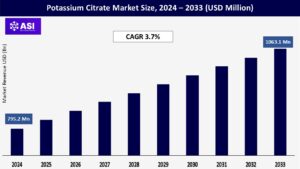
The Global potassium citrate market size was valued at approximately USD 795.2 million in 2024 and is projected to reach USD 1063.1 million by 2033, growing at a CAGR of 3.7% during the forecast period (2025–2033).
The Potassium Citrate Market pertains to the area dedicated to the manufacturing, usage, and distribution of potassium citrate—a white, crystalline compound widely utilized in pharmaceuticals, food and beverage, and industrial sectors. Potassium citrate primarily serves as an alkalizing agent, buffering agent, and a source of potassium.
In the pharmaceutical industry, it is commonly utilized to prevent and treat kidney stones, gout, and specific urinary tract issues because of its capacity to lessen urine acidity. In culinary applications, it functions as a flavour enhancer, preservative, and acidity regulator, especially in soft drinks and processed food products.
Potassium citrate usually comes in either powder or granular forms and is recognized for its excellent solubility in water, as well as its non-toxic characteristics and adaptability to various formulations. Notable attributes include its high bioavailability, stability when stored, and simplicity in blending with both solid and liquid dosage forms.
The market is propelled by a greater awareness of urinary health, a heightened demand for functional foods, and the increasing use of potassium-based components in pharmaceutical and nutraceutical offerings. Additionally, regulatory approvals and advancements in formulation technology have further boosted its demand across various industries.
The global rise in kidney stones, urinary tract infections, and metabolic acidosis is mainly due to changes in diet, lack of exercise, and not drinking enough water. Potassium citrate plays an important role in preventing and treating these issues.
It increases urine pH and reduces the chances of forming calcium oxalate and uric acid stones. As more people become aware of these conditions and diagnosis rates improve, the demand for potassium citrate as a key treatment option is steadily growing, particularly in urology and nephrology.
Potassium citrate is becoming more popular as a potassium supplement and acidity regulator in functional foods and beverages. As people grow more health-conscious and look for products that promote cardiovascular health, electrolyte balance, and bone health, manufacturers are integrating potassium citrate into their recipes.
Its GRAS (Generally Recognized As Safe) designation and compatibility with a variety of food items make it a favoured additive, especially in sports drinks, dietary supplements, and fortified products.
Though potassium citrate provides numerous therapeutic advantages, its excessive use or incorrect dosages can result in significant side effects such as digestive discomfort, elevated potassium levels in the blood (Hyperkalemia), and potential heart issues.
These concerns are especially critical for individuals with kidney dysfunction or those taking potassium-sparing drugs. Because of these health risks, regulatory bodies enforce stringent guidelines for its use and labelling, which can limit product development and marketing options, particularly for over-the-counter products.
The production and marketing of potassium citrate, particularly in pharmaceuticals and nutraceuticals, are governed by stringent regulatory standards in various countries. Companies are required to adhere to quality criteria regarding purity, safety, labelling, and clinical effectiveness.
This often entails lengthy and costly testing and approval processes, especially for new drug formulations or functional food items. Smaller companies may struggle to enter or grow within heavily regulated markets, hindering overall industry expansion.
| Report Metric | Details |
|---|---|
| Segmentations | |
| By Function |
Acidulant (Primary Function) Emulsifier Diuretic (Medical Function) |
| By End-Use Industry |
Food & Beverage Pharmaceuticals Personal Care Industrial |
| Key Players |
|
| Geographies Covered | |
| North America |
U.S. |
| Europe |
U.K. |
| Asia Pacific |
China |
| Middle East & Africa |
Saudi Arabia |
| Latin America |
Brazil |
The Potassium Citrate Market is segmented by Function (Acidulant, Emulsifier, Diuretic), By End-Use (Food & Beverage, Pharmaceuticals, Personal Care, Industrial).
Each factor plays a crucial role in enhancing patient safety, increasing the adoption of self-administered anticoagulant therapies, and supporting the development of more convenient, prefilled drug delivery systems that streamline treatment in the management of thromboembolic and cardiovascular conditions.
Potassium citrate serves as a vital acidulant in food and beverage items, regulating pH levels, improving flavour, and prolonging shelf life. It delivers a zesty taste in soft drinks, fruit juices, and jams, while ensuring acidity stability in processed foods. Its capability to function as a buffering agent without adding sodium makes it an ideal choice for low-sodium product lines.
In cosmetics and pharmaceuticals, potassium citrate acts as an emulsifying agent—helping to keep the consistency and stability of creams, syrups, and lotions intact. It enhances product texture and uniformity, particularly in mixtures containing both oil and water-based components.
Within the pharmaceutical industry, potassium citrate is utilized as a mild diuretic and alkalizing agent to avert kidney stone formation and lower urinary acidity. This function is vital in nephrology and urology care and is key to managing chronic issues such as renal tubular acidosis and recurring nephrolithiasis.
Potassium citrate is widely utilized in processed food and beverages for its roles as a pH regulator, preservative, and salt substitute. As the demand for functional foods, clean-label ingredients, and reduced-sodium products increases, the food and beverage sector continues to be the primary consumer of potassium citrate.
In the pharmaceutical industry, potassium citrate is incorporated into tablets, syrups, and granules to treat urinary issues and electrolyte imbalances. Its emerging significance in clinical nutrition and therapeutic hydration solutions positions the pharmaceutical sector as a key area for growth.
Potassium citrate is used as a buffering and chelating agent in personal care products such as toothpaste, mouthwashes, skincare items, and shampoos. It maintains pH balance and boosts the effectiveness and safety of cosmetic formulations, particularly for those with sensitive skin.
In industrial settings, potassium citrate finds applications in specialty cleaners, detergents, and lab-grade chemicals where controlled alkalinity and low toxicity are essential. It is preferred in green chemistry due to its biodegradability and environmentally safe profile in formulations.
North America leads the Potassium Citrate Market, primarily driven by the U.S. and Canada, where there is significant awareness about kidney health, dietary supplements, and pH-balanced nutrition, fuelling substantial demand. The region’s advanced pharmaceutical industry, high rates of kidney stones and urinary issues, along with a well-established healthcare system, contribute to the greater utilization of potassium citrate in both prescription and over-the-counter products.
Furthermore, the increasing desire for low-sodium and clean-label food and beverage items promotes its role as a functional ingredient. Clear regulations from the FDA and a rising consumer preference for natural health options continue to boost market expansion.
Europe is a well-established and strictly regulated market for potassium citrate, fuelled by a broad acceptance of clean-label ingredients and rigorous food safety regulations. Major contributors to this market include Germany, France, Italy, and the UK, where there is considerable demand in both the pharmaceutical and food processing industries.
The growing elderly population and heightened emphasis on preventive healthcare are increasing the use of potassium citrate in therapeutic and wellness contexts, especially related to cardiovascular and renal health.
Additionally, the EU’s sustainability trends and sodium reduction campaigns are encouraging food manufacturers to replace traditional preservatives with potassium-based substitutes.
The Potassium Citrate Market is experiencing the fastest growth in the Asia-Pacific region, with significant markets such as India, China, Japan, South Korea, and Southeast Asia. Key factors driving this growth include rapid urbanization, the expansion of healthcare infrastructure, and a rise in consumer spending on health and wellness products.
India and China are also becoming important manufacturing centers thanks to their cost benefits and increasing pharmaceutical production. Japan is at the forefront of developing advanced nutritional and therapeutic products.
Heightened awareness regarding kidney health, coupled with a rise in the consumption of functional beverages and dietary supplements, is continually driving demand in the region.
Latin America is witnessing consistent growth in the potassium citrate market, mainly attributed to heightened health awareness, increased usage of dietary supplements, and a trend towards functional foods. Brazil, Mexico, Chile, and Argentina are at the forefront of the regional market, benefiting from better healthcare access and a rise in urinary tract disorders and lifestyle-related conditions.
Initiatives by the government to encourage domestic pharmaceutical and nutraceutical production are also aiding in market growth. Nonetheless, economic difficulties and pricing pressures continue to pose challenges for the adoption of high-purity potassium citrate in industrial and medical applications.
The Middle East and Africa region is emerging as a potential market for potassium citrate, with significant growth observed in countries such as Saudi Arabia, the UAE, Egypt, and South Africa. The expansion of the market is driven by a higher prevalence of kidney diseases, increased investment in healthcare infrastructure, and a growing focus on preventive and functional nutrition.
Although the pharmaceutical industry remains the main user, the food and beverage sector are increasingly utilizing potassium citrate for flavour stabilization and reducing sodium content.
Variability in regulations and limited awareness in rural areas may hinder quicker adoption, but urban health trends and government health initiatives present opportunities for growth in the long term.
The market was estimated to be roughly USD 820 million in 2024.
It is projected that the market will expand at a CAGR of 6.3% between 2025 and 2033.
The Powder form segment leads due to its extensive usage in pharmaceutical and food sectors, attributed to its solubility, stability, and versatility.
The Asia-Pacific region is predicted to experience the most significant growth, fueled by the development of healthcare infrastructure, rising demand for supplements, and increasing food processing activities.
Key players include Jungbunzlauer Suisse AG, Gadot Biochemical Industries, FBC Industries, and Tate & Lyle PLC.
1.1 Summary
1.2 Research methodology
2.1 Research Objectives
2.2 Market Definition
2.3 Limitations & Assumptions
2.4 Market Scope & Segmentation
2.5 Currency & Pricing Considered
3.1 Drivers
3.2 Geopolitical Impact
3.3 Human Factors
3.4 Technology Factors
4.1 Porters Five Forces Analysis
4.2 Value Chain Analysis
4.3 Average Pricing Analysis
4.4 M & A, Agreements & Collaboration Analysis
5.1 Potassium Citrate Market, By Function
5.1.1 Introduction
5.1.2 Market Size & Forecast
5.2 Potassium Citrate Market, By End-Use Industry
6.1 North America Potassium Citrate Market, By Country
6.1.1 Potassium Citrate Market, By Function
6.1.2 Potassium Citrate Market, By End-Use Industry
6.2.1 Potassium Citrate Market, By Function
6.2.2 Potassium Citrate Market, By End-Use Industry
6.3 Canada
7.1 U.K.
7.2 Germany
7.3 France
7.4 Spain
7.5 Italy
7.6 Russia
7.7 Nordic
7.8 Benelux
7.9 The Rest of Europe
8.1 China
8.2 South Korea
8.3 Japan
8.4 India
8.5 Australia
8.6 Taiwan
8.7 South East Asia
8.8 The Rest of Asia-Pacific
9.1 UAE
9.2 Turkey
9.3 Saudi Arabia
9.4 South Africa
9.5 Egypt
9.6 Nigeria
9.7 Rest of MEA
10.1 Brazil
10.2 Mexico
10.3 Argentina
10.4 Chile
10.5 Colombia
10.6 Rest of Latin America
11.1 Global Market Share (%) By Players
11.2 Market Ranking By Revenue for Players
11.3 Competitive Dashboard
11.4 Product Mapping