

Pulmonary Arterial Hypertension Market
Pulmonary Arterial Hypertension Market Share & Trends Analysis Report, By Drug Class (Endothelin Receptor Antagonists (ERAs), Phosphodiesterase-5 Inhibitors (PDE-5 Inhibitors), Prostacyclin and Prostacyclin Analogs, Soluble Guanylate Cyclase (sGC) Stimulators, Calcium Channel Blockers, Others), By Route of Administration (Oral, Inhaled, Intravenous/Subcutaneous), By Type (Branded Drugs, Generic Drugs), By Distribution Channel (Hospital Pharmacies, Retail Pharmacies, Online Pharmacies)– Industry Analysis Report, Regional Outlook, Growth Potential, Price Trends, Competitive Market Share & Forecast, 2025–2033.

Historical Period: 2019-2024
Forecast Period: 2025-2033
Report Code :
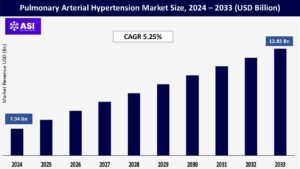
CAGR: 5.25%
Last Updated : August 22, 2025
The global Pulmonary Arterial Hypertension Market was valued at approximately USD 7.94 billion in 2024 and is projected to reach USD 12.83 billion by 2033, growing at a CAGR of 5.25% during the forecast period (2025–2033).
The Pulmonary Arterial Hypertension (PAH) Drugs Market focuses on treatments developed for a rare, progressive disorder characterized by high blood pressure in the arteries of the lungs, leading to the narrowing and stiffening of pulmonary arteries. This condition increases the workload on the heart and can result in right-sided heart failure if left untreated.
PAH drugs are used to improve symptoms such as shortness of breath, fatigue, chest pain, and dizziness, and ultimately to enhance the quality of life and survival rates of patients. Major drug classes include endothelin receptor antagonists (ERAs), phosphodiesterase-5 inhibitors (PDE-5 inhibitors), prostacyclin analogs, and soluble guanylate cyclase (sGC) stimulators. These drugs work by relaxing the blood vessels, reducing pulmonary vascular resistance, and improving blood flow in the lungs.
The market is characterized by a high demand for novel and combination therapies due to the complex and incurable nature of PAH. With rising awareness, increasing diagnosis rates, and advancements in targeted therapies and drug delivery systems, the PAH drugs market continues to grow, although treatment costs and disease rarity pose challenges to accessibility and affordability.
In recent years, there has been a significant increase in awareness of PAH among both healthcare professionals and the general population. This has led to earlier and more accurate diagnoses, especially due to improved screening tools and specialist centers. Since PAH is a life-threatening disease that progresses rapidly if left untreated, early detection is critical. As more patients are identified in earlier stages, the demand for effective therapies rises, driving market growth.
The PAH drugs market is driven by continuous innovation in targeted therapies that address the underlying mechanisms of the disease. New drugs, including combination therapies that simultaneously target multiple pathways such as the endothelin, nitric oxide, and prostacyclin pathways are proving to be more effective than monotherapies. The development of oral formulations and novel delivery systems for previously injectable drugs has also improved patient adherence. These breakthroughs, supported by regulatory incentives for rare diseases (orphan drug status), are accelerating drug approvals and fueling market expansion.
One of the most significant restraints for the PAH drugs market is the extremely high cost of treatment, which limits accessibility for a large portion of the global population. PAH therapies often involve lifelong treatment with specialized drugs that can cost tens of thousands of dollars per year. Many of these therapies are patented and have limited generic alternatives, keeping prices high.
Despite insurance or government health schemes, out-of-pocket costs remain a barrier, particularly in low- and middle-income countries. Moreover, the need for regular monitoring, specialist consultations, and potential hospitalization adds to the overall financial burden. This economic challenge restricts widespread adoption and adherence to treatment, thereby hindering the growth potential of the market.
| Report Metric | Details |
|---|---|
| Segmentations | |
| By Drug Class |
Endothelin Receptor Antagonists (ERAs) Phosphodiesterase-5 Inhibitors (PDE-5 Inhibitors) Prostacyclin and Prostacyclin Analogs Soluble Guanylate Cyclase (sGC) Stimulators Calcium Channel Blockers Others
|
| By Route of Administration |
Oral Inhaled Intravenous/Subcutaneous |
| By Type |
Branded Drugs Generic Drugs |
| By Distribution Channel |
Hospital Pharmacies Retail Pharmacies Online Pharmacies |
| Key Players |
|
| Geographies Covered | |
| North America |
U.S. |
| Europe |
U.K. |
| Asia Pacific |
China |
| Middle East & Africa |
Saudi Arabia |
| Latin America |
Brazil |
The Pulmonary Arterial Hypertension Market is segmented by Drug class, Route of administration, Type and Distribution Channels. Each factor plays a vital role in expanding early diagnosis, optimizing patient care through targeted treatment strategies, and accelerating the development of advanced therapies that improve survival rates and quality of life for individuals living with pulmonary arterial hypertension.
Endothelin Receptor Antagonists (ERAs) This class includes drugs such as bosentan, ambrisentan, and macitentan, which block the effects of endothelin, a potent vasoconstrictor. ERAs are a cornerstone of PAH therapy due to their ability to improve exercise capacity and delay disease progression. They are often used as monotherapy or in combination regimens.
Phosphodiesterase-5 Inhibitors (PDE-5 Inhibitors) Drugs like sildenafil and tadalafil help relax pulmonary blood vessels by enhancing nitric oxide signaling. Widely used due to their oral availability and favorable safety profiles, PDE-5 inhibitors are often prescribed in early and intermediate stages of PAH. Prostacyclin and Prostacyclin Analogs These include drugs like epoprostenol, treprostinil, and iloprost that mimic prostacyclin, a vasodilator with anti-proliferative properties. Typically used in advanced PAH, these agents improve survival but are often reserved for severe cases due to their complex administration routes (IV or inhaled).
Soluble Guanylate Cyclase (sGC) Stimulators Riociguat is the key drug in this class, promoting vasodilation via the nitric oxide-sGC-cGMP pathway. It is the only drug approved for both PAH and chronic thromboembolic pulmonary hypertension (CTEPH), adding to its significance in this market. Calcium Channel Blockers These are used in a small subset of patients who respond positively to vasoreactivity testing.
While cost-effective, their use is limited due to the narrow population of eligible patients and the need for careful monitoring. Others Includes emerging therapies such as Rho kinase inhibitors and tyrosine kinase inhibitors, which are currently under clinical evaluation and represent future growth potential.
Oral administration is the most preferred route for its convenience, patient compliance, and wide applicability across multiple drug classes (e.g., PDE-5 inhibitors, ERAs, sGC stimulators). This segment dominates the market, especially in outpatient settings. Inhaled formulations (like iloprost and treprostinil) offer localized delivery to the lungs, reducing systemic side effects.
While effective, their frequent dosing and device dependency slightly limit widespread use. Intravenous/Subcutaneous
Reserved for advanced PAH cases, especially when oral or inhaled therapies fail. Drugs like epoprostenol (IV) and treprostinil (subcutaneous) provide potent effects but require pump systems or central line access, making them more suitable for hospital-based or highly monitored home care.
Branded therapies dominate the market due to the high cost of innovation, extensive clinical trials, and regulatory approval for rare diseases. These drugs benefit from patent protection and often enjoy exclusivity under orphan drug policies, contributing to high market revenues.
This segment is gradually growing as some key patents expire, allowing the entry of cost-effective alternatives. Generic drugs help improve access to treatment, especially in low- and middle-income countries, but are still limited in availability compared to other therapeutic areas.
Hospital Pharmacies A critical channel for patients requiring IV or SC therapies and close monitoring. Hospitals also serve as central hubs for initiating treatment plans and titrating doses in severe or newly diagnosed cases. Retail Pharmacies Serve patients on long-term oral medications. The increasing prescription of PDE-5 inhibitors and ERAs for home-based treatment makes retail pharmacies a strong distribution channel, especially in urban areas.
Online Pharmacies This channel is gaining traction due to convenience, home delivery, and digital prescription services. It is especially relevant in managing chronic conditions like PAH that require regular drug refills and offers potential growth in the post-pandemic digital health landscape.
North America is expected to hold the greatest market share of 35.1% in 2024, due to a high prevalence of infertility, improved fertility treatment capabilities, and improved reimbursement policies. The United States is expected to account for most of this regional market share, with continuously increasing awareness and acceptance of assisted reproductive technologies (ART), a growing availability of fertility clinics, an increased desire for sperm donation and sperm cryopreservation, and the increased acceptance of artificial insemination as a common practice.
Artificial insemination is also widely accepted for livestock breeding, particularly in the dairy and beef industries. The presence of leading companies such as CooperSurgical, Inc. and Hamilton Thorne Ltd. will also positively impact innovation and adoption of new technologies for human and livestock fertility.
Europe represents a well-established regional market for artificial insemination due to progressive healthcare systems, favorable rules and regulations, and an increased acceptance of delayed parenthood. Major contributors include Germany, France, UK, Austria, and the Netherlands where all have a strong commitment towards fertility care and public funding for ART procedures. The region has created large artificial insemination programs, particularly in dairy food production, and have also adopted ART usage such as IVF.
According to Eurostat, ART and fertility treatments within the EU market have grown steadily over the past few years, suggesting acceptance by society and a strong government investment in fertility care and ART. These factors combined with an aging population and increased infertility rates are expected to yield substantial long-term growth in the male fertility market within Europe.
The Asia-Pacific region is forecasted to be the fastest growing thorughout the forecast period, with a CAGR of 8.3%, due to several factors prompting an increase in infertility, improved access to healthcare and increased investment from governments in livestock genetic enhancement program. China, India and Japan are the larger contributors to the region’s market growth.
In India, over 80 million cattle have been inseminated under the National Artificial Insemination Programme run by the government in 2023 demonstrating huge uptake in the veterinary sector. The human fertility sector is also experiencing a boom, with valuable opportunities arising from urbanization, cheaper services, and an increase in education around reproductive health.
Latin America and the Middle East & Africa (MEA) are emerging markets that show moderate growth, as they are beginning to invest in fertility services and agricultural development. Brazil, Argentina, and South Africa are leading the way in livestock artificial insemination programs aimed at improving the efficiency of animal production in terms of meat and milk.
Similar developments are now being seen in the human segment with people becoming more aware of fertility treatment and improving in healthcare structures although Brazil, Argentina, and South Africa have the added problem of wealth disparities and access to ART services in communities. Cultural aspects of assisted reproduction as well as ART are also a challenge for most of the countries and markets in these regions.
The pulmonary arterial hypertension market was valued at USD 7.94 billion in 2024.
The market is projected to grow at a CAGR of 5.25% from 2025 to 2033.
Endothelin Receptor Antagonists (ERAs) hold the largest market share.
The North America region is expected to witness the highest growth rate.
Major players include Johnson & Johnson, United Therapeutics Corporation and Gilead Sciences, Inc.
1.1 Summary
1.2 Research methodology
2.1 Particulate Adjuvants
2.2 Aluminum-Based Adjuvants
2.3 Toll- Like Receptor Agonists
3.1 Drivers
3.2 Geopolitical Impact
3.3 Human Factors
3.4 Technology Factors
4.1 Porters Five Forces Analysis
4.2 Value Chain Analysis
4.3 Average Pricing Analysis
4.4 M & A, Agreements & Collaboration Analysis
5.1 Pulmonary Arterial Hypertension Market, By Drug Class
5.1.1 Introduction
5.1.2 Market Size & Forecast
5.2 Pulmonary Arterial Hypertension Market, By Route of Administration
5.3 Pulmonary Arterial Hypertension Market, By Type
5.4 Pulmonary Arterial Hypertension Market, By Distribution channel
6.1 North America Pulmonary Arterial Hypertension Market, By Country
6.1.1 Pulmonary Arterial Hypertension Market, By Drug Class
6.1.2 Pulmonary Arterial Hypertension Market, By Route of Administration
6.1.3 Pulmonary Arterial Hypertension Market, By Type
6.1.4 Pulmonary Arterial Hypertension Market, By Distribution channel
6.2 U.S
6.2.1 Pulmonary Arterial Hypertension Market, By Drug Class
6.2.2 Pulmonary Arterial Hypertension Market, By Route of Administration
6.2.3 Pulmonary Arterial Hypertension Market, By Type
6.2.4 Pulmonary Arterial Hypertension Market, By Distribution channel
6.3 Canada
7.1 U.K.
7.2 Germany
7.3 France
7.4 Spain
7.5 Italy
7.6 Russia
7.7 Nordic
7.8 Benelux
7.9 The Rest of Europe
8.1 China
8.2 South Korea
8.3 Japan
8.4 India
8.5 Australia
8.6 Taiwan
8.7 South East Asia
8.8 The Rest of Asia-Pacific
9.1 UAE
9.2 Turkey
9.3 Saudi Arabia
9.4 South Africa
9.5 Egypt
9.6 Nigeria
9.7 Rest of MEA
10.1 Brazil
10.2 Mexico
10.3 Argentina
10.4 Chile
10.5 Colombia
10.6 Rest of Latin America
11.1 Global Market Share (%) By Players
11.2 Market Ranking By Revenue for Players
11.3 Competitive Dashboard
11.4 Product Mapping