

Rutile Market
Rutile Market & Trends Analysis Report, By Grade (Natural Rutile, Synthetic Rutile), By Application (Pigments, Welding Electrodes, Titanium Metal Production), By End User (Paints & Coatings, Aerospace & Defense)– Industry Analysis Report, Regional Outlook, Growth Potential, Price Trends, Competitive Market Share & Forecast, 2025–2033.

Historical Period: 2019-2024
Forecast Period: 2025-2033
Report Code :
CAGR: 4.6%
Last Updated : March 13, 2026
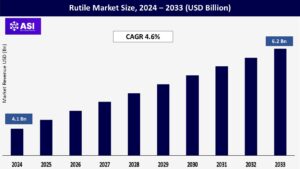
The global rutile market size was valued at USD 4.1 billion in 2024 and is anticipated to reach USD 6.2 billion by 2033, expanding at a CAGR of 4.6%.
Rutile, a natural form of titanium dioxide (TiO₂), is a critical mineral used in pigment production, metal processing, and welding consumables. Increasing demand from the construction, aerospace, automotive, and coatings industries is driving sustained market growth globally.
The main raw material used to make titanium dioxide pigments, which are extensively used in paints, coatings, plastics, and paper, is rutile. TiO₂ pigments, which are prized for their high opacity, brightness, UV resistance, and chemical stability, are in high demand due to the growth in urbanization, infrastructure development, and consumer goods manufacturing. These qualities make them essential for industrial applications, packaging, automotive coatings, and construction.
Because of its remarkable strength-to-weight ratio, resistance to corrosion, and thermal stability, titanium metal which is derived from rutile is essential to the automotive and aerospace industries.
The need for high purity rutile is being driven by the growth of air travel worldwide, as well as the quick uptake of electric vehicles (EVs) and lightweight automotive materials. Its strategic application in engine parts, performance coatings, and structural components
Ecological effects include habitat disruption, water contamination, and land degradation are linked to the extraction and processing of rutile. As a result, strict environmental laws present major obstacles to new mining ventures and expansions, especially in industrialized nations like Australia, the US, and some areas of Europe.
Supply side growth may be constrained by these limitations, which may result in delays, higher compliance expenses, or even the stoppage of operations.
The world’s supply of rutile is highly concentrated geographically, with significant quantities found in South Africa, Australia, and Sierra Leone. Due to its concentration, the market is susceptible to interruptions from natural disasters in important mining regions, worker strikes, regulatory changes, and geopolitical unrest.
Price volatility is also a result of the limited supply of natural rutile and reliance on mining outputs, which can discourage investment in downstream uses and have an impact on long-term agreements.
| Report Metric | Details |
|---|---|
| Segmentations | |
| By Grade |
Natural Rutile Synthetic Rutile |
| By Application |
Pigments Welding Electrodes Titanium Metal Production |
| By End User |
Paints & Coatings Aerospace & Defense |
| Key Players |
|
| Geographies Covered | |
| North America |
U.S. |
| Europe |
U.K. |
| Asia Pacific |
China |
| Middle East & Africa |
Saudi Arabia |
| Latin America |
Brazil |
The Rutile Market is segmented by Function (Acidulant, Emulsifier, Diuretic), By End-Use (Food & Beverage, Pharmaceuticals, Personal Care, Industrial).
Each factor plays a crucial role in enhancing patient safety, increasing the adoption of self-administered anticoagulant therapies, and supporting the development of more convenient, prefilled drug delivery systems that streamline treatment in the management of thromboembolic and cardiovascular conditions.
Natural Rutile (Dominant Segment)
Natural rutile is a mineral that occurs naturally and requires little preparation. It is highly sought after in the production of welding electrodes and pigments because of its exceptionally high titanium dioxide (TiO₂) content. It is the leading market category since it is also a favored direct feedstock for chlorination operations in the production of titanium metal.
Synthetic Rutile
Ilmenite is upgraded using a variety of beneficiation techniques to create synthetic rutile. In areas with insufficient natural rutile sources, its demand is rising. Because of its great purity, synthetic rutile is mostly utilized in cutting edge processes like the manufacturing of titanium sponge, which is essential to the defense, aerospace, and medical sectors.
Pigments (Largest Segment)
The most popular white pigment in the world is titanium dioxide (TiO₂), which is generated from rutile and is valued for its remarkable brightness, opacity, and UV resistance. It is essential to the formulation of paper, paints, plastics, and inks. The dominance of this market is still being driven by the expanding demand from the packaging, automotive, and construction industries.
Welding Electrodes
A crucial ingredient in welding electrode coating, rutile is prized for its superior arc stability, ease of slag removal, and clean weld finishes. An important factor driving up demand for this application is the consistent expansion of the shipbuilding, infrastructure, and construction sectors.
Titanium Metal Production
Using the Kroll process, rutile is the main raw material used to make titanium sponge. In the aerospace, defense, and medical implant industries, where lightweight strength and corrosion resistance are crucial, this sponge is further processed into ingots, sheets, and precision components.
Paints & Coatings (Dominant Sector)
This is the top enduse market, driven mostly by the fast expansion of the automotive, marine, and construction sectors. TiO₂ generated from rutile is necessary to create coatings that are UV-stable, weather-resistant, and aesthetically pleasing. It is a popular option for both decorative and protective applications due to its high opacity and brightness.
Aerospace & Defense
For the production of titanium metal, which is utilized in jet engines, airframes, and missile systems, rutile is essential in this high-performance industry.It is essential for advanced engineering and defense-grade components due to its remarkable strength-to-weight ratio, heat resistance, and corrosion resistance.
This region is characterized by advanced technological capabilities, particularly in aerospace and automotive manufacturing. The United States stands out as a major consumer of high-purity rutile, primarily for titanium metal production used in defense and aerospace applications.
Asia-Pacific is witnessing the highest growth rate, with China and India driving significant demand for rutile-based pigments, spurred by massive infrastructure and industrial development. Australia plays a strategic role as the world’s largest natural rutile producer, supporting both domestic consumption and global exports.
Europe maintains stable demand owing to mature industries such as automotive, paints, and specialty chemicals. Stringent environmental regulations are accelerating the shift toward high-grade synthetic rutile, especially in applications requiring cleaner production inputs.
Latin America is seeing rising demand for rutile in construction and decorative coatings, fueled by urbanization and industrial expansion. On the supply side, African nations like Mozambique and Sierra Leone are emerging as key exporters, increasing their presence in the global rutile trade.
The global rutile market size in 2024 was USD 4.1 billion
The projected CAGR of the rutile market is 4.6%
The Pigments and Paints & Coatings dominate the rutile market.
Asia-Pacific shows the highest growth potential, led by China, India, and Australia.
1.1 Summary
1.2 Research methodology
2.1 Research Objectives
2.2 Market Definition
2.3 Limitations & Assumptions
2.4 Market Scope & Segmentation
2.5 Currency & Pricing Considered
3.1 Drivers
3.2 Geopolitical Impact
3.3 Human Factors
3.4 Technology Factors
4.1 Porters Five Forces Analysis
4.2 Value Chain Analysis
4.3 Average Pricing Analysis
4.4 M & A, Agreements & Collaboration Analysis
5.1 Rutile Market, By Grade
5.1.1 Introduction
5.1.2 Market Size & Forecast
5.2 Rutile Market, By Application
5.3 Rutile Market, By End User
6.1 North America Rutile Market , By Country
6.1.1 Rutile Market, By Grade
6.1.2 Rutile Market, By Application
6.1.3 Rutile Market, By End User
6.2 U.S.
6.2.1 Rutile Market, By Grade
6.2.2 Rutile Market, By Application
6.2.3 Rutile Market, By End User
6.3 Canada
7.1 U.K.
7.2 Germany
7.3 France
7.4 Spain
7.5 Italy
7.6 Russia
7.7 Nordic
7.8 Benelux
7.9 The Rest of Europe
8.1 China
8.2 South Korea
8.3 Japan
8.4 India
8.5 Australia
8.6 Taiwan
8.7 South East Asia
8.8 The Rest of Asia-Pacific
9.1 UAE
9.2 Turkey
9.3 Saudi Arabia
9.4 South Africa
9.5 Egypt
9.6 Nigeria
9.7 Rest of MEA
10.1 Brazil
10.2 Mexico
10.3 Argentina
10.4 Chile
10.5 Colombia
10.6 Rest of Latin America
11.1 Global Market Share (%) By Players
11.2 Market Ranking By Revenue for Players
11.3 Competitive Dashboard
11.4 Product Mapping