

Smart Home Market
Smart Home Market Share & Trends Analysis Report, By Product (Smart Lighting, Smart Speakers, Smart Security & Surveillance, Smart Appliances, Smart Thermostats, Others), By Technology (Wireless, Wired), By Application (Energy Management, Security, Home Entertainment, Healthcare, Smart Kitchen, Others), By Sales Channel (Online, Offline) Industry Analysis Report, Regional Outlook, Growth Potential, Price Trends, Competitive Market Share & Forecast, 2025–2033

Historical Period: 2019-2024
Forecast Period: 2025-2033
Report Code :
CAGR: 11.2%
Last Updated : October 30, 2025
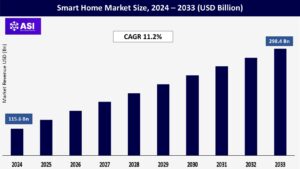
The worldwide Smart Home Market was estimated to be valued at around USD 115.6 billion in 2024 and is anticipated to reach USD 298.4 billion by 2033, experiencing a CAGR of 11.2% during the projected period from 2025 to 2033.
The Smart Home Market includes a diverse array of connected home technologies that utilize internet-connected devices to automate and remotely control various household functions. These systems improve comfort, convenience, energy efficiency, security, and health monitoring. Typically, smart home technologies consist of lighting, thermostats, security systems, smart speakers, appliances, and environmental sensors, which are usually controlled centrally through smartphones, hubs, or voice assistants.
The growth of the market is propelled by swift advancements in IoT (Internet of Things), an increase in consumer awareness, initiatives for energy conservation, and a higher adoption of AI-driven and voice-activated systems. The growing demand for home automation, remote monitoring, and connected lifestyle solutions across both developed and emerging markets continues to drive the worldwide adoption of smart homes.
Contemporary consumers are increasingly looking for intelligent solutions that improve comfort, automate daily tasks, and minimize energy consumption. Smart thermostats, lighting systems, and voice-activated assistants allow homeowners to manage appliances remotely and fine-tune energy usage, resulting in substantial savings over time.
Furthermore, a heightened awareness of environmental issues has led many consumers to embrace energy-efficient systems. Government initiatives that advocate for energy-efficient housing and provide incentives for adopting smart energy devices further facilitate market growth.
The incorporation of AI-driven systems that adapt to user behavior and modify settings accordingly is also enhancing the user experience, leading to a quicker adoption rate.
The swift progress and decreasing costs of IoT devices have transformed the smart home landscape. The widespread availability of high-speed internet, the rising use of smartphones, and the evolution of wireless technologies, including Wi-Fi 6 and Zigbee, facilitate smooth communication among devices.
As the compatibility and integration between different platforms enhance, smart home ecosystems are becoming more user-friendly and scalable. Additionally, the involvement of major tech companies such as Amazon, Google, and Apple has contributed to the growth of voice-operated systems, speeding up market adoption.
These advancements are consistently reducing barriers to entry, making smart home technologies more prevalent in both developed and emerging markets.
A significant barrier to the expansion of the smart home market is the apprehension surrounding data privacy and cybersecurity. Since smart homes depend on interconnected devices and cloud services, they are susceptible to cyber threats and unauthorized intrusions.
Cybercriminals can take advantage of security vulnerabilities to manipulate home systems, access personal information, or incapacitate essential functions such as surveillance or alarms. This escalating risk diminishes consumer confidence, particularly in areas with inadequate data protection laws.
Furthermore, numerous smart home devices do not adhere to standardized security measures, and many manufacturers neglect to provide regular software updates or support, which amplifies risk exposure. For consumers, worries regarding how companies manage, utilize, and safeguard their personal data lead to reluctance in embracing these technologies.
Regulatory agencies are increasingly prioritizing cybersecurity measures, yet the lack of a universal standard still restricts market growth, especially in developing nations where consumer knowledge and digital security systems are still evolving.
| Report Metric | Details |
|---|---|
| Segmentations | |
| By Product |
Smart Lighting Smart Speakers Smart Security & Surveillance Smart Appliances Smart Thermostats Others |
| By Technology |
Wireless Wired |
| By Application |
Energy Management Security Home Entertainment Healthcare Smart Kitchen Others |
| By Sales Channel |
Online Offline |
| Key Players |
|
| Geographies Covered | |
| North America |
U.S. |
| Europe |
U.K. |
| Asia Pacific |
China |
| Middle East & Africa |
Saudi Arabia |
| Latin America |
Brazil |
The Smart Home Market is divided into categories based on product (such as lighting control, security systems, entertainment, and HVAC), technology (wired or wireless), and application (residential or commercial).
Wireless technology is the most prevalent because it is easy to install, while security and energy management systems are the most commonly adopted. Residential applications represent the largest portion of the market, fueled by the need for consumer convenience and efficiency.
The market encompasses a diverse array of products including lighting management, security and access systems, HVAC regulation, smart home entertainment, intelligent kitchen devices, and healthcare solutions for homes.
Among these offerings, security and access systems (like smart locks, surveillance cameras, and motion sensors) lead the market due to heightened consumer apprehensions regarding safety and burglary prevention. Lighting management systems are also becoming more popular, particularly with the incorporation of sensors and dimmers that help lower energy usage.
In addition, smart entertainment systems, such as smart televisions and voice-activated speakers, are witnessing significant adoption fueled by increasing demand for digital experiences at home. HVAC regulation, represented by smart thermostats, is experiencing swift expansion because of its advantages in energy efficiency and rising environmental awareness.
Smart home technologies are typically divided into wired and wireless categories. Wireless technologies such as Wi-Fi, Zigbee, Z-Wave, Bluetooth, and Thread lead the market because of their lower installation costs, ease of integration, and adaptability.
Wi-Fi is commonly used for devices that need high-speed data transmission, while Zigbee and Z-Wave are favored for low-energy applications like sensors and lighting. In contrast, wired technologies provide greater reliability and security but are becoming less popular due to the complexity of installation and limited flexibility for retrofitting.
The Smart Home Market is mainly utilized in both residential and commercial environments. The residential segment commands the largest portion of the market, driven by rising urbanization, higher disposable incomes, and the demand for convenience and safety from consumers.
Smart homes facilitate the automation of everyday tasks, increasing comfort and optimizing energy consumption. Commercial settings—such as hotels, office complexes, and retail stores—are also implementing smart technologies to enhance energy management, security, and operational effectiveness.
These establishments are progressively adopting centralized control systems to regulate lighting, temperature, and access, creating a more sustainable and secure atmosphere.
North America is at the forefront of the smart home industry, holding a substantial portion of the revenue due to heightened consumer awareness, the early uptake of cutting-edge technologies, and a strong presence of major companies like Amazon, Apple, and Google.
Within this region, the U.S. stands out as the leading nation, where smart speakers, lighting solutions, and security systems are commonly integrated into homes. The growth in this area is bolstered by a well-established IoT ecosystem, widespread access to high-speed internet, and an increasing demand for energy-efficient products.
Furthermore, governmental incentives for smart energy devices and supportive policies regarding home automation enhance the expansion of the market.
Europe stands out as a significant player, propelled by a growing awareness of environmental issues, favorable regulatory environments, and increasing investments in smart grid technology. Nations like Germany, the UK, France, and the Netherlands are at the forefront of implementing smart home solutions, particularly in energy management and home security.
The European Union’s commitment to sustainability and energy efficiency has driven the uptake of smart thermostats, lighting systems, and automated HVAC controls.
Furthermore, the rise of smart city projects and the integration of renewable energy sources are boosting the adoption of connected home technologies in both residential and commercial sectors.
The smart home market in the Asia-Pacific area is experiencing the highest growth due to swift urban development, increasing disposable incomes, and heightened digital adoption. Countries including China, Japan, South Korea, and India are leading the way in regional implementation.
China is at the forefront with widespread adoption of smart city and smart home technologies, bolstered by robust manufacturing capabilities and a tech-savvy population. Japan and South Korea are also prominent for their advanced home automation and AI integration.
In India, the market is growing thanks to rising smartphone usage and internet accessibility, although it faces challenges linked to infrastructure and affordability. Initiatives from the government, such as the “Smart Cities Mission,” are further promoting growth.
Latin America is slowly growing, especially in Brazil and Mexico. The rising middle-class demographic, enhanced internet access, and greater recognition of the advantages of home automation are fueling this trend. Concerns over security, particularly in urban settings, are driving the demand for smart surveillance and access control technologies.
However, the expansion of the market is somewhat limited by the high costs of devices and the lack of consumer awareness in rural areas. Still, there is significant potential in the region as infrastructure advancements continue and smart device prices become more affordable.
The MEA region is becoming a notable market, particularly in the Gulf Cooperation Council (GCC) countries such as the UAE and Saudi Arabia. These countries are making significant investments in smart city initiatives and upscale residential projects, where smart home technologies play a key role.
The growing focus on energy conservation and government initiatives supporting IoT implementation are driving market growth. In Africa, the adoption rate is still low due to financial limitations and insufficient infrastructure, although urban areas are increasingly interested in smart security and lighting systems.
The market was valued at USD 115.6 billion in 2024.
The market is projected to grow at a CAGR of 11.2% from 2025 to 2033.
Smart Lighting and Smart Security hold the largest market shares by product.
Asia-Pacific is expected to witness the highest growth rate during the forecast period.
Major players include Amazon, Google, Apple, Samsung, Honeywell, and Schneider Electric.
1.1 Summary
1.2 Research methodology
2.1 Research Objectives
2.2 Market Definition
2.3 Limitations & Assumptions
2.4 Market Scope & Segmentation
2.5 Currency & Pricing Considered
3.1 Drivers
3.2 Geopolitical Impact
3.3 Human Factors
3.4 Technology Factors
4.1 Porters Five Forces Analysis
4.2 Value Chain Analysis
4.3 Average Pricing Analysis
4.4 M & A, Agreements & Collaboration Analysis
5.1 Smart Home Market, By Product
5.1.1 Introduction
5.1.2 Market Size & Forecast
5.2 Smart Home Market, By Technology
5.3 Smart Home Market, By Application
5.4 Smart Home Market, By Sales Channel
6.1 North America Smart Home Market , By Country
6.1.1 Smart Home Market, By Product
6.1.2 Smart Home Market, By Technology
6.1.3 Smart Home Market, By Application
6.1.4 Smart Home Market, By Sales Channel
6.2 U.S.
6.2.1 Smart Home Market, By Product
6.2.2 Smart Home Market, By Technology
6.2.3 Smart Home Market, By Application
6.2.4 Smart Home Market, By Sales Channel
6.3 Canada
7.1 U.K.
7.2 Germany
7.3 France
7.4 Spain
7.5 Italy
7.6 Russia
7.7 Nordic
7.8 Benelux
7.9 The Rest of Europe
8.1 China
8.2 South Korea
8.3 Japan
8.4 India
8.5 Australia
8.6 Taiwan
8.7 South East Asia
8.8 The Rest of Asia-Pacific
9.1 UAE
9.2 Turkey
9.3 Saudi Arabia
9.4 South Africa
9.5 Egypt
9.6 Nigeria
9.7 Rest of MEA
10.1 Brazil
10.2 Mexico
10.3 Argentina
10.4 Chile
10.5 Colombia
10.6 Rest of Latin America
11.1 Global Market Share (%) By Players
11.2 Market Ranking By Revenue for Players
11.3 Competitive Dashboard
11.4 Product Mapping