

Soft Flooring Market
Soft Flooring Market & Trends Analysis Report, By Product Type (Rugs & Carpets, Carpet Tiles, ), By Application (Residential, Healthcare and Hospitality), By Distribution Channel (Offline, Online)– Industry Analysis Report, Regional Outlook, Growth Potential, Price Trends, Competitive Market Share & Forecast, 2025–2033.

Historical Period: 2019-2024
Forecast Period: 2025-2033
Report Code :
CAGR: 4.4%
Last Updated : March 7, 2026
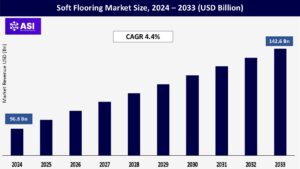
The global soft flooring market size was valued at approximately USD 96.8 billion in 2024 and is projected to reach USD 142.6 billion by 2033, growing at a CAGR of 4.4% during the forecast period.
Soft flooring products such as carpets, rugs, and carpet tiles are increasingly adopted across residential, commercial, and institutional sectors due to their aesthetic appeal, acoustic benefits, comfort, and insulation properties.
Key growth factors include rising urbanization, increasing construction activities, and a growing demand for personalized and cozy interior environments. Additionally, advancements in manufacturing technologies and eco-friendly materials are driving product innovation and consumer interest globally.
One of the main drivers of the soft flooring industry is the continuous urbanization trend, especially in developing nations. Particularly in Asia-Pacific, the Middle East, and some regions of Africa, the need for new residential structures and housing complexes is being driven by the rapid population expansion in urban centers.
In home interiors, soft flooring—such as carpets, rugs, and textile-based floor coverings—is widely preferred because to its comfort, sound absorption, thermal insulation, and visual appeal.
Soft carpeting is becoming more and more popular in living rooms, hallways, nurseries, and bedrooms since it feels warm underfoot and can improve the atmosphere of the house.
It is anticipated that private real estate investments and government-supported affordable housing initiatives would further boost product demand in both the premium and low-cost residential categories.
The demand for long-lasting, stylish soft flooring solutions is being driven by the hospitality, retail, and commercial office sectors’ ongoing investments in interior renovations, remodeling, and refurbishment.
Carpet tiles, broadloom carpets, and modular rugs are examples of soft flooring products that are popular in these settings because of their cost-effectiveness, ease of care, acoustic qualities, and design versatility.
Particularly in high-traffic areas, soft flooring materials are prone to wear, discoloration, and moisture damage. This restricts their use in spaces where hard flooring is preferred, such as baths and kitchens. This is being addressed by advancements in waterproof and stain-resistant coatings, but adoption is still difficult.
Many soft flooring products, especially those made of synthetic fibers, are criticized for their limited recyclability and dependence on petroleum-based ingredients, despite the growing need for sustainable solutions. Manufacturers are being pushed to create circular flooring solutions by consumer demand for greener options and regulatory pressure.
| Report Metric | Details |
|---|---|
| Segmentations | |
| By Product Type |
Rugs & Carpets: The Leading Market Carpet Tiles: The Sector with the Fastest Growth |
| By Application |
The largest application segment is residential. Healthcare and Hospitality |
| By Distribution Channel |
Offline (Dominant Channel: Traditional Retail) Online (Rapidly Expanding Channel) |
| Key Players |
|
| Geographies Covered | |
| North America |
U.S. |
| Europe |
U.K. |
| Asia Pacific |
China |
| Middle East & Africa |
Saudi Arabia |
| Latin America |
Brazil |
The Soft Flooring Market is segmented by Function (Acidulant, Emulsifier, Diuretic), By End-Use (Food & Beverage, Pharmaceuticals, Personal Care, Industrial).
Each factor plays a crucial role in enhancing patient safety, increasing the adoption of self-administered anticoagulant therapies, and supporting the development of more convenient, prefilled drug delivery systems that streamline treatment in the management of thromboembolic and cardiovascular conditions.
The market for soft flooring is still dominated by wall-to-wall carpets and area rugs because of their warmth, comfort, ability to reduce noise, and versatility in design. In frigid climates and residential settings, where thermal insulation and comfortable aesthetics are top concerns, these goods are particularly well-liked.
Carpets and rugs come in a wide range of types, from high-end wool and handwoven alternatives to more affordable synthetics, and are often used in hallways, living rooms, and bedrooms.
Demand for high-end, custom-designed carpets has increased due to growing interest in luxury home décor and interior customisation, especially in North America, Europe, and the Middle East.
Because of its adaptability, simplicity of installation, and little maintenance needs, carpet tiles—also referred to as modular carpets—represent the product category with the greatest rate of growth. They are perfect for high-traffic locations like workplaces, coworking spaces, educational institutions, and healthcare facilities because of their modular design, which enables individual tile replacement.
Carpet tile use is accelerating due to the growing popularity of open-plan and agile workspaces, especially in metropolitan business hubs. In order to satisfy customers who are concerned about sustainability, producers are also providing a large variety of colors, patterns, and textures, including tiles with recycled content and low-VOC backing systems.
The market for soft flooring is dominated by the residential sector, which is fueled by widespread use in hallways, living rooms, bedrooms, and nurseries. Carpets and rugs are now commonplace in house interiors due to consumer demand for soft, noise-reducing, and thermally insulating flooring solutions.
Homeowners are now able to customize their homes with digitally printed patterns, modular carpets, and rugs that can be customized, thanks to the rise in home renovation projects, DIY culture, and online interior design tools.
Customers now have easier access to a wide range of soft flooring solutions that are suitable for both classic and modern interiors, thanks to the growth of e-commerce flooring platforms.
Soft carpeting is essential to establishing an opulent and welcoming ambiance in the hotel industry. Because of their visual appeal, acoustic qualities, and comfort underfoot, broadloom carpets and custom rugs are widely utilized in hotel and resort conference rooms, lobbies, hallways, and guest rooms.
Soft flooring options are becoming more popular in healthcare settings because of their antibacterial qualities, cushioning, and capacity to lower the risk of weariness and injuries, particularly in patient rooms, recovery wards, and senior living facilities.
In order to improve patient outcomes and facility environments, specialized healthcare carpets are made to meet infection control standards while also enhancing mobility support and sound absorption.
Soft flooring sales are still dominated by the offline segment, which holds the most market share. Typically, home improvement stores, specialty flooring showrooms, interior design studios, and physical shops are where consumers buy carpets, rugs, and modular flooring.
The capacity to visually examine textures, colors, and finishes as well as the advantage of receiving in-person advice from salespeople or interior designers are major factors contributing to offline domination. These elements have a special impact on expensive purchases and custom installations, when tactile pleasure and confidence in the caliber of the product are crucial.
The online distribution channel is growing rapidly, fueled by the rise of e-commerce platforms, brand-owned websites, and digital marketplaces that offer convenient browsing, doorstep delivery, and competitive pricing.
The integration of technologies such as augmented reality (AR) visualizers, AI-based design recommendations, and sample delivery services is improving consumer confidence in buying soft flooring products online.
The demand for soft flooring in North America’s mature yet profitable market is mostly driven by interior design, remodeling, and renovation projects for both residential and commercial buildings.
Because of its high discretionary incomes, robust home remodeling culture, and extensive use of luxury carpets and modular carpet tiles, the United States leads the region in demand.
Additionally, the area is witnessing a rise in interest in hypoallergenic and ecological flooring solutions, particularly among urban residents and consumers who value design. The use of soft flooring is further supported by ongoing investments in coworking spaces, healthcare infrastructure, and hospitality remodeling.
The worldwide soft flooring industry is expected to grow at the fastest rate in the Asia-Pacific. Urbanization, the growth of the middle class, and the speed at which homes and businesses are being built, especially in China, India, Indonesia, and Vietnam, are the main causes of this expansion.
Affordable housing developments, high-rise apartments, and the rapidly expanding hotel industry are creating a significant need for soft flooring options that are reasonably priced, long-lasting, and aesthetically pleasing.
The market potential in metropolitan areas is also being increased by more exposure to Western interior design trends and a greater focus on indoor comfort and aesthetics.
Strict indoor environmental quality laws, green building guidelines, and a strong customer demand for recyclable and environmentally friendly flooring materials support Europe’s steady industry expansion.
Leading adopters of sustainable carpets and rugs, which are frequently composed of natural fibers or recycled synthetic materials, include Germany, the UK, France, and the Nordic countries.
Demand is sustained in part by the development of low-emission, VOC-compliant products and the growing use of modular carpet systems in commercial settings (such as offices, classrooms, and hotels). An ongoing cycle of flooring renovations and replacements is also supported by Europe’s aging housing base.
Demand is moderate but growing throughout the Middle East and Latin America as a result of growing investments in infrastructure, residential construction, and tourism.
Interest in aesthetically pleasing and comfortable flooring options is rising as a result of the substantial expansion of the hotel and luxury real estate industries in nations like Saudi Arabia, Brazil, Mexico, and the United Arab Emirates.
Soft flooring alternatives are comparatively more expensive than hard floors due to high import duties, limited local production, and weaker brand penetration, which hinder market expansion in certain regions. However, long-term prospects are still being created by government-driven urban housing efforts and high-end commercial ventures.
The soft flooring market was valued at USD 96.8 billion in 2024.
The soft flooring market is projected at a CAGR of 4.4%.
The Wall-to-wall carpets and area rugs lead the product type.
The Asia-Pacific region witnesses the highest growth, due to rapid construction and rising income levels
1.1 Summary
1.2 Research methodology
2.1 Research Objectives
2.2 Market Definition
2.3 Limitations & Assumptions
2.4 Market Scope & Segmentation
2.5 Currency & Pricing Considered
3.1 Drivers
3.2 Geopolitical Impact
3.3 Human Factors
3.4 Technology Factors
4.1 Porters Five Forces Analysis
4.2 Value Chain Analysis
4.3 Average Pricing Analysis
4.4 M & A, Agreements & Collaboration Analysis
5.1 Soft Flooring Market, By Product Type
5.1.1 Introduction
5.1.2 Market Size & Forecast
5.2 Soft Flooring Market, By Application
5.3 Soft Flooring Market, By Distribution Channel
6.1 North America Soft Flooring Market , By Country
6.1.1 Soft Flooring Market, By Product Type
6.1.2 Soft Flooring Market, By Application
6.1.3 Soft Flooring Market, By Distribution Channel
6.2 U.S.
6.2.1 Soft Flooring Market, By Product Type
6.2.2 Soft Flooring Market, By Application
6.2.3 Soft Flooring Market, By Distribution Channel
6.3 Canada
7.1 U.K.
7.2 Germany
7.3 France
7.4 Spain
7.5 Italy
7.6 Russia
7.7 Nordic
7.8 Benelux
7.9 The Rest of Europe
8.1 China
8.2 South Korea
8.3 Japan
8.4 India
8.5 Australia
8.6 Taiwan
8.7 South East Asia
8.8 The Rest of Asia-Pacific
9.1 UAE
9.2 Turkey
9.3 Saudi Arabia
9.4 South Africa
9.5 Egypt
9.6 Nigeria
9.7 Rest of MEA
10.1 Brazil
10.2 Mexico
10.3 Argentina
10.4 Chile
10.5 Colombia
10.6 Rest of Latin America
11.1 Global Market Share (%) By Players
11.2 Market Ranking By Revenue for Players
11.3 Competitive Dashboard
11.4 Product Mapping