

Spine X-ray and Computed Tomography (CT) Market
Spine X-ray and Computed Tomography (CT) Market share & Trends Analysis Report, By Application (Degenerative Disc Disease, Spinal Fractures and Injuries, Spinal Tumors, Spinal Infections, Congenital Spine Disorders, Pre- and Post-operative Planning, Osteoporosis and Bone Density Assessment, Scoliosis and Spinal Deformities) By End User (Hospitals, Diagnostic Imaging Centers, Specialty Clinics (Orthopedic and Neurology Clinics), Academic & Research Institutes, Ambulatory Surgical Centers) Industry Analysis Report, Regional Outlook, Growth Potential, Price Trends, Competitive Market Share & Forecast, 2025–2033

Historical Period: 2019-2024
Forecast Period: 2025-2033
Report Code :
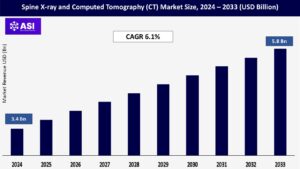
CAGR: 6.1%
Last Updated : August 29, 2025
The global Spine X-ray and Computed Tomography (CT) Market was valued at approximately USD 3.4 billion in 2024 and is projected to reach USD 5.8 billion by 2033, growing at a CAGR of 6.1% during the forecast period (2025–2033).
Spine X-ray and CT imaging systems are essential diagnostic modalities that visualize and assess spinal pathologies, including fractures, degenerative disc disease, infectious processes, tumors and developmental anomalies. X-ray is a rapid and low-cost imaging modality that is effective for bone structure and alignment evaluation, while CT imaging provides detailed cross-sections of the anatomy to facilitate less straightforward diagnoses and pre-operative planning. Spinal X-ray and CT systems are applied routinely in hospitals, imaging centers and specialty orthopedic clinics to assess potential spinal injuries, plan interventions, and monitor treatment gains. The market growth is primarily affected by the increasing global burden of spinal disorders and spinal injuries, especially in the rising aging population, and increasing adoption of imaging modalities in developing markets. Technological developments such as AI-enhanced CT modalities, portable X-ray devices and seamless integration with PACS systems are influencing demand. The increase in outpatient diagnostic service facilities and minimally invasive spine surgery will continue to support growth across regional markets.
The epidemic growth of spinal disorders worldwide degenerative disc disease, spinal stenosis, vertebral fractures, scoliosis, and herniated discs is a significant driver of the global spine X-ray and CT imaging market. Spinal disorders are identified as one of the leading causes of disability globally.
For example, the Global Burden of Disease Study 2021 reported that, low back pain was the single leading cause of disability worldwide, affecting approximately 619 million people in 2020 and projected to be greater than 843 million by 2050. As the population ages and becomes sedentary, this burden has increased immensely.
Older adults, in particular, are at increased risk of spinal degeneration and osteoporotic fractures; spinal trauma from falls, traffic accidents, and work-related injuries continue to be a prominent area of spinal imaging. The World Health Organization (WHO) reported between 250,000 and 500,000 spinal cord injuries worldwide every year, which are primarily related to traumatic events associated with traffic accidents and falls. A reliance on X-ray and CT imaging for initial diagnosis, and continued management of these conditions is paramount, wherein X-rays and CT imaging can assess for bone alignment, fractures or soft tissue involvement.
What occurred as a result of advancements in technology in digital imaging, detector sensitivity and integration of AI? Spine X-ray and CT imaging has fundamentally changed. Current digital radiography (DR) systems have produced with not only better image quality and improved resolution with lower radiation doses, but advanced multi-slice CT systems have enabled imaging of the complex 3D spatial anatomy of the spine and it is important for pre-surgical images and accurate diagnosis.
AI diagnostic support tools have also increasingly been utilized in imaging platforms. In 2023, GE HealthCare introduced the Revolution Aspire CT scanner, which included intelligent workflow tools and automated AI-enabled spinal segmentation of images to both reduce image analysis time and improve diagnostic confidence. Siemens Healthineers and Canon Medical similarly developed AI systems that enhance identification of spinal abnormalities, reduce time in interpretation and improve radiologists confidence in their decisions in reading images.
Emerging markets like India and Southeast Asia are adopting digital X-ray systems using cloud-based PACS (Picture Archiving and Communication System) to quickly and efficiently address the need for diagnostics in rural areas. Portable and mobile X-ray solutions are also growing in popularity and demand for use in emergencies and urgent care in rural health care settings. Technology in spinal imaging is providing accessible and accurate images, and efficient diagnostic imaging is rapid growth in the field.
One of the primary restraints affecting the growth of the Spine X-ray and Computed Tomography (CT) market is the high cost associated with advanced imaging systems and related procedures. CT scanners and high-resolution digital X-ray systems are expensive to purchase, operate, and maintain, often requiring substantial capital investment.
For example, a single high-end CT scanner can cost anywhere between USD 500,000 to over USD 2 million, depending on features and capabilities. Moreover, operational costs—including technician salaries, service contracts, and energy consumption—add to the total expenditure, making these modalities financially burdensome for smaller healthcare facilities, especially in developing regions.
Patients in lower-income settings may also face out-of-pocket expenses if insurance coverage is limited or unavailable, reducing access and utilization. This economic burden limits equipment adoption in rural hospitals and community clinics, thereby restricting market penetration. The high costs also pose a barrier to frequent use of CT scans for routine spinal assessments, despite their superior diagnostic capability compared to traditional imaging methods.
| Report Metric | Details |
|---|---|
| Segmentations | |
| By Application |
Degenerative Disc Disease Spinal Fractures and Injuries Spinal Tumors Spinal Infections Congenital Spine Disorders Pre- and Post-operative Planning Osteoporosis and Bone Density Assessment Scoliosis and Spinal Deformities |
| By End User |
Hospitals Diagnostic Imaging Centers Specialty Clinics (Orthopedic and Neurology Clinics) Academic & Research Institutes Ambulatory Surgical Centers |
| Key Players |
Philips Healthcare Siemens Healthineers GE HealthCare Canon Medical Systems Fujifilm Healthcare Samsung Medison Shimadzu Corporation Carestream Health Agfa-Gevaert Group Konica Minolta Healthcare Hitachi Healthcare (now part of Fujifilm) Planmed Oy Mindray Medical International Esaote S.p.A. Neusoft Medical Systems |
| Geographies Covered | |
| North America |
U.S. |
| Europe |
U.K. |
| Asia Pacific |
China |
| Middle East & Africa |
Saudi Arabia |
| Latin America |
Brazil |
The Spine X-ray and Computed Tomography (CT) Market is segmented by application and end-user. These segments reflect the diverse clinical indications and healthcare settings where spine imaging plays a vital role in diagnosis, monitoring, and surgical planning.
Degenerative Disc Disease dominated the market in 2024 due to the increasing incidence of degenerative spinal disease and chronic back pain related to spinal degeneration associated with aging. Clinically, we routinely assess changes related to disc height loss, osteophyte formation, and spinal canal narrowing using CT and high-resolution X-rays. Globally, the continued aging population has driven imaging demand for treatment of spinal degeneration, which is another area showing steady growth.
Spinal Fractures and Injuries is a fast-growth area, driven by the increase in motor vehicle accidents, falls, and sports injuries resulting in trauma. CT plays an important role in the assessment of complex spinal fractures in emergency departments as the imaging gold standard. Based on the increased number of emergency department visits with suspected spinal trauma, this area will continue to grow enhanced by CT.
Spinal Tumors have a unique need for localization and cancer staging, typically on CT imaging to evaluate for bony involvement and associate biopsies. While a smaller area of imaging use, the increasing incidence of metastatic spinal lesions and image-guided surgery is facilitating modest growth in public health. Spinal infections, including osteomyelitis and discitis are now commonly diagnosed using CT and MRI.
Plain films remain the first modality for spinal infection, with CT generally used to evaluate for bony erosion and abscess formation, especially in the immunocompromised patient. Spina bifida and scoliosis are congenital spine disorders in children that are continually producing demand for X-ray imaging. CT scans are used from time to time for further detail in evaluation and especially for surgical planning, but a majority of the imaging for this segment is performed in pediatric hospitals and rodent specialized centers.
Pre- and Post-Operative Planning is another segment experiencing trends in the utilization of CT scans. Spine surgeons depend heavily on 3D CT imaging for assessing alignment, implant position and fusion. The continued prevalence of minimally invasive spine surgery necessitates even greater demand for sophisticated imaging technology. Osteoporosis and Bone Density Assessment often rely on spine X-rays and vertebral fracture assessments (VFAs) to supplement DEXA scans.
CT based evaluation of bone mineral density is also being utilized with greater frequency for opportunistic screening of older adults who are undergoing a CT scan for other reasons. The overall role of Scoliosis and Spinal Deformities is dynamic with the need for serial X-ray imaging that specifically targets adolescents. Increasing prominence of school screening programs and greater recognition of early intervention for scoliosis are driving sustained imaging volumes in the scoliosis imaging segment.
With the overwhelming share of the spine X-ray and CT market, hospitals will have an estimated market share of 62.5% in 2024. Hospitals are the main first point of care for both emergency and scheduled imaging. With established infrastructure for advanced imaging, established radiologists, and surgical departments, hospitals have high imaging volumes for specific cases including trauma, surgery planning, and post-operative.
The Diagnostic Imaging Centers is a growing market, being driven mostly from the outsourcing of imaging services from hospitals. As Diagnostic Imaging Centers provide a faster turnaround and lower cost for outsourced imaging, demand is high especially in urban markets for patients looking for a fast non-emergent access to spinal imaging. Specialty Clinics (Orthopedic and Neurology Clinics) are still exhibiting modest growth.
Although, these clinics will refer patients to partnering imaging centers; more are establishing in-house x-ray and low-dose CT for patient convenience and to lower wait times for evaluation of chronic low back pain, and evaluation of spinal alignment. Academic & Research Institutes have long mastered the use of spine imaging to support clinical studies, medical education, and technology development.
Although this is a small segment of the market, it serves to pioneer and validate new imaging methods. As another end-user segment, Ambulatory Surgical Centers (ASCs) are becoming most relevant especially in areas seeing increases in out-patient spine surgery. ASCs will likely continue using portable X-ray systems and allied imaging sites to complete pre- and post-op CT’s.
North America accounted for the largest market share of 41.2% in 2024, mainly owing to its advanced healthcare infrastructure, increasing prevalence of spinal disorders, and rapid commercialization of advanced diagnostic imaging techniques. The region’s market is driven primarily by the highly developed United States healthcare infrastructure and access to advanced diagnostic imaging techniques, along with a high volume of spinal surgeries and extensive use of spine imaging procedures (spine X-ray and CT) in both an inpatient and outpatient setting.
The rising number of degenerative spine diseases, increased road traffic accidents and sports-related injuries, and the increasing number of spinal diagnostics are all contributing elements driving demand. In addition, expanding reimbursement coverage for CT and digital radiography, robust radiology networks, and continuing technological advances including lower dose CT and artificial intelligent image interpretation systems are also all contributing to expanding North America spinal imaging market.
Europe is an important part of the global market with the largest markets being in Germany, France, the UK, and the Netherlands. This part of the world sees a high prevalence of osteoporosis, scoliosis, and spinal injuries, especially in seniors. Vertebral fractures and degenerative spine conditions are common in the aging population according to Eurostat and create a steady need for imaging.
Good advances in imaging technology literature in western Europeand eastern Europe is beginning to take on digital systems and CT based systems. With increasing public awareness about early diagnosis and integration of image guided surgery, growth across the continent is forecasted explosive in the time to come.
The Asia-Pacific area is expected to have the largest growth with projected CAGR of 8.4% up to 2030 with compounded growth primarily attributable to urbanization, increase in healthcare infrastructure, and upwardly mobile middle-class population expand. This population is mostly driven from key contributors like China, India, and Japan that have experienced increased rates of spinal degeneration, trauma injuries, and congenital spine disorders in both children and adults.
The depth of government investments into modernizing their radiology departments and increasing access to diagnostic imaging in tier-2 and tier-3 cites. The combination of the availability of low-cost CT systems and increasing demand for outpatient diagnostic services will continue to drive increasing access in the Asia-Pacific.
The spine X-ray and CT market in Latin America and the Middle East and Africa is experiencing slow growth. Brazil and Mexico are leading the way in adoption in Latin America, while the UAE, Saudi Arabia, and South Africa are making new investments in digital imaging infrastructure. These regions are now enjoying increased access to healthcare, developing public-private partnerships, and rising consumer burdens from spinal trauma and degenerative conditions.
However, there are still barriers including limited access to advanced imaging equipment, inconsistent reimbursement structures, and even economic conditions which impede the total market potential. However, awareness on the rise, and the prevalence of telehealth based diagnostics should initiate mid-range, incremental growth in the coming years.
The market was valued at USD 3.4 billion in 2024.
The market is projected to grow at a CAGR of 6.1% from 2025 to 2033.
Degenerative Disc Disease hold the largest market share.
The Asia-Pacific region is expected to witness the highest growth rate.
Major players include Philips Healthcare, Siemens Healthineers, GE HealthCare.
1.1 Summary
1.2 Research methodology
2.1 Research Objectives
2.2 Market Definition
2.3 Limitations & Assumptions
2.4 Market Scope & Segmentation
2.5 Currency & Pricing Considered
3.1 Drivers
3.2 Geopolitical Impact
3.3 Human Factors
3.4 Technology Factors
4.1 Porters Five Forces Analysis
4.2 Value Chain Analysis
4.3 Average Pricing Analysis
4.4 M & A, Agreements & Collaboration Analysis
5.1 Spine X-ray and Computed Tomography (CT) Market, By Application
5.1.1 Introduction
5.1.2 Market Size & Forecast
5.2 Spine X-ray and Computed Tomography (CT) Market, By End User
6.1 North America Spine X-ray and Computed Tomography (CT) Market, By Country
6.1.1 Spine X-ray and Computed Tomography (CT) Market, By Application
6.1.2 Spine X-ray and Computed Tomography (CT) Market, By End User
6.2 U.S.
6.2.1 Spine X-ray and Computed Tomography (CT) Market, By Application
6.2.2 Spine X-ray and Computed Tomography (CT) Market, By End User
6.3 Canada
7.1 U.K.
7.2 Germany
7.3 France
7.4 Spain
7.5 Italy
7.6 Russia
7.7 Nordic
7.8 Benelux
7.9 The Rest of Europe
8.1 China
8.2 South Korea
8.3 Japan
8.4 India
8.5 Australia
8.6 Taiwan
8.7 South East Asia
8.8 The Rest of Asia-Pacific
9.1 UAE
9.2 Turkey
9.3 Saudi Arabia
9.4 South Africa
9.5 Egypt
9.6 Nigeria
9.7 Rest of MEA
10.1 Brazil
10.2 Mexico
10.3 Argentina
10.4 Chile
10.5 Colombia
10.6 Rest of Latin America
11.1 Global Market Share (%) By Players
11.2 Market Ranking By Revenue for Players
11.3 Competitive Dashboard
11.4 Product Mapping