

Textile Coatings Market
Textile Coatings Market Share & Trends Analysis Report, By Coating Type (Thermoplastics, Thermosets), By Application (Clothing, Transportation, Industrial, Home Furnishings, Healthcare), By Coating Method (Direct, Foam, Hot Melt, Others), By End Use (Consumer, Industrial, Defense, Others) Industry Analysis Report, Regional Outlook, Growth Potential, Price Trends, Competitive Market Share & Forecast, 2025–2033

Historical Period: 2019-2024
Forecast Period: 2025-2033
Report Code :
CAGR: 6.5%
Last Updated : July 22, 2026
The global Textile Coatings Market size was estimated to be worth USD 6.9 billion in 2024 and is projected to grow at a compound annual growth rate (CAGR) of 6.5% from 2025 to 2033, reaching USD 12.5 billion.
Applying polymeric or chemical formulations to textile substrates to improve their durability, fire, water, UV, and chemical resistance is known as textile coating. The growing need for high-performance textiles in industries like automotive, protective apparel, healthcare, and home furnishings is the main factor propelling the market’s expansion.
Demand is also being accelerated by rising global construction and automotive activity, as well as growing consumer preferences for both functional and aesthetically pleasing textile finishes.
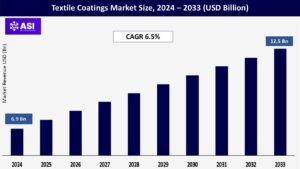
The rising demand for high-performance textiles in sectors such as automotive, healthcare, construction, and defense is a significant factor behind growth.
Coatings applied to textiles improve attributes such as water resistance, flame retardancy, UV protection, and antimicrobial properties, making them ideal for uses like airbags, personal protective equipment, tents, and insulation materials. As industries increasingly utilize more robust and functional materials, the need for coated textiles substantially increases.
Rapid urban growth, shifts in consumer habits, and increasing disposable incomes are driving the demand for high-performance apparel and home décor items. Coated fabrics are extensively utilized in rain gear, outdoor apparel, curtains, upholstery, and tablecloths due to their visual appeal and protective characteristics.
Furthermore, fashion trends that prioritize comfort, stain resistance, and weatherproof qualities are enhancing the use of textile coatings in casual and athletic wear. This trend is particularly noticeable in developing countries, where the growth of the middle class is propelling retail expansion.
These factors are collectively spurring innovations in environmentally friendly coatings, such as water-based and bio-based options, as producers strive to satisfy performance needs while adhering to environmental regulations.
A significant challenge in the textile coatings industry is the rising awareness of environmental effects and the need for regulatory adherence. Many conventional coatings, especially those made from PVC and solvent-based materials, emit volatile organic compounds (VOCs) and include harmful substances.
Regulatory organizations such as the EPA, REACH, and OEKO-TEX enforce stringent regulations on the usage of chemicals and emissions, pushing manufacturers to either invest in expensive reformulations or transition to environmentally friendly alternatives.
This leads to increased production costs and can make it difficult for small and medium-sized enterprises to compete effectively, thereby restraining market growth.
The textile coatings market is divided into four segments: coating type, application, coating method, and end use. Each of these segments provides distinct insights into consumer demand, product development, and market drivers across a range of industrial sectors.
The market for textile coatings is mostly divided into two segments: thermosets and thermoplastics. The market is dominated by thermoplastics like ethylene-vinyl acetate (EVA), polyurethane (PU), and polyvinyl chloride (PVC) because of their water resistance, flexibility, and durability.
Because PU coatings are waterproof and breathable, they are especially popular in clothing and sportswear. Despite growing environmental concerns, PVC is still widely used in industrial applications such as upholstery and tarpaulins.
However, thermosets—such as silicone and epoxy—are employed in high-performance settings where long-term durability, chemical stability, and heat resistance are critical, like in industrial or medical textiles.
Textile coatings are used in many different industries. A sizable portion is made up of clothing, which is driven by consumer demand for clothing that is UV, stain, and water resistant. Coated textiles are essential for safety and comfort in transportation applications, including airbags, seat fabrics, and automobile interiors.
Coatings are used in the industrial segment in filtration fabrics, tents, and conveyor belts that need to be strong and resistant to chemicals. Coated textiles are used in home furnishings such as tablecloths, curtains, and upholstery for both protection and aesthetics.
Coated textiles are crucial in the healthcare industry for creating antimicrobial, fluid-resistant bedding and gowns, and their use has increased dramatically since the COVID-19 pandemic.
Direct coating, foam coating, hot melt coating, and other techniques are important coating techniques. Because of its ease of use and adaptability, direct coating is widely used, particularly in home textiles and clothing. Foam coating, which is appropriate for upholstery and automotive textiles, provides cushioning and thermal insulation.
Hot melt coating is becoming more and more popular because it is an environmentally friendly, solvent-free method that works well for adhesive and technical applications. Other cutting-edge techniques serve specific, precise industrial applications.
The market is dominated by the consumer segment, which includes apparel and home furnishings. Then come industrial uses, which call for long-lasting high-performance coatings.
Coated textiles are used in the defence industry for protective gear, and they are also used in other industries like healthcare and the maritime industry for their longevity, performance, and hygienic qualities.
North America plays a crucial role in the global textile coatings market, fueled by advanced manufacturing capabilities, a high demand for technical textiles, and strict regulatory requirements. The United States is the leader in this region, supported by strong end-use sectors such as automotive, aerospace, defense, and healthcare.
Textile coatings are commonly utilized in applications such as seat covers, airbags, personal protective equipment (PPE), and hospital furnishings. The rising popularity of smart textiles and sustainable coating technologies is also driving R&D investment in this area.
In addition, the increasing demand for eco-friendly and non-toxic coatings, coupled with heightened consumer awareness regarding performance and safety, has further stimulated market growth.
Europe is a developed market with strict environmental regulations and advanced technology. Leading nations with a strong emphasis on creating premium, environmentally friendly, and functionally enhanced textiles include Germany, France, Italy, and the United Kingdom.
The demand for coated textiles in technical clothing, outdoor equipment, and interior components is fuelled by the region’s thriving fashion and automotive industries. Europe is also well-represented in the industrial and healthcare sectors, where coated textiles are utilised in protective gear, insulation, and filtration.
Furthermore, EU regulations supporting fluorine-free and low-VOC coatings are encouraging the use of greener substitutes and spurring regional innovation.
The textile coatings market is experiencing the highest growth in the Asia-Pacific region, spearheaded by nations such as China, India, Japan, South Korea, and Vietnam. This area enjoys advantages from a large textile manufacturing sector, cost-effective production, and a rise in local consumption.
Due to their extensive industrial operations and increasing need for coated textiles in sectors like automotive, construction, and apparel, China and India are the leading players. Japan and South Korea serve as centers of innovation, especially for high-performance coatings used in electronics, medical applications, and defense textiles.
The rapid growth of urban areas, increasing disposable incomes, and a rising preference for performance-oriented clothing and home textiles are further driving the market’s growth.
Latin America is experiencing moderate growth, mainly fueled by emerging economies such as Brazil, Mexico, and Argentina. The textile coatings market in the region is propelled by increasing demand in sectors like home furnishings, automotive, and industrial textiles.
Factors such as rising urbanization, enhanced living standards, and the growth of local manufacturing capabilities are contributing to this trend. Nonetheless, the market encounters challenges including inadequate technological infrastructure, reliance on imports for specialty chemicals, and economic volatility.
In spite of these obstacles, the expanding construction and healthcare industries are presenting new prospects for coated textile applications.
The Middle East and Africa region is becoming a notable market for textile coatings, with growth fueled by advancements in infrastructure, modernization of defense, and increasing healthcare demands.
Nations such as Saudi Arabia, the UAE, South Africa, and Egypt are at the forefront of the demand for coated textiles utilized in protective apparel, tents, geotextiles, and medical products.
However, the rapid growth of the market is hindered by a lack of local manufacturing capabilities and regulatory obstacles. Despite this, a rise in investment toward industrial development, a growing population, and heightened awareness of functional fabrics are anticipated to enhance the demand for coated textiles in the upcoming years.
The market was valued at USD 6.9 billion in 2024.
The market is projected to grow at a CAGR of 6.5% from 2025 to 2033.
Thermoplastics segment holds the largest market share.
Asia-Pacific is expected to witness the highest growth rate.
Major players include Covestro AG, Huntsman International LLC, Solvay S.A., Lubrizol Corporation, and BASF SE.
1.1 Summary
1.2 Research methodology
2.1 Particulate Adjuvants
2.2 Aluminum-Based Adjuvants
2.3 Toll- Like Receptor Agonists
3.1 Drivers
3.2 Geopolitical Impact
3.3 Human Factors
3.4 Technology Factors
4.1 Porters Five Forces Analysis
4.2 Value Chain Analysis
4.3 Average Pricing Analysis
4.4 M & A, Agreements & Collaboration Analysis
5.1 Textile Coatings Market , By Product Type
5.1.1 Introduction
5.1.2 Market Size & Forecast
5.2 Textile Coatings Market, By Application
5.3 Textile Coatings Market, By End User
6.1 North America , Textile Coatings Market, By Country
6.1.1 Textile Coatings Market , By Product Type
6.1.2 Textile Coatings Market, By Application
6.1.3 Textile Coatings Market, By End User
6.2 U.S.
6.2.1 Textile Coatings Market , By Product Type
6.2.2 Textile Coatings Market, By Application
6.2.3 Textile Coatings Market, By End User
6.3 Canada
7.1 U.K.
7.2 Germany
7.3 France
7.4 Spain
7.5 Italy
7.6 Russia
7.7 Nordic
7.8 Benelux
7.9 The Rest of Europe
8.1 China
8.2 South Korea
8.3 Japan
8.4 India
8.5 Australia
8.6 Taiwan
8.7 South East Asia
8.8 The Rest of Asia-Pacific
9.1 UAE
9.2 Turkey
9.3 Saudi Arabia
9.4 South Africa
9.5 Egypt
9.6 Nigeria
9.7 Rest of MEA
10.1 Brazil
10.2 Mexico
10.3 Argentina
10.4 Chile
10.5 Colombia
10.6 Rest of Latin America
11.1 Global Market Share (%) By Players
11.2 Market Ranking By Revenue for Players
11.3 Competitive Dashboard
11.4 Product Mapping