

Ticagrelor Market
Ticagrelor Market Share & Trends Analysis Report, By Product Type (Branded Drugs, Generic Drugs), By Dosage Form ( 60 mg Tablets, 90 mg Tablets, Other Formulations), By Indication ( Acute Coronary Syndrome (ACS), Myocardial Infarction, ,Stroke, Other Cardiovascular Conditions), By Distribution Channel ( Hospital Pharmacies, Retail Pharmacies, Online Pharmacies), By End User (Hospitals, Cardiology Clinics, Ambulatory Surgical Centers, Homecare Settings) – Industry Analysis Report, Regional Outlook, Growth Potential, Price Trends, Competitive Market Share & Forecast, 2025–2033.

Historical Period: 2019-2024
Forecast Period: 2025-2033
Report Code :
CAGR: 7.66%
Last Updated : August 20, 2025
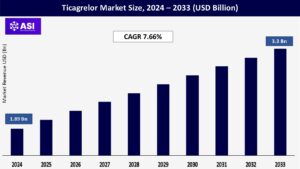
The global Ticagrelor Market was valued at approximately USD 1.89 billion in 2024 and is projected to reach USD 3.3 billion by 2033, growing at a CAGR of 7.66% during the forecast period (2025–2033).
Ticagrelor is a medicine taken by mouth that helps prevent serious heart problems like heart attacks and strokes. It is mainly used for people who have had a heart attack or have a condition called acute coronary syndrome (ACS), which means the heart isn’t getting enough blood. Ticagrelor belongs to a group of drugs that stop blood cells called platelets from sticking together and forming harmful clots. Unlike some older medicines, it works quickly and reliably because it doesn’t need to be changed by the body before it starts working. This makes it a popular choice for doctors. The demand for ticagrelor is growing as more people around the world suffer from heart diseases and as new and better treatments are developed. It is sold by the company AstraZeneca under the name Brilintaor or Brilique in some countries.
Some of the main features of ticagrelor are that it is absorbed into the body quickly, its effects can be reversed, and it doesn’t stay in the body too long, which helps doctors manage treatment more easily. As patents expire, more companies may start making their own versions of ticagrelor, especially in developing countries, which could make it more widely available and affordable.
Heart disease remaining the leading cause of death worldwide, there is an increasing need for effective antiplatelet therapies to prevent life-threatening events such as heart attacks and strokes. Aging populations, sedentary lifestyles, unhealthy diets, and growing rates of diabetes and hypertension are all contributing to the surge in CVD cases.
Ticagrelor, with its proven efficacy in reducing cardiovascular risks, is seeing greater demand as healthcare providers look for reliable and fast-acting treatments to manage these conditions.
The advancement of healthcare infrastructure and increasing awareness about heart health, especially in emerging markets. As countries in Asia, Latin America, and the Middle East continue to invest in better healthcare systems and expand access to treatment, more patients are being diagnosed and treated for heart-related conditions.
Alongside this, public health campaigns and educational efforts have led to earlier diagnosis and better management of risk factors. These developments are creating a favorable environment for the wider adoption of ticagrelor, especially as generic versions become available and lower the cost, making the drug more accessible to a broader patient base.
A major restraint in the ticagrelor market is its high cost compared to other antiplatelet drugs, particularly generic alternatives like clopidogrel. While ticagrelor offers superior efficacy and a faster onset of action, its premium pricing can limit accessibility, especially in low- and middle-income countries where healthcare budgets are constrained and out-of-pocket costs are high. This can lead physicians and healthcare providers to favor more affordable options, even if they are slightly less effective.
Additionally, in markets where insurance coverage is limited or reimbursement policies are restrictive, patients may struggle to afford long-term use of ticagrelor, which is typically prescribed for extended periods after a cardiac event. The high cost also poses challenges for widespread adoption in public healthcare systems, making pricing a critical barrier to market expansion, particularly in resource-limited settings.
| Report Metric | Details |
|---|---|
| Segmentations | |
| By Product |
Branded Drugs Generic Drugs
|
| By Dosage |
60 mg Tablets 90 mg Tablets Other Formulations |
| By Indication |
Acute Coronary Syndrome (ACS) Myocardial Infarction Stroke Other Cardiovascular Conditions
|
| By Distribution Channel |
Hospital Pharmacies Retail Pharmacies Online Pharmacies |
| By End User |
Hospitals Cardiology Clinics Ambulatory Surgical Centers Homecare Settings |
| Key Players |
|
| Geographies Covered | |
| North America |
U.S. |
| Europe |
U.K. |
| Asia Pacific |
China |
| Middle East & Africa |
Saudi Arabia |
| Latin America |
Brazil |
The Ticagrelor Market is segmented by product type ,Dosage form ,Indication ,Distribution Channels and End User. Each factor plays a crucial role in expanding patient access, improving treatment outcomes, and meeting regulatory standards in cardiovascular care.
Branded Drugs (e.g., Brilinta by AstraZeneca) currently dominate the market due to strong physician trust, proven clinical efficacy, and brand recognition. These drugs are often preferred in high-income countries and well-equipped hospital settings.
However, their high cost limits access in price-sensitive markets. Generic Drugs are rapidly gaining traction, particularly in developing countries and regions with cost-conscious healthcare systems. With patent expiration in several regions, generics are becoming more widely available, increasing affordability and boosting overall market penetration.
90 mg Tablets are commonly prescribed during the initial phase of treatment for acute coronary syndrome or myocardial infarction and represent a major share of the market due to their critical role in early intervention. 60 mg Tablets are typically used in the long-term maintenance phase post-cardiovascular events, especially when continued dual antiplatelet therapy (DAPT) is needed.
This dosage form supports sustained demand for chronic use. Other Formulations, such as modified-release or combination therapies, are limited but may see future development as companies explore new delivery formats to improve compliance and reduce side effects.
Acute Coronary Syndrome (ACS) is the leading indication for ticagrelor use, driven by rising incidence rates and guidelines recommending ticagrelor over older drugs like clopidogrel for high-risk patients. Myocardial Infarction represents a significant portion of the market, as ticagrelor is widely used in both prevention and post-event recovery due to its superior efficacy in reducing recurrent cardiac events.
Stroke is an emerging indication, although ticagrelor’s use here is more selective and often limited by clinical guidelines and risk-benefit considerations. Other Cardiovascular Conditions like peripheral artery disease or high-risk stable angina contribute to a smaller but growing segment as research continues to explore expanded use cases.
Hospital Pharmacies hold a dominant share due to the acute nature of cardiovascular events treated in hospital settings, especially immediately post-infarction or during procedures like angioplasty. Retail Pharmacies are important for continuing outpatient therapy, especially for long-term maintenance doses like the 60 mg formulation.
Online Pharmacies are gaining popularity due to convenience, rising digital health adoption, and the growth of e-prescriptions, particularly in urban areas and during the COVID-19 pandemic era.
Hospitals are the primary end users, especially for emergency care and initial diagnosis and treatment of ACS or myocardial infarction. They play a key role in initiating ticagrelor therapy. Cardiology Clinics serve as follow-up and maintenance centers, where long-term medication management decisions are made.
Ambulatory Surgical Centers may use ticagrelor as part of perioperative care in cardiovascular procedures, though their market share is smaller compared to hospitals. Homecare Settings are becoming more significant, particularly in developed countries, as more patients transition to managing chronic cardiovascular conditions at home with regular medication adherence and remote monitoring.
North America, particularly the United States, holds a dominant share in the global ticagrelor market due to a high prevalence of cardiovascular diseases, well-established healthcare infrastructure, and strong adoption of branded drugs like Brilinta.
The presence of major pharmaceutical players and favorable reimbursement policies further support market growth. The region also benefits from early access to new formulations, clinical trials, and robust physician awareness. However, rising healthcare costs are prompting a gradual shift toward generic alternatives.
Europe is the second-largest market, with countries like Germany, the UK, France, and Italy leading in usage. The region has a high burden of cardiac diseases and strong adherence to clinical guidelines that recommend ticagrelor for acute coronary syndrome and myocardial infarction.
The presence of universal healthcare systems ensures broad access, although cost-control measures in some countries encourage the use of generics. AstraZeneca’s strong regional presence and marketing efforts have supported Brilique’s uptake across major European markets.
The Asia Pacific region is experiencing the fastest growth in the ticagrelor market, driven by the rising incidence of heart disease, rapid urbanization, and improvements in healthcare access. Countries like China, India, Japan, and South Korea are seeing increased investment in healthcare infrastructure and growing awareness about preventive cardiology.
However, cost sensitivity and limited insurance coverage in some parts of the region hinder widespread adoption of branded drugs, creating strong opportunities for generic ticagrelor manufacturers.
The ticagrelor market in Latin America is moderately growing, with Brazil, Mexico, and Argentina being the key contributors. The increasing burden of non-communicable diseases like hypertension and diabetes, which are major risk factors for cardiovascular conditions, is boosting demand.
However, economic constraints, uneven healthcare access, and limited awareness pose challenges. Growth is expected as more countries expand their public healthcare coverage and as generic versions become more widely available.
The MEA region represents a smaller but gradually expanding market. Countries like Saudi Arabia, the UAE, and South Africa are showing growing demand for advanced cardiovascular treatments, supported by rising healthcare investments and government-led health initiatives.
However, large parts of the region still face limited access to advanced therapies, low physician awareness, and budget constraints. Despite these challenges, the market holds potential due to increasing diagnosis rates and strategic entry of global pharmaceutical companies.
The market was valued at USD 1.89 billion in 2024.
The market is projected to grow at a CAGR of 7.66% from 2025 to 2033.
Branded Drugs hold the largest market share.
The North America and Europe region is expected to witness the highest growth rate.
Major players include AstraZeneca ,Teva Pharmaceuticals and Mylan N.V.
1.1 Summary
1.2 Research methodology
2.1 Research Objectives
2.2 Market Definition
2.3 Limitations & Assumptions
2.4 Market Scope & Segmentation
2.5 Currency & Pricing Considered
3.1 Drivers
3.2 Geopolitical Impact
3.3 Human Factors
3.4 Technology Factors
4.1 Porters Five Forces Analysis
4.2 Value Chain Analysis
4.3 Average Pricing Analysis
4.4 M & A, Agreements & Collaboration Analysis
5.1 Ticagrelor Market, By Product
5.1.1 Introduction
5.1.2 Market Size & Forecast
5.2 Ticagrelor Market, By Dosage Form
5.3 Ticagrelor Market, By End User
6.1 North America Ticagrelor Market, By Product
6.1.1 Ticagrelor Market, By Product
6.1.2 Ticagrelor Market, By Dosage Form
6.1.3 Ticagrelor Market, By Application
6.1.4 Ticagrelor Market, By End User
6.2 U.S.
6.2.1 Ticagrelor Market, By Product
6.2.2 Ticagrelor Market, By Technology
6.2.3 Ticagrelor Market, By Application
6.2.4 Ticagrelor Market, By End User
6.3 Canada
7.1 U.K.
7.2 Germany
7.3 France
7.4 Spain
7.5 Italy
7.6 Russia
7.7 Nordic
7.8 Benelux
7.9 The Rest of Europe
8.1 China
8.2 South Korea
8.3 Japan
8.4 India
8.5 Australia
8.6 Taiwan
8.7 South East Asia
8.8 The Rest of Asia-Pacific
9.1 UAE
9.2 Turkey
9.3 Saudi Arabia
9.4 South Africa
9.5 Egypt
9.6 Nigeria
9.7 Rest of MEA
10.1 Brazil
10.2 Mexico
10.3 Argentina
10.4 Chile
10.5 Colombia
10.6 Rest of Latin America
11.1 Global Market Share (%) By Players
11.2 Market Ranking By Revenue for Players
11.3 Competitive Dashboard
11.4 Product Mapping