

Tridecanol Market
Tridecanol Market Report & Trends Analysis Report, By Type (Synthetic Tridecanol (Dominant Segment), Natural Tridecanol), By Application (Surfactants (Largest Application), Lubricants, Coatings, Agrochemicals)– Industry Analysis Report, Regional Outlook, Growth Potential, Price Trends, Competitive Market Share & Forecast, 2025–2033.

Historical Period: 2019-2024
Forecast Period: 2025-2033
Report Code :
CAGR: 5.1%
Last Updated : March 7, 2026
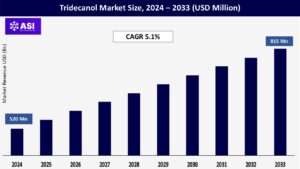
The global tridecanol market size was valued at approximately USD 520 million in 2024 and is projected to reach USD 815 million by 2033, growing at a CAGR of 5.1% during the forecast period.
Tridecanol, a long-chain fatty alcohol (C13), is a key intermediate in the production of surfactants, lubricants, plasticizers, coatings, and agrochemicals. Known for its excellent emulsifying, wetting, and lubricating properties, it plays a vital role in multiple industrial processes.
Growth is fueled by increasing demand for high-performance surfactants in detergents and personal care products, rising industrial lubricant usage, and expanding applications in environmentally friendly coatings and agrochemical formulations.
In the manufacturing of nonionic and anionic surfactants for detergents, cleansers, and personal care items, tridecanol is widely used. It is a favored component in both home and commercial cleaning formulas due to its capacity to create stable emulsions, improve wetting qualities, and increase cleaning effectiveness.
Demand for organically produced tridecanol is being driven by the growing trend toward biodegradable and bio-based surfactants, especially in North America and Europe. Large-scale detergent production is the main driver of the Asia-Pacific region’s strong demand.
Tridecanol is a useful addition in industrial and automotive lubricants due to its superior lubricating properties and chemical durability. It works as a coalesce agent in coatings, improving gloss, long-term durability, and film formation.
Environmentally friendly and low-VOC coatings are becoming more and more popular worldwide, which is speeding up their use in aqueous paint systems and opening up new business prospects for producers.
Although the proportion of naturally occurring fatty alcohols from vegetable oils is steadily rising, the production of tridecanol is still mostly dependent on petrochemical feedstocks like olefins.
Supply chain interruptions and fluctuations in crude oil prices can have a big impact on manufacturing expenses and profit margins. For manufacturers hoping to keep prices steady in cutthroat markets, this price sensitivity presents a problem.
Tridecanol must meet stringent purity and safety requirements set by regulatory agencies, such as the U.S. Food and Drug Administration (FDA), the European Chemicals Agency under REACH, and the U.S. Environmental Protection Agency (EPA), in particular end-use segments, such as agrochemicals, food-contact coatings, and cosmetics.
Fulfilling these compliance criteria can prolong product development and frequently result in increased production costs.
| Report Metric | Details |
|---|---|
| Segmentations | |
| By Type |
Synthetic Tridecanol (Dominant Segment) Natural Tridecanol |
| By Application |
Surfactants (Largest Application) Lubricants Coatings Agrochemicals |
| Key Players |
|
| Geographies Covered | |
| North America |
U.S. |
| Europe |
U.K. |
| Asia Pacific |
China |
| Middle East & Africa |
Saudi Arabia |
| Latin America |
Brazil |
The Tridecanol Market Report is segmented by Function (Acidulant, Emulsifier, Diuretic), By End-Use (Food & Beverage, Pharmaceuticals, Personal Care, Industrial).
Each factor plays a crucial role in enhancing patient safety, increasing the adoption of self-administered anticoagulant therapies, and supporting the development of more convenient, prefilled drug delivery systems that streamline treatment in the management of thromboembolic and cardiovascular conditions.
has the biggest market share because of its constant quality, cost-effective large-scale production, and applicability for a variety of industrial applications, such as coatings, lubricants, and detergents. It is the goto option for bulk manufacturing because of its reliable supply chain and affordable production prices.
The growing need for renewable, plant-based raw ingredients in surfactants, personal care formulations, and environmentally friendly cleaning products is expected to sustain natural tridecanol’s predicted fastest compound annual growth rate. The transition to bio based tridecanol in luxury product categories is being accelerated by growing consumer and regulatory attention to sustainability.
Accounts for the largest share of the market, with extensive use in detergents, emulsifiers, and dispersing agents across household cleaning, industrial cleaning, and personal care products. Its ability to enhance cleaning efficiency, wetting, and emulsion stability makes it indispensable in these sectors.
Utilized as an additive to improve wear resistance, reduce friction, and enhance lubrication efficiency in industrial machinery, automotive engines, and metalworking applications.
Functions as a coalescing agent in water-based paints and varnishes, improving flow, leveling, gloss, and film durability while supporting low-VOC, eco-friendly formulations.
Serves as a solvent and emulsifier in pesticide formulations, aiding in the even dispersion of active ingredients for improved efficacy.
Asia-Pacific leads the global tridecanol market, with China dominating production through its extensive petrochemical and oleochemical manufacturing base.
Strong demand stems from large-scale detergent manufacturing, growing automotive lubricant consumption, and expanding industrial coatings production. India, Japan, and Southeast Asian countries also contribute significantly to regional growth.
A mature yet stable market, driven by specialty surfactants, high-performance lubricants, and environmentally friendly coatings. The U.S. holds the largest share in the region, with market growth supported by stringent regulatory compliance, technological advancements, and the adoption of green chemistry practices.
Demand is fueled by strict environmental regulations and a pronounced shift toward bio-based and sustainable chemicals.
Germany, France, and the UK are key consumers, particularly in coatings, personal care products, and specialty surfactants. Manufacturers in the region are increasingly investing in renewable feedstocks to meet regulatory and consumer expectations.
Exhibiting steady growth driven by rising consumption in agrochemicals, construction coatings, and industrial applications. Brazil and Mexico lead demand in Latin America, while Saudi Arabia and the UAE are emerging as major markets in the Middle East due to industrial expansion and diversification initiatives.
The tridecanol market size in 2024 is USD 520 million.
The tridecanol market projected CAGR is 5.1%.
The Synthetic Tridecanol in Surfactant Applications dominates the tridecanol market.
The Asia-Pacific shows the highest growth potential, driven by large-scale production and industrial demand
1.1 Summary
1.2 Research methodology
2.1 Research Objectives
2.2 Market Definition
2.3 Limitations & Assumptions
2.4 Market Scope & Segmentation
2.5 Currency & Pricing Considered
3.1 Drivers
3.2 Geopolitical Impact
3.3 Human Factors
3.4 Technology Factors
4.1 Porters Five Forces Analysis
4.2 Value Chain Analysis
4.3 Average Pricing Analysis
4.4 M & A, Agreements & Collaboration Analysis
5.1 Tridecanol Market, By Type
5.1.1 Introduction
5.1.2 Market Size & Forecast
5.2 Tridecanol Market, By Application
6.1 North America Tridecanol Market, By Country
6.1.1 Tridecanol Market, By Type
6.1.2 Tridecanol Market, By Application
6.2.1 Tridecanol Market, By Type
6.2.2 Tridecanol Market, By Application
6.3 Canada
7.1 U.K.
7.2 Germany
7.3 France
7.4 Spain
7.5 Italy
7.6 Russia
7.7 Nordic
7.8 Benelux
7.9 The Rest of Europe
8.1 China
8.2 South Korea
8.3 Japan
8.4 India
8.5 Australia
8.6 Taiwan
8.7 South East Asia
8.8 The Rest of Asia-Pacific
9.1 UAE
9.2 Turkey
9.3 Saudi Arabia
9.4 South Africa
9.5 Egypt
9.6 Nigeria
9.7 Rest of MEA
10.1 Brazil
10.2 Mexico
10.3 Argentina
10.4 Chile
10.5 Colombia
10.6 Rest of Latin America
11.1 Global Market Share (%) By Players
11.2 Market Ranking By Revenue for Players
11.3 Competitive Dashboard
11.4 Product Mapping