

Tulathromycin Market
Tulathromycin Market Share and Trend Analysis, By Formulation (Injections, Gels, Creams, Ointments), By Application (Bovine Respiratory Disease (BRD), Swine Respiratory Disease (SRD), Foot Rot, Others), By Distribution Channel (Veterinary Hospitals and Clinics, Retail Veterinary Pharmacies, Online Platforms), By End User (Veterinary Professionals, Livestock Farmers, Animal Healthcare Institutions) Industry Analysis Report, Regional Outlook, Growth Potential, Price Trends, Competitive Market Share & Forecast, 2026–2033

Historical Period: 2019-2024
Forecast Period: 2025-2033
Report Code :
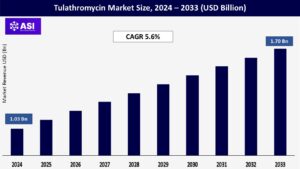
CAGR: 5.6%
Last Updated : April 2, 2026
The global tulathromycin market size was valued at USD 1.03 billion in 2024 and is projected to reach USD 1.70 billion by 2033, growing at a CAGR of 5.6% during the forecast period (2025–2033).
A common treatment for respiratory infections in pigs and cattle is tulathromycin, a macrolide antibiotic belonging to the triamilide group. When administered as a single long-acting injection, it fights off the main pathogens that cause swine respiratory disease (SRD) and bovine respiratory disease (BRD), solidifying its position as a top veterinary treatment.
Its one-dose method, which reduces handling and animal stress while providing long-lasting protection, is preferred by farmers and veterinarians. The need for dependable treatments like tulathromycin increases as farms get bigger and put more emphasis on preventing disease, which is in line with international initiatives to raise the bar for livestock care.
Its ability to effectively combat major infections supports contemporary methods aimed at effectively managing the health of herds. In order to increase its application across animal species, ongoing research investigates novel formulations and combinations.
Although there are worries about antibiotic resistance, guidelines encourage responsible use to maintain its efficacy. Cheap generic versions are making them more widely available, especially in developing nations, and assisting smaller farms in economically controlling outbreaks.
Tulathromycin continues to be essential for preserving livestock health and food production systems around the world by striking a balance between disease prevention, animal welfare, and sustainable practices.
The rise in respiratory illnesses in livestock, particularly in pigs and cattle, is one of the main causes of the demand for tulathromycin. One of the main causes of illness and mortality among cattle globally is bovine respiratory disease (BRD), which also causes large financial losses for farmers and the meat industry.
A common macrolide antibiotic used to treat and prevent BRD and related respiratory infections is tulathromycin. It is a recommended treatment option because it effectively combats important pathogens like Histophilus somni, Pasteurella multocida, and Mannheimia haemolytica.
Outbreaks of respiratory illnesses are frequently caused by the stress that animals endure during transportation, environmental changes, overcrowding, and inadequate ventilation. These infections are becoming more common as modern farming methods become more intensive.
Tulathromycin is frequently used as a first-line treatment in preventive veterinary care, which is becoming more and more important as a result. Furthermore, this medication’s quick action and long-lasting effects eliminate the need for repeated dosages, which lowers costs for large-scale operations.
All things considered, the growing demand and awareness for efficient respiratory disease management are anticipated to significantly fuel Tulathromycin’s market expansion in the upcoming years.
The growing demand for safe, high-quality meat and dairy products worldwide is another significant factor driving the tulathromycin market. Consumers are looking for more animal protein in their diets as populations and incomes rise, particularly in developing nations. The livestock industry is under pressure to keep flocks and herds healthy as a result of this change.
Any decline in animal health brought on by infections may result in decreased output, poorer-quality meat, and possible hazards to food safety. Tulathromycin is crucial in this situation because it keeps animals healthy and productive.
Furthermore, regulatory bodies in numerous nations are currently implementing more stringent policies concerning food safety and animal welfare. Demand for ethically and traceably produced animal products is also rising. Farmers and veterinarians can meet these standards while reducing financial losses from disease outbreaks thanks to tulathromycin’s strong safety profile and efficacy.
Large farms need to maintain operational efficiency, and its long-acting formula guarantees better compliance and fewer treatments. The use of trustworthy veterinary antibiotics like Tulathromycin is anticipated to increase gradually as consumers become more conscious of the source of their food and livestock producers concentrate more on disease control.
The growing concern about antibiotic resistance around the world is one of the main factors limiting the market for tulathromycin. The extensive and occasional overuse of antibiotics in livestock has alarmed medical professionals, researchers, and regulatory agencies over the years.
There is mounting evidence that excessive use of veterinary antibiotics can result in the emergence of drug-resistant bacteria that may be transferred to people through the environment, direct contact, or the food chain.
Owing to these worries, a number of nations have enacted stringent laws governing the use of antibiotics in animals, particularly those that are crucial to human health. Some areas are concerned about tulathromycin because it is a macrolide antibiotic. In some markets, farmers and veterinarians are urged or even mandated to use fewer of these antibiotics or switch to more natural supplements or vaccines.
Livestock producers are becoming more cautious as a result of these shifting regulations and growing consumer awareness of antibiotic-free meat and dairy. Tulathromycin demand may therefore be constrained, particularly in areas with strict antibiotic stewardship regulations. Despite the drug’s efficacy and widespread use in veterinary medicine, this resistance may impede market expansion if improperly addressed.
| Report Metric | Details |
|---|---|
| Segmentations | |
| By Formulation |
Injections Gels Creams Ointments |
| By Application |
Bovine Respiratory Disease (BRD) Swine Respiratory Disease (SRD) Foot Rot Others |
| By Distribution Channel |
Veterinary Hospitals and Clinics Retail Veterinary Pharmacies Online Platforms |
| By End User |
Veterinary Professionals Livestock Farmers Animal Healthcare Institutions |
| Key Players |
|
| Geographies Covered | |
| North America |
U.S. |
| Europe |
U.K. |
| Asia Pacific |
China |
| Middle East & Africa |
Saudi Arabia |
| Latin America |
Brazil |
The market for tulathromycin is divided into four formulation categories: injections, gels, creams, and ointments. Injectable formulations are the most widely used of these. This is due to the fact that tulathromycin is mostly administered as long-acting intramuscular or subcutaneous injections to treat respiratory conditions in pigs and cattle.
The injectable form eliminates the need for frequent dosing by ensuring faster absorption and a longer duration of action. Less frequently used, creams, gels, and ointments are usually used for uncommon localized infections. Though injections are anticipated to continue to be the most common, newer formulations may be developed in the upcoming years due to ongoing research and developments in drug delivery.
The market for tulathromycin is segmented by application, including foot rot, swine respiratory disease, and bovine respiratory disease (BRD). Because of the high prevalence of this disease in feedlot cattle, BRD continues to be the most popular application segment. Since respiratory infections in pigs have a major impact on growth rates and meat quality, SRD is another important application area.
On a smaller scale, the medication is also used to treat infectious foot rot in sheep. Tulathromycin is extremely useful in contemporary livestock health management due to its capacity to target a wide variety of respiratory pathogens.
The market is divided into three segments based on distribution: online platforms, retail veterinary pharmacies, and veterinary clinics and hospitals. This market is dominated by veterinary clinics and hospitals because using antibiotics requires a prescription and professional consultation.
These conditions guarantee that Tulathromycin is prescribed, dosed, and administered correctly. Additionally, important are retail veterinary pharmacies, especially in rural or semi-urban areas where farmers frequently buy their medications directly.
Although regulatory restrictions on online antibiotic sales continue to be a limiting factor in many countries, online distribution channels are gradually becoming more popular due to their convenience and wider availability.
Veterinary practitioners, livestock farmers, and animal healthcare facilities make up the end-user segment. Since tulathromycin is a prescription antibiotic that needs to be given under a doctor’s supervision, its main users are veterinarians.
Another important user group is livestock farmers, particularly in large-scale commercial farming, where productivity depends on disease prevention and control.
Tulathromycin is used in clinical trials and treatment trials by veterinary research facilities and animal healthcare facilities, which helps to ensure its continued safety and evaluation. Overall, the use of antibiotics like tulathromycin is rising as a result of farmers’ increased awareness and cooperation with veterinarians.
Because of its robust livestock industry and sophisticated veterinary healthcare system, North America dominates the tulathromycin market. With more than 95 million cattle and 75 million hogs in 2024, the United States has a high demand for beef and pork, which drives the widespread use of tulathromycin to treat respiratory illnesses such as BRD and SRD.
Government welfare programs, strict food safety regulations, and antibiotic stewardship encourage its responsible use. Important companies like Elanco and Zoetis support regional innovation and market expansion.
Due to stringent antibiotic-use regulations, Europe is a developed yet strictly regulated market for tulathromycin. In terms of veterinary and livestock care, nations like the UK, France, and Germany are at the forefront. The use of essential antibiotics, such as macrolides, is restricted and closely supervised under the EU’s One Health initiative.
In regions where outbreaks are common, tulathromycin is still essential for treating BRD and SRD. Improved disease surveillance, increased demand for meat free of antibiotics, and a modest recovery in veterinary antibiotic sales following the pandemic are all contributing factors to the steady growth.
Due to the fast growth of the livestock and poultry industries, the Asia Pacific is the region with the fastest rate of growth in the tulathromycin market. Important contributors include nations like Australia, Japan, China, and India.
Following African Swine Fever, China, which has the largest hog population in the world, has seen an increase in the demand for antibiotics. India’s enormous cattle population is experiencing an increase in respiratory problems.
Regulations are changing, but people are becoming more conscious of animal health. Concerns about food safety, increased veterinary access, and rising incomes are all contributing to the region’s market expansion.
The Middle East, Africa, and Latin America are expanding but still underdeveloped markets for tulathromycin. Large populations of pigs and cattle in Latin American nations like Brazil, Argentina, and Mexico fuel demand. With more than 230 million cattle in Brazil alone, respiratory illnesses are a serious issue.
Adoption is slowed in the Middle East and Africa by a lack of veterinary infrastructure, but government initiatives and outside assistance are assisting in the improvement of animal health systems. Tulathromycin demand is predicted to increase gradually in both regions as disease control gets better.
The market was valued at USD 1.03 billion in 2024.
The market is projected to grow at a CAGR of 5.6 % from 2025 to 2033.
Injections hold the largest market share.
The Asia Pacific region is expected to witness the highest growth rate.
Major players include Zoetis, Virbac, Huvepharma, Ceva, Norbrook, Boehringer
1.1 Summary
1.2 Research methodology
2.1 Research Objectives
2.2 Market Definition
2.3 Limitations & Assumptions
2.4 Market Scope & Segmentation
2.5 Currency & Pricing Considered
3.1 Drivers
3.2 Geopolitical Impact
3.3 Human Factors
3.4 Technology Factors
4.1 Porters Five Forces Analysis
4.2 Value Chain Analysis
4.3 Average Pricing Analysis
4.4 M & A, Agreements & Collaboration Analysis
5.1 Tulathromycin Market, By Formulation
5.1.1 Introduction
5.1.2 Market Size & Forecast
5.2 Tulathromycin Market, By Application
5.3 Tulathromycin Market, By Distribution Channel
5.4 Tulathromycin Market, By End User
6.1 North America Tulathromycin Market, By Country Type
6.1.1 Tulathromycin Market, By Formulation
6.1.2 Tulathromycin Market, By Application
6.1.3 Tulathromycin Market, By Distribution Channel
6.1.4 Tulathromycin Market, By End User
6.2 U.S.
6.2.1 Tulathromycin Market, By Formulation
6.2.2 Tulathromycin Market, By Application
6.2.3 Tulathromycin Market, By Distribution Channel
6.2.4 Tulathromycin Market, By End User
6.3 Canada
7.1 U.K.
7.2 Germany
7.3 France
7.4 Spain
7.5 Italy
7.6 Russia
7.7 Nordic
7.8 Benelux
7.9 The Rest of Europe
8.1 China
8.2 South Korea
8.3 Japan
8.4 India
8.5 Australia
8.6 Taiwan
8.7 South East Asia
8.8 The Rest of Asia-Pacific
9.1 UAE
9.2 Turkey
9.3 Saudi Arabia
9.4 South Africa
9.5 Egypt
9.6 Nigeria
9.7 Rest of MEA
10.1 Brazil
10.2 Mexico
10.3 Argentina
10.4 Chile
10.5 Colombia
10.6 Rest of Latin America
11.1 Global Market Share (%) By Players
11.2 Market Ranking By Revenue for Players
11.3 Competitive Dashboard
11.4 Product Mapping