

Tunable Diode Laser Analyzer (TDLA) Market
Tunable Diode Laser Analyzer (TDLA) Market Share & Trends Analysis Report, By Measurement Type (In-situ, Extractive), By Gas Analyzer Type (Oxygen (O₂), Ammonia (NH₃), Carbon Dioxide (CO₂), Methane (CH₄), Others), By Industry (Oil & Gas, Power Generation, Chemicals & Petrochemicals, Metals & Mining, Cement, Healthcare, Others) Industry Analysis Report, Regional Outlook, Growth Potential, Price Trends, Competitive Market Share & Forecast, 2025–2033.

Historical Period: 2019-2024
Forecast Period: 2025-2033
Report Code :
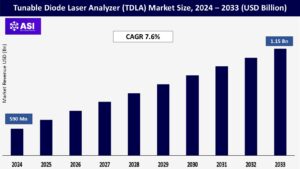
CAGR: 7.6%
Last Updated : November 29, 2025
The global Tunable Diode Laser Analyzer (TDLA) Market was valued at USD 590 million in 2024 and is projected to reach USD 1.15 billion by 2033, expanding at a CAGR of 7.6% during the forecast period (2025–2033).
Tunable Diode Laser Analyzers are high-precision gas measurement devices used to detect and monitor gases such as oxygen (O₂), carbon dioxide (CO₂), ammonia (NH₃), methane (CH₄), and others in real-time, non-contact, and highly selective ways. They rely on the principle of laser absorption spectroscopy, offering significant advantages over traditional gas analyzers, including fast response time, high sensitivity, low maintenance, and robust performance in harsh industrial environments.
These analyzers are widely deployed in industries like oil & gas, power generation, cement, chemicals & petrochemicals, metals & mining, and healthcare for emissions monitoring, combustion control, process optimization, and safety assurance. Growing emphasis on environmental compliance, carbon emission reduction, and industrial safety standards is driving rapid adoption globally.
The global push for decarbonization and cleaner industrial operations is driving adoption of TDLA systems. Regulatory bodies such as the U.S. Environmental Protection Agency (EPA), European Union (EU), and national environmental agencies in Asia-Pacific are enforcing stricter norms on greenhouse gas emissions.
Tunable diode laser analyzers provide accurate and continuous emissions monitoring for gases such as CO₂, NOx, and CH₄, helping industries meet compliance targets and avoid penalties.
Industries such as oil & gas, power generation, cement, and petrochemicals require real-time monitoring of gases to improve efficiency, ensure safety, and reduce downtime. TDLA devices offer non-contact measurement, which is highly effective in environments with extreme heat, pressure, or dust.
Their ability to provide fast, selective, and stable measurements makes them crucial for applications such as combustion optimization, leak detection, and hazardous gas monitoring.
Despite their advantages, the adoption of TDLA systems faces challenges due to high capital investment, calibration requirements, and the need for specialized expertise. Smaller industries or facilities with limited budgets may opt for traditional analyzers, even though they are less accurate.
Additionally, the integration of TDLA devices into existing process systems often requires skilled technicians, which increases operational costs and limits adoption in resource-constrained regions.
| Report Metric | Details |
|---|---|
| Segmentations | |
| By Measurement Type |
In-situ Extractive |
| By Gas Analyzer Type |
Oxygen (O₂) Ammonia (NH₃) Carbon Dioxide (CO₂) Methane (CH₄) Others |
| By Industry |
Oil & Gas Power Generation Chemicals & Petrochemicals Metals & Mining Cement Healthcare Others |
| Key Players |
|
| Geographies Covered | |
| North America |
U.S. |
| Europe |
U.K. |
| Asia Pacific |
China |
| Middle East & Africa |
Saudi Arabia |
| Latin America |
Brazil |
The Tunable Diode Laser Analyzer Market is segmented by Measurement Type, Gas Analyzer Type, and Industry.
North America represents a prominent market for Tunable Diode Laser Analyzers (TDLAs), largely driven by the region’s focus on environmental monitoring, industrial process optimization, and stringent emission control regulations.
The United States leads demand, with TDLAs widely deployed in oil & gas refineries, petrochemical plants, and power generation facilities for continuous gas monitoring and leak detection.
The shale gas boom and growth in LNG infrastructure have further increased the adoption of TDLA systems for safety, process efficiency, and compliance with Environmental Protection Agency (EPA) standards.
Canada contributes with strong applications in mining, pulp & paper, and energy sectors, where accurate gas detection is crucial for operational safety. The region also emphasizes research and innovation, with manufacturers introducing advanced TDLA systems featuring enhanced sensitivity, multi-gas detection, and integration with digital platforms.
Increasing investments in carbon capture and storage (CCS) projects also strengthen market prospects for TDLAs in North America.
Europe is another major market for TDLAs, underpinned by its strict regulatory framework on emissions and strong industrial base. Countries such as Germany, the U.K., and France are significant adopters, particularly in sectors like chemicals, pharmaceuticals, cement, and energy.
Germany’s advanced manufacturing and environmental initiatives have created substantial demand for TDLAs in industrial emissions monitoring and compliance with EU directives such as the Industrial Emissions Directive (IED).
The U.K. demonstrates strong adoption in oil & gas and power generation, while France and Italy focus on cement and chemical industries. The region’s increasing reliance on renewable energy sources and transition toward decarbonization are also pushing industries to adopt advanced gas analysis systems.
Additionally, European vendors are known for innovation in laser spectroscopy technologies, offering highly reliable and energy-efficient TDLA solutions. This strong technological ecosystem positions Europe as a critical hub for both demand and production of advanced laser analyzers.
Asia-Pacific is the fastest-growing region in the TDLA market, supported by industrialization, energy demand, and rising environmental awareness. China dominates adoption, with significant investments in coal-fired power plants, cement production, steel manufacturing, and chemical industries where TDLAs are used for process efficiency and emissions control.
Japan and South Korea showcase advanced applications in refining, petrochemicals, and semiconductor manufacturing, leveraging TDLAs for precise gas detection in cleanroom environments. India’s rapid industrial growth, coupled with rising government focus on emission reduction, is driving adoption in power generation and heavy industries.
Additionally, Southeast Asian countries are witnessing increased deployment of TDLA systems in cement, fertilizer, and natural gas processing facilities. Local manufacturing capabilities in China and favorable government initiatives in APAC make the region not only a high-demand market but also a competitive production hub for TDLA equipment.
Latin America’s TDLA market is developing steadily, with Brazil and Mexico as the leading adopters. In Brazil, the oil & gas industry, combined with expanding chemical and mining operations, supports demand for accurate and reliable gas analyzers.
Mexico’s refining and industrial sectors also contribute significantly, particularly in monitoring emissions and enhancing process safety. Other nations such as Chile and Argentina are gradually adopting TDLAs in cement and energy applications.
While the region faces challenges such as economic volatility and dependence on imports, ongoing modernization of industrial facilities and stricter environmental standards are expected to drive further growth.
The Middle East & Africa (MEA) market for TDLAs is expanding due to the region’s strong dependence on oil & gas, petrochemicals, and power generation. Countries like Saudi Arabia, the UAE, and Qatar are investing in TDLA systems for refining operations, natural gas processing, and compliance with global emission norms.
In Africa, South Africa leads adoption with demand from mining, cement, and energy industries. The region is gradually diversifying into cleaner energy sources, and TDLAs are playing a key role in ensuring efficient emissions monitoring.
Though high costs and import reliance pose challenges, increasing industrial investments and environmental initiatives are expected to foster steady growth of TDLA adoption in MEA.
The market was valued at USD 590 million in 2024.
The market is projected to grow at a CAGR of 7.6% (2025–2033).
Oxygen analyzers (O₂) hold the largest share due to their critical role in combustion and process safety.
The Asia-Pacific region is expected to grow fastest, driven by industrial expansion and stricter emission norms.
Major players include ABB, Siemens, Yokogawa, Emerson, and SICK AG.
1.1 Summary
1.2 Research methodology
2.1 Research Objectives
2.2 Market Definition
2.3 Limitations & Assumptions
2.4 Market Scope & Segmentation
2.5 Currency & Pricing Considered
3.1 Drivers
3.2 Geopolitical Impact
3.3 Human Factors
3.4 Technology Factors
4.1 Porters Five Forces Analysis
4.2 Value Chain Analysis
4.3 Average Pricing Analysis
4.4 M & A, Agreements & Collaboration Analysis
5.1 Tunable Diode Laser Analyzer (TDLA) Market, By Measurement Type
5.1.1 Introduction
5.1.2 Market Size & Forecast
5.2 Tunable Diode Laser Analyzer (TDLA) Market, By Gas Analyzer Type
5.3 Tunable Diode Laser Analyzer (TDLA) Market, By Industry
6.1 North America Tunable Diode Laser Analyzer (TDLA) Market, By Country
6.1.1 Tunable Diode Laser Analyzer (TDLA) Market, By Measurement Type
6.1.2 Tunable Diode Laser Analyzer (TDLA) Market, By Gas Analyzer Type
6.1.3 Tunable Diode Laser Analyzer (TDLA) Market, By Industry
6.2 U.S.
6.2.1 Tunable Diode Laser Analyzer (TDLA) Market, By Measurement Type
6.2.2 Tunable Diode Laser Analyzer (TDLA) Market, By Gas Analyzer Type
6.2.3 Tunable Diode Laser Analyzer (TDLA) Market, By Industry
6.3 Canada
7.1 U.K.
7.2 Germany
7.3 France
7.4 Spain
7.5 Italy
7.6 Russia
7.7 Nordic
7.8 Benelux
7.9 The Rest of Europe
8.1 China
8.2 South Korea
8.3 Japan
8.4 India
8.5 Australia
8.6 Taiwan
8.7 South East Asia
8.8 The Rest of Asia-Pacific
9.1 UAE
9.2 Turkey
9.3 Saudi Arabia
9.4 South Africa
9.5 Egypt
9.6 Nigeria
9.7 Rest of MEA
10.1 Brazil
10.2 Mexico
10.3 Argentina
10.4 Chile
10.5 Colombia
10.6 Rest of Latin America
11.1 Global Market Share (%) By Players
11.2 Market Ranking By Revenue for Players
11.3 Competitive Dashboard
11.4 Product Mapping