

Ventilation Fan Market
Ventilation Fan Market Share & Trends Analysis Report, By Type (Axial Fans, Centrifugal Fans, Cross Flow Fans, Mixed Flow Fans, Others), By Application (Residential, Commercial, Industrial, Others), By Installation (Wall-Mounted, Ceiling-Mounted, Window-Mounted, Ducted, Others), By End User (Households, Offices, Factories, Healthcare Facilities, Others) Industry Analysis Report, Regional Outlook, Growth Potential, Price Trends, Competitive Market Share & Forecast, 2025–2033.

Historical Period: 2019-2024
Forecast Period: 2025-2033
Report Code :
CAGR: 6.3%
Last Updated : December 3, 2025
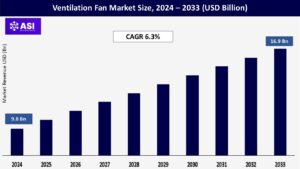
The global Ventilation Fan Market size was valued at USD 9.8 billion in 2024 and is projected to reach USD 16.9 billion by 2033, expanding at a CAGR of 6.3% during the forecast period (2025–2033).
Ventilation fans are essential equipment designed to circulate air, remove excess heat, humidity, smoke, and airborne contaminants, and maintain indoor air quality (IAQ) across residential, commercial, and industrial environments. They play a vital role in reducing risks of respiratory diseases, controlling odors, and ensuring thermal comfort and safety. With rising concerns around urbanization, pollution, energy efficiency, and occupational safety, ventilation fans are increasingly adopted in homes, offices, hospitals, factories, and commercial complexes.
Technological innovations such as energy-efficient motors, IoT-enabled smart fans, variable speed drives (VSDs), and noise-reduction systems are shaping modern ventilation systems. Governments worldwide are also introducing stringent indoor air quality and building ventilation regulations, particularly in the wake of COVID-19, further accelerating demand.
Urbanization, air pollution, and lifestyle changes are contributing to increasing awareness of the importance of clean indoor air. Poor ventilation leads to buildup of pollutants, allergens, and moisture, which can cause respiratory illnesses, allergies, and structural damage. Ventilation fans are thus increasingly adopted to maintain air circulation, especially in residential and healthcare facilities, boosting market demand.
Governments and regulatory bodies across the globe are emphasizing green buildings and energy-efficient infrastructure. Modern ventilation fans equipped with EC (electronically commutated) motors, smart sensors, and automated controls offer higher energy efficiency and sustainability compared to conventional fans. Their integration into smart homes and commercial building automation systems is driving market adoption, particularly in developed economies.
While ventilation fans are critical, their adoption is hindered by high initial installation costs, complex ducting systems, and recurring maintenance expenses. In large-scale industrial setups, energy consumption can be significant, further adding to operational costs. Small and medium businesses or households in cost-sensitive regions may prefer cheaper alternatives or delay upgrades, which can restrain market growth.
| Report Metric | Details |
|---|---|
| Segmentations | |
| By Type |
Axial Fans Centrifugal Fans Cross Flow Fans Mixed Flow Fans Others |
| By Application |
Residential Commercial Industrial Others |
| By Installation |
Wall-Mounted Ceiling-Mounted Window-Mounted Ducted Systems Others |
| By End User |
Households Offices Factories Healthcare Facilities Others |
| Key Players |
|
| Geographies Covered | |
| North America |
U.S. |
| Europe |
U.K. |
| Asia Pacific |
China |
| Middle East & Africa |
Saudi Arabia |
| Latin America |
Brazil |
The Ventilation Fan Market is segmented by Type, Application, Installation, and End User.
North America represents a significant market for ventilation fans, driven by the region’s focus on energy efficiency, indoor air quality, and advanced building infrastructure. The United States leads adoption, with strong demand across residential, commercial, and industrial sectors.
Increasing awareness about the health impacts of indoor air pollution, coupled with stringent ventilation standards set by organizations such as the Environmental Protection Agency (EPA) and the American Society of Heating, Refrigerating, and Air-Conditioning Engineers (ASHRAE), boosts the need for efficient ventilation systems.
Commercial spaces, hospitals, and manufacturing facilities widely adopt ventilation fans to maintain air circulation and comply with workplace safety norms. Canada also contributes to steady growth, supported by sustainable building initiatives and green construction programs.
Technological advancements, such as smart ventilation systems integrated with IoT and energy recovery features, are widely being deployed, reinforcing the region’s leadership in innovation-driven demand.
Europe holds a prominent share of the global ventilation fan market, supported by strict environmental regulations and widespread adoption of energy-efficient building technologies. Countries such as Germany, the U.K., and France are key markets, where ventilation fans are essential in both residential and commercial sectors to ensure compliance with the EU Energy Performance of Buildings Directive (EPBD) and indoor air quality standards.
Germany’s advanced manufacturing industry and the U.K.’s large commercial real estate sector drive consistent adoption. Southern European nations, including Italy and Spain, are experiencing rising demand due to urbanization and hospitality sector growth.
The region’s commitment to sustainability has spurred innovations in energy-saving fans, demand-controlled ventilation, and systems with low-noise operation. Moreover, Europe’s focus on retrofitting older buildings with modern ventilation solutions further supports the market’s expansion.
The growing adoption of centralized and decentralized ventilation systems in green buildings keeps Europe at the forefront of sustainable ventilation technologies.
Asia-Pacific is the fastest-growing region in the ventilation fan market, driven by rapid urbanization, industrialization, and growing construction activity. China leads with massive demand from residential apartments, industrial facilities, and large-scale commercial complexes.
With increasing concerns over indoor and outdoor pollution, Chinese consumers and industries are heavily investing in ventilation solutions. Japan and South Korea demonstrate strong adoption in technologically advanced residential and industrial setups, where smart, compact, and energy-efficient ventilation systems are increasingly used.
India’s booming real estate sector, combined with government initiatives promoting better housing standards, is driving growth in residential and small commercial applications.
Southeast Asian countries such as Indonesia, Thailand, and Vietnam are also emerging markets, with rising demand fueled by hospitality, healthcare, and office building projects. Furthermore, growing industrial safety regulations across APAC are pushing the adoption of industrial-grade ventilation fans, particularly in manufacturing, automotive, and chemical industries.
Latin America’s ventilation fan market is developing steadily, with Brazil and Mexico as the primary growth drivers. In Brazil, rising urban housing demand, coupled with industrial expansion, fuels consistent market adoption.
Mexico’s construction sector, along with commercial facilities such as shopping malls and offices, is witnessing greater demand for efficient ventilation systems. Other countries like Argentina, Chile, and Colombia are gradually adopting modern ventilation fans in healthcare and hospitality projects.
Economic constraints and reliance on imports pose challenges; however, growing awareness of energy efficiency and sustainable infrastructure development is expected to encourage broader adoption. Demand from the mining and manufacturing sectors also contributes to the industrial ventilation fan segment in the region.
The Middle East & Africa (MEA) region is witnessing increasing demand for ventilation fans, primarily due to its climate conditions, booming construction sector, and growing focus on indoor air quality.
In the Gulf Cooperation Council (GCC) countries such as Saudi Arabia, the UAE, and Qatar, the need for ventilation fans is high in commercial buildings, luxury residential projects, and hospitality facilities. The UAE, with its rapid real estate development and green building standards, leads adoption of energy-efficient ventilation systems.
In Africa, South Africa is the largest market, driven by industrial applications, healthcare infrastructure, and urban housing developments. Other African countries, including Nigeria and Kenya, are gradually expanding their adoption as urbanization rises. Despite challenges such as cost sensitivity and reliance on imported products, the MEA region shows strong potential due to increasing investments in large-scale infrastructure and smart city projects.
The ventilation fan market was valued at USD 9.8 billion in 2024.
The ventilation fan market is projected to grow at a CAGR of 6.3% (2025–2033).
The Residential application segment leads due to rising demand in homes and apartments.
The Asia-Pacific region is expected to register the fastest growth, driven by urbanization and industrial expansion.
Major players include Panasonic, Mitsubishi Electric, Delta Electronics, and Havells India.
1.1 Summary
1.2 Research methodology
2.1 Research Objectives
2.2 Market Definition
2.3 Limitations & Assumptions
2.4 Market Scope & Segmentation
2.5 Currency & Pricing Considered
3.1 Drivers
3.2 Geopolitical Impact
3.3 Human Factors
3.4 Technology Factors
4.1 Porters Five Forces Analysis
4.2 Value Chain Analysis
4.3 Average Pricing Analysis
4.4 M & A, Agreements & Collaboration Analysis
5.1 Ventilation Fan Market, By Type
5.1.1 Introduction
5.1.2 Market Size & Forecast
5.2 Ventilation Fan Market, By Application
5.3 Ventilation Fan Market, By Installation
5.4 Ventilation Fan Market, By End User
6.1 North America Ventilation Fan Market, By Country
6.1.1 Ventilation Fan Market, By Type
6.1.2 Ventilation Fan Market, By Application
6.1.3 Ventilation Fan Market, By Installation
6.1.4 Ventilation Fan Market, By End User
6.2 U.S.
6.2.1 Ventilation Fan Market, By Type
6.2.2 Ventilation Fan Market, By Application
6.2.3 Ventilation Fan Market, By Installation
6.2.4 Ventilation Fan Market, By End User
6.3 Canada
7.1 U.K.
7.2 Germany
7.3 France
7.4 Spain
7.5 Italy
7.6 Russia
7.7 Nordic
7.8 Benelux
7.9 The Rest of Europe
8.1 China
8.2 South Korea
8.3 Japan
8.4 India
8.5 Australia
8.6 Taiwan
8.7 South East Asia
8.8 The Rest of Asia-Pacific
9.1 UAE
9.2 Turkey
9.3 Saudi Arabia
9.4 South Africa
9.5 Egypt
9.6 Nigeria
9.7 Rest of MEA
10.1 Brazil
10.2 Mexico
10.3 Argentina
10.4 Chile
10.5 Colombia
10.6 Rest of Latin America
11.1 Global Market Share (%) By Players
11.2 Market Ranking By Revenue for Players
11.3 Competitive Dashboard
11.4 Product Mapping