

Nespresso Capsules Market
Nespresso Capsules Market Size, Market Share & Trends Analysis Report, By Type (Intenso, Espresso, Pure Origine, Lungo, Decaffeinato), By Application (Home Use, Commercial Use), By Sales-Channel (Online Retailers, Supermarkets and Hypermarkets, Coffee Shops and Cafes, Specialty Stores, Direct Sales (Company Websites), Others), By Region (North America, Europe, Asia-Pacific, Middle East and Africa, Latin America) – Industry Analysis Report, Regional Outlook, Growth Potential, Price Trends, Competitive Market Share & Forecast, 2025–2033

Historical Period: 2019-2024
Forecast Period: 2025-2033
Report Code : ASIFBR1016
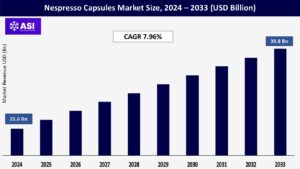
CAGR: 7.96%
Last Updated : November 7, 2025
The global Nespresso capsules market is poised for substantial growth, driven by the rising demand for convenient, high-quality coffee experiences. Valued at USD 21.6 billion in 2024, the market is projected to reach USD 39.8 billion by 2033, expanding at a CAGR of 7.96% during 2025-2033.
Key growth factors include the increasing popularity of single-serve coffee machines, premium coffee consumption trends, and technological advancements in capsule design. Sustainability efforts, such as biodegradable and recyclable capsules, are also shaping market dynamics.
However, challenges such as environmental concerns, competitive alternatives, and price sensitivity may impact growth. Despite these hurdles, the market is expected to thrive due to product innovations, expanding consumer preferences, and regional market penetration. As coffee culture evolves, Nespresso capsules remain a strong contender in the premium coffee segment, offering a blend of convenience, quality, and sustainability.
Global coffee consumption continues to rise, especially in emerging markets. The International Coffee Organization (ICO) reported a global consumption of over 178 million 60-kg bags in 2023, a 2.1% increase from the previous year. One of the primary drivers of the Nespresso capsules market is the increasing consumer demand for convenience without compromising quality The ease of use and quick preparation offered by Nespresso machines appeal to busy consumers seeking high-quality coffee without the hassle. Modern consumers, especially millennials and urban professionals, are shifting toward single-serve coffee solutions that offer quick preparation, consistent taste, and premium quality all of which are delivered by Nespresso capsules.
According to the National Coffee Association (NCA), over 42% of American coffee drinkers use single-serve machines at home as of 2023, up from just 29% in 2016. This demand is further amplified by the growing work-from-home culture post-COVID-19, with consumers investing more in home coffee appliances and looking for barista-quality beverages in the comfort of their own homes. Nespresso machines paired with compatible capsules provide a seamless way to achieve this, leading to a sharp increase in capsule sales.
As consumers become more discerning, there is a growing demand for premium coffee experiences, driving the popularity of Nespresso’s diverse capsule offerings. The global coffee culture has undergone a significant transformation over the past decade, marked by a “premiumization” trend. Consumers are increasingly seeking higher-quality, ethically sourced, and flavor-rich coffee options. Nespresso has capitalized on this shift by offering a wide range of capsules such as Intenso, Pure Origine, and Lungo that highlight unique bean origins, roast profiles, and aromatic notes.
In 2023, the specialty coffee segment represented 62.1% of the global coffee market value, and that percentage continues to rise annually. Nespresso’s product strategy aligns perfectly with this trend, catering to both novice drinkers and connoisseurs with diverse preferences. This evolution in taste has increased brand loyalty and repeat purchases among premium segment consumers.
The single serve coffee sold heavily over the past decade, and with that growth has come a wave of new entrants, particularly in the market for Nespresso-compatible capsules. Dozens of brands, including Starbucks, Lavazza, Illy, Peet’s Coffee, and local boutique roasters, now offer capsules compatible with Nespresso OriginalLine machines. These alternatives are often priced 20–40% lower than official Nespresso capsules, making them highly attractive to cost-conscious consumers. Moreover, some of these third-party brands are offering added value in the form of specialty blends, fair-trade sourcing, compostable materials, and unique regional flavors, increasing their appeal.
The compatibility of these capsules with Nespresso machines blurs brand loyalty, as consumers now have access to a broader selection without needing to invest in new equipment. This growing price-sensitive and variety-seeking customer base is eroding Nespresso’s once unchallenged hold over its ecosystem. While Nespresso retains strong customer loyalty, particularly in the VertuoLine (which is more proprietary and less penetrated by third-party brands), the OriginalLine continues to face intense competitive pressure, especially in Europe and North America.
To remain competitive, Nespresso is compelled to invest heavily in innovation, marketing, and customer engagement, which can squeeze profit margins. It also forces the brand to explore new distribution models and rethink exclusivity strategies, especially as retailers and online platforms increasingly promote Nespresso-compatible products under private labels.
| Report Metric | Details |
|---|---|
| Segmentations | |
| By Type |
Intenso Espresso Pure Origine Lungo Decaffeinato |
| By Application |
Home Use Commercial Use |
| By Sales Channel |
Online Retailers Supermarkets and Hypermarkets Coffee Shops and Cafes Specialty Stores Direct Sales (Company Websites) Others |
| Key Players |
Nespresso (Nestlé) Starbucks. Illy L’OR Espresso Coffee Nirvana Peet’s Coffee Jacobs Douwe Egberts Pro Caffè Vergnano Caramelly Blue Tokai Coffee Roasters Coffeeza |
| Geographies Covered | |
| North America |
U.S. |
| Europe |
U.K. |
| Asia Pacific |
China |
| Middle East & Africa |
Saudi Arabia |
| Latin America |
Brazil |
Based on the type segment, the Nespresso Capsules market is categorized into Intenso, Espresso, Pure Origine, Lungo, and Decaffeinato capsules.
Intenso Capsules are particularly favored in regions with a cultural inclination toward rich espresso-based beverages such as Italy, Spain, and Latin America. Their intense aroma and full-bodied character appeal to seasoned coffee drinkers, contributing to their growing popularity in both home and commercial settings.
Espresso Capsules are a widely consumed type globally, due to their classic taste and universal appeal. In 2024, they held the largest market share within the type segment. Their widespread use in residential settings and cafés highlights their versatility and convenience. The Espresso range continues to attract both traditional coffee enthusiasts and newer consumers entering the premium coffee market.
Pure Origine Capsules capsules cater to a niche yet expanding segment of consumers interested in exploring flavor nuances from specific regions such as Ethiopia, Colombia, and India. Their popularity is also rising among millennials and Gen Z consumers who seek artisanal and sustainable coffee options.
Lungo Capsules are designed for a longer extraction process, producing a milder yet aromatic brew. They are preferred in Northern European countries and parts of North America, where consumers often favor larger cups of coffee. In 2024, Lungo capsules experienced growth as part of the broader trend toward customized coffee consumption and hybrid brewing styles that blend espresso and filter coffee characteristics.
Decaffeinato Capsules cater to health-conscious consumers and those with caffeine sensitivities. While historically occupying a smaller market segment, Decaffeinato capsules have seen rising adoption due to increased awareness of health and wellness. Countries with aging populations and growing decaf trends, such as Japan and Germany, are witnessing a notable uptick in Decaffeinato sales.
Based on the application segment, the Nespresso Capsules market is segmented into Home Use and Commercial Use.
Home Use dominated the application segment in 2024, accounting for more than 56.3% of the global market share. The proliferation of affordable single-serve machines and the consumer shift toward at-home gourmet coffee experiences are key growth drivers. Over 30% of U.S. households owned a single-serve coffee maker, a figure expected to grow with evolving work-from-home trends. The convenience, consistency, and wide variety of flavors available in Nespresso capsules make them particularly appealing for daily home consumption.
Commercial Use is also growing rapidly, with Nespresso Professional solutions being adopted across offices, hospitality, and the foodservice sector. Businesses are increasingly recognizing the value of offering high-quality coffee as part of their customer and employee experience. In hotels and high-end retail, Nespresso machines are often positioned as a luxury amenity. The commercial application is gaining traction in co-working spaces and boutique cafés, especially in urban centers across Europe and Asia-Pacific. This segment is projected to grow at a CAGR of 7.8% between 2026 and 2033.
Based on the sales channel segment, the Nespresso Capsules market is divided into Online Retailers, Supermarkets and Hypermarkets, Coffee Shops and Cafes, Specialty Stores, Direct Sales (Company Websites), and Others.
Online Retailers have emerged as a dominant sales channel, driven by the convenience of doorstep delivery, wide product availability, and subscription models. In 2024, e-commerce platforms accounted for nearly 38% of global Nespresso capsule sales, fueled by strong performances on Amazon, Walmart.com, and regional platforms such as Flipkart (India) and Tmall (China). Online channels also enable access to limited editions and specialty blends, enhancing consumer engagement.
Supermarkets and Hypermarkets remain a vital part of the distribution strategy, particularly in Europe and North America. These channels benefit from high visibility, consumer trust, and impulse purchasing behavior. Nespresso capsules are prominently displayed alongside coffee machines and accessories, making them accessible to a broader demographic. In 2024, this segment held a 26.4% share of the market and continues to benefit from private-label collaborations with large retail chains.
Coffee Shops and Cafes represent both a direct revenue stream and a strategic brand positioning platform. Specialty cafés and independent coffee shops often use Nespresso Professional systems to serve premium-quality espresso, introducing new consumers to the brand. This segment is especially relevant in urban areas where convenience and speed are critical factors in customer choice.
Specialty Stores, including boutique coffee retailers and gourmet food stores, provide a curated shopping experience for coffee enthusiasts. These outlets often carry exclusive blends, limited editions, and high-end accessories, appealing to consumers seeking a more personalized experience. Though smaller in volume, this segment boasts higher average spending per customer.
Direct Sales via Company Websites allow Nespresso to maintain full control over the customer journey, brand presentation, and pricing strategy. Through its official platform, the company offers personalized recommendations, capsule recycling options, and loyalty programs such as Nespresso Club. In 2024, this channel played a pivotal role in customer retention and engagement, especially in mature markets like France, Switzerland, and the United Kingdom.
Dominating the global market, North America accounted 39.2% of the revenue in 2024, with the United States leading the demand for premium coffee products. The United States is a combination of high disposable income, a well-established coffee culture, and a growing preference for premium at-home coffee experiences. According to the National Coffee Association (NCA), 63% of American adults drink coffee daily, and single-serve brewing systems are present in over 40% of U.S. households. Canada, with its growing specialty coffee scene and eco-conscious consumers, has also emerged as a key market. Nespresso’s sustainability initiatives, including capsule recycling programs, align well with Canadian values, further driving brand loyalty and sales.
Europe remains a strong market for Nespresso, driven by a rich coffee culture and high consumer spending on premium beverages. Countries such as France, Switzerland, Germany, and Italy are among the top consumers of Nespresso capsules, thanks to their appreciation of espresso-based drinks and premium lifestyle products.
The Asia-Pacific region is experiencing rapid growth, with a projected CAGR of 10.2% from 2024 to 2031. Countries like China and Japan are witnessing increased adoption of single-serve coffee machines. China is a major growth frontier and expanding base of young, urban professionals who value convenience, innovation, and luxury branding. Nespresso has responded to this demand with localized marketing, celebrity partnerships, and expansion of its physical boutiques in Tier 1 and Tier 2 cities.
Latin America, while traditionally known as a coffee-producing region, is increasingly becoming a consumer market for premium coffee products, including Nespresso capsules. In 2024, the region contributed modestly to global revenue but is experiencing steady growth, especially in Brazil, Mexico, Chile, and Colombia.
Brazil, the world’s largest coffee producer, is witnessing a cultural shift as younger consumers explore diverse coffee preparation methods, moving beyond traditional filtered coffee. Nespresso’s range of single-origin and specialty blends resonates well with this demographic, who are drawn to global brands with sustainable sourcing credentials. Localized product offerings and capsule varieties tailored to Brazilian palates have also improved penetration.
The market in this region is emerging, with a CAGR of 7.9% expected from 2024 to 2031, as urbanization and disposable incomes rise. In the Middle East, countries like the United Arab Emirates, Saudi Arabia, and Qatar are seeing rapid growth in premium coffee consumption.
The nespresso capsules market is valued at approximately USD 21.6 billion in 2024.
The nespresso capsules market is expected to grow at a CAGR of 7.96% from 2025 to 2031.
Espresso capsules currently dominate the market in terms of volume and value.
Home use leads the market due to rising demand for convenient premium coffee.
Online retailers and supermarkets are the most prominent sales channels.
North America holds the largest market share of nespresso capsules in 2024.
Growth is driven by rising global coffee consumption and demand for premium single-serve options.
1.1 Summary
1.2 Research methodology
2.1 Research Objectives
2.2 Market Definition
2.3 Limitations & Assumptions
2.4 Market Scope & Segmentation
2.5 Currency & Pricing Considered
3.1 Drivers
3.2 Geopolitical Impact
3.3 Human Factors
3.4 Technology Factors
4.1 Porters Five Forces Analysis
4.2 Value Chain Analysis
4.3 Average Pricing Analysis
4.4 M & A, Agreements & Collaboration Analysis
5.1 Global Nespresso Capsules Market, By Type
5.1.1 Introduction
5.1.2 Market Size & Forecast
5.2 Global Nespresso Capsules Market, By Application
5.3 Global Nespresso Capsules Market, By Sales Channel
6.1 North America Nespresso Capsules Market, By Country
6.1.1 Nespresso Capsules Market, By Type
6.1.2 Nespresso Capsules Market, By Applications
6.1.3 Nespresso Capsules Market, By Sales Channel
6.2 U.S.
6.2.1 Nespresso Capsules Market, By Type
6.2.2 Nespresso Capsules Market, By Application
6.2.3 Nespresso Capsules Market, By Sales Channel
6.3 Canada
7.1 U.K.
7.2 Germany
7.3 France
7.4 Spain
7.5 Italy
7.6 Russia
7.7 Nordic
7.8 Benelux
7.9 The Rest of Europe
8.1 China
8.2 South Korea
8.3 Japan
8.4 India
8.5 Australia
8.6 Taiwan
8.7 South East Asia
8.8 The Rest of Asia-Pacific
9.1 UAE
9.2 Turkey
9.3 Saudi Arabia
9.4 South Africa
9.5 Egypt
9.6 Nigeria
9.7 Rest of MEA
10.1 Brazil
10.2 Mexico
10.3 Argentina
10.4 Chile
10.5 Colombia
10.6 Rest of Latin America
11.1 Global Market Share (%) By Players
11.2 Market Ranking By Revenue for Players
11.3 Competitive Dashboard
11.4 Product Mapping