

Optical Coherence Tomography (OCT) Market
Optical Coherence Tomography (OCT) Market Segmentation Share & Trends Analysis Report, By Type (Handheld OCT Devices, Table-top OCT Systems, Catheter-based OCT Devices, Doppler OCT Devices) By End User (Hospitals, Clinics, Ambulatory Surgical Centers, Diagnostic Imaging Centers, Research & Academic Institutes) Industry Analysis Report, Regional Outlook, Growth Potential, Price Trends, Competitive Market Share & Forecast, 2025–2033

Historical Period: 2019-2024
Forecast Period: 2025-2033
Report Code :
CAGR: 9.5%
Last Updated : August 29, 2025
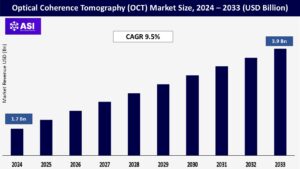
The global Optical Coherence Tomography (OCT) Market was valued at approximately USD 1.7 billion in 2024 and is projected to reach USD 3.9 billion by 2033, growing at a CAGR of 9.5% during the forecast period (2025–2033).
Optical Coherence Tomography (OCT) is a non-invasive imaging technique that produces high-resolution cross-sectional images of biological tissues, used widely in ophthalmology, cardiology, dermatology, and oncology. OCT permits early disease diagnosis and ongoing monitoring and provides optically detailed visualization of microstructural layering of tissues, particularly in retinal structures and the coronary arteries. Typically, OCT utilizes light waves to image any surface in real-time and at micrometer resolution, while remaining entirely non-contact. In this regard, OCT has become essential in diagnosing glaucoma, age-related macular degeneration (AMD) and diabetic retinopathy. In cardiology, catheter based optical coherence tomography (OCT) is used increasingly to assess plaque characteristics of order to facilitate plaque delivery and stenting. Market growth is driven by the increasing prevalence of chronic eye disorders, technological advances in swept-source and spectral-domain OCT, and increasing deployment of portable and handheld OCTs. Expanding adoption of OCT in cardiology and dermatology, additional funding in healthcare, and the increasing demand for non-invasive methods for diagnosis contribute positively to market growth.
The increase in the global burden of chronic eye diseases, including age-related macular degeneration (AMD), diabetic retinopathy, and glaucoma, has been a significant driver and contributor to the increased demand for optical coherence tomography (OCT). The World Health Organization (WHO) data shows that at least 2.2 billion people globally have a vision impairment, and more than 1 billion of these cases could have been avoided, or remain unaddressed.
Since early detection is key to preventing irreversible vision loss, ophthalmologists turn to OCT as the first line of imaging technology, as it can provide high resolution, cross-sectional photographs of the retina in a real-time and non-invasive manner. Diabetic retinopathy is rapidly increasing associated with the global epidemic of diabetes; the International Diabetes Federation estimates there are over 537 million adults living with diabetes globally in 2021 and estimates this number will increase to 643 million by 2030.
This illustrates the ability of OCT to provide the ability to trying to identify retinal layers, and provide clinicians the ability to identify early disease, including microaneurysms, retinal edema, and neovascularization. Glaucoma is also often asymptomatic in the early stages, and therefore it is important a patient has standardized and regular monitoring of the retinal nerve fiber layer (RNFL), which has been possible using OCT. The rise of these conditions, coupled with the increasing awareness, is certainly leading to rapid escalation of implementation of OCT across the world in primary eye care.
Rapid advancements in the OCT imaging technologies—including spectral-domain optical coherence tomography (SD-OCT), swept-source optical coherence tomography (SS-OCT), and optical coherence tomography angiography (OCTA)—have expanded the capabilities of the technology from solely ophthalmology applications towards usefulness in cardiology, dermatology, and oncology.
The enhancements to OCT in terms of tissue penetration depth, image acquisition speed, and image resolution enable more applications related to intravascular imaging, assessing tumor margins, and diagnosing skin lesions. In cardiology specifically, catheter-based intravascular OCT has become a standard of care in many institutions as part of percutaneous coronary interventions (PCI), and it allows physicians to appropriately position stents and is recommended to examine plaque morphology.
One such system is the Dragonfly™ OPTIS™ imaging catheter from Abbott, which integrates OCT to provide real-time images of coronary arteries to improve outcomes during coronary intervention. Similar advancements are occurring in dermatology for OCT imaging of basal cell carcinoma and actinic keratosis, enabling more confident non-invasive diagnoses and help to avoid unnecessary biopsies.
Even more exciting in 2024 is that AI-enabled optical coherence tomography systems are beginning to be marketed that can analyze and interpret images and ultimately, decrease turnaround time. Major competitive players such as Carl Zeiss Meditec and Heidelberg Engineering have incorporated artificial intelligence into their products to classify disease and determine progression. A combination of these elements enhances diagnostic accuracy within the field and support expansion beyond to other sectors.
One of the biggest barriers to growth of the optical coherence tomography (OCT) market is the high price of OCT systems. This is especially true for advanced OCT systems such as spectral-domain (SD-OCT), and swept-source OCT (SS-OCT), which range between USD 50,000 and USD 150,000 and more, depending on the configuration and type of technology.
As a result, many small clinics, primary healthcare, and hospitals in developing and under-developed areas cannot afford these prices. Maintenance costs, software licensing, and the need for qualified personnel to operate the devices are added pressure points for health care providers.
In developing countries, such as sub-Saharan Africa, parts of South East Asia, and Latin America, where health budgets are limited, essential services have priority, and in many cases, even small private clinics do not view SD-OCT and SS-OCT technology a priority. As a result, many regions already lacking infrastructure for the delivery of eye care, will likely not see market penetration of OCT technology, which will continue to hinder global growth of medical diagnostics for OCT.
| Report Metric | Details |
|---|---|
| By Type |
Handheld OCT Devices Table-top OCT Systems Catheter-based OCT Devices Doppler OCT Devices
|
| By End User |
Hospitals Clinics Ambulatory Surgical Centers Diagnostic Imaging Centers Research & Academic Institutes
|
| Key Players |
Carl Zeiss Meditec Heidelberg Engineering Optovue Inc. Topcon Corporation NIDEK Co., Ltd. Canon Inc. Leica Microsystems Santec Corporation Abbott Laboratories Thorlabs Inc. |
| North America |
U.S. |
| Europe |
U.K. |
| Asia Pacific |
China |
| Middle East & Africa |
Saudi Arabia |
| Latin America |
Brazil |
The Optical Coherence Tomography (OCT) Market is segmented by type and end-user. Each segment contributes uniquely to diagnostic precision and patient management across various clinical applications, particularly in ophthalmology and cardiology.
The handheld OCT devices segment was expected to have the largest market share in 2024 because of their portable nature, ease of use and increased use in pediatric eye care and community care settings. Handheld OCT devices are especially beneficial for patients who are unable to use traditional tabletop systems, for example infants or patients with limited mobility.
Its increased use in point-of-care diagnostics and rural health programs is likely to contribute to a proliferation of handheld devices worldwide. Although table-top OCT systems remain common in ophthalmology clinics and hospitals, especially when diagnosing retinal diseases (diabetic retinopathy, macular degeneration, etc.) table-top devices traditionally have a consistency and stability in image capturing, plus the ability for high resolution scans which are ideal for identifying detailed retinal layers and their relationships.
The segment continues to benefit from advances in both spectral-domain and swept-source imaging technologies. Catheter-based OCT Devices This segment is generating considerable momentum, attributed to increasing use in interventional cardiology. Catheter-based OCT can provide high-resolution intravascular imaging, and allows cardiologists to characterize the contents of the plaque and examine stent deployment in a PCI. Due to the increase in the global prevalence of cardiovascular disease, this segment is expected to continue to grow rapidlyv
The OCT market is heavily led by the hospitals segment during 2024. Hospitals’ major investments in overall technology and equipment, as well as the existence of multidisciplinary departments and high patient volume for diagnostic procedures, allow hospitals to have the greatest share. The OCT device is most often performed in the hospitals’ ophthalmology, cardiology and oncology departments to assist with measurements, imaging, and treatment plans.
Specialty clinics are the most common-employed users of the OCT systems. Speciality clinics, such as ophthalmology and dermatology centers, favour portable handheld version of devices, which offer quick diagnostics and accurate measurements without the space and extensive set-up associated with traditional stationary setups. The trend toward outpatient care and early detection of disease strongly favors the outpatient opportunities. Ambulatory Surgical Centers ASCs are experiencing an increased adoption of the OCT technology, particularly for their more common ophthalmic surgeries and minor cardiovascular IS procedures.
The cost-effective model of revenue and shorter turnaround for patients is allowing for more and more clinics to positively affirm their new portable, efficient and attractive model of using the OCT technology1. Diagnostic Imaging Centers This sector has been able to continue growing steadily with the focus on early diagnosis and preventative care. Imaging Centers have added OCT to their imaging portfolio to provide complete eye exams and vast vascular imaging services in urban and semi-urban areas.
Research & Academic Institutes Universities and medical research institutes will continue to acquire high-end OCT systems for basic and applied research. These institutes are also key to advancing OCT applications in various areas such as neuroscience, oncology, and tissue engineering, driving innovation in the market for the long term.
North America accounts for the largest market share of approximately 38.5% in 2024 due to several factors including key players in OCT manufacture presence in the region, advancements in healthcare infrastructure, and high incidences of chronic eye diseases like diabetic retinopathy, age-related macular degeneration and glaucoma.
The US is expected to hold the largest share in the region as a result of higher adoption levels of advanced diagnostic technologies and developments in the clinical application of OCT in the areas of cardiology and oncology. Also supporting the adoption of OCT systems in h ospitals and clinics are strong reimbursement structures in place for the modalities in practice and the continual approvals of technologies in the US by the FDA.
Europe constitutes a large share of the market, primarily driven by countries like Germany, the United Kingdom, France, and Italy. The large presence of organizations like Carl Zeiss Meditec (Germany) and Heidelberg Engineering (Germany) supports further innovation in the region.
The region also benefits from the aging and growing burden from diabetes-related eye complications. It was estimated that by 2021, over 8 million individuals aged 65 years and over in the EU suffered from some form of visual impairment. The European market also benefits from greater funding for research and clinical studies on OCT, particularly as it relates to neurology and oncology.
The Asia-Pacific region holds the fastest growing segment in the OCT market space, forecasted to grow at a projected CAGR of 10.6% during the forecast period. The demand is largely driven by rapid urbanization and increasing health care expenditures paired with a growing aging population in countries like China, India, and Japan.
Countries like Japan are leading the adoption of OCT technologies, especially in ophthalmology, while countries like India and China have a rapidly increasing number of dependencies of portable and hand-held OCT systems, particularly in rural and semi-urban clinics. Government policies that are aimed at improving access to diagnostic imaging and preventative care also support growth in the regional market.
The Latin America and MEA regions show modest levels of growth in -market; primarily from growing awareness and investment in healthcare. Countries like Brazil and South Africa are expanding diagnostic capabilities, especially in ocular and dermatological imaging.
Further, although there have been improvements, barriers persist regarding access to sophisticated diagnostic imaging resources, lower spending on healthcare per capitia, and inequitable distribution of health services in rural areas; limiting market uptake. Long term growth is anticipated through partnerships, mobile health programs, and international assistance programs to promote the uptake of OCT systems in the region.
The market was valued at USD 1.7 billion in 2024.
The market is projected to grow at a CAGR of 9.5% from 2025 to 2033.
The ophthalmology hold the largest market share.
The Asia-Pacific region is expected to witness the highest growth rate.
Major players include Carl Zeiss Meditec and Heidelberg Engineering, Optovue Inc.
1.1 Summary
1.2 Research methodology
2.1 Research Objectives
2.2 Market Definition
2.3 Limitations & Assumptions
2.4 Market Scope & Segmentation
2.5 Currency & Pricing Considered
3.1 Drivers
3.2 Geopolitical Impact
3.3 Human Factors
3.4 Technology Factors
4.1 Porters Five Forces Analysis
4.2 Value Chain Analysis
4.3 Average Pricing Analysis
4.4 M & A, Agreements & Collaboration Analysis
5.1 Optical Coherence Tomography (OCT) Market, By Type
5.1.1 Introduction
5.1.2 Market Size & Forecast
5.2 Optical Coherence Tomography (OCT) Market, By End User
6.1 North America Optical Coherence Tomography (OCT) Market, By Country
6.1.1 Optical Coherence Tomography (OCT) Market, By Type
6.1.2 Optical Coherence Tomography (OCT) Market, By End User
6.2 U.S.
6.2.1 Optical Coherence Tomography (OCT) Market , By Type
6.2.2 Optical Coherence Tomography (OCT) Market , By End User
6.3 Canada
7.1 U.K.
7.2 Germany
7.3 France
7.4 Spain
7.5 Italy
7.6 Russia
7.7 Nordic
7.8 Benelux
7.9 The Rest of Europe
8.1 China
8.2 South Korea
8.3 Japan
8.4 India
8.5 Australia
8.6 Taiwan
8.7 South East Asia
8.8 The Rest of Asia-Pacific
9.1 UAE
9.2 Turkey
9.3 Saudi Arabia
9.4 South Africa
9.5 Egypt
9.6 Nigeria
9.7 Rest of MEA
10.1 Brazil
10.2 Mexico
10.3 Argentina
10.4 Chile
10.5 Colombia
10.6 Rest of Latin America
11.1 Global Market Share (%) By Players
11.2 Market Ranking By Revenue for Players
11.3 Competitive Dashboard
11.4 Product Mapping