

Dental Intraoral Scanners Market
Dental Intraoral Scanners Market Share & Trends Analysis Report, By Product Type (Powder-Free Scanners (dominant), Powder-Based Scanners), By Modality Type (Standalone (cart-based), Portable (hand-held)), By Application (Orthodontics, Prosthodontics, Implantology, Endodontics), By End-User (Dental Clinics, Hospitals, Dental Labs, Academic & Research Institutes).Industry Analysis Report, Regional Outlook, Growth Potential, Price Trends, Competitive Market Share & Forecast, 2025–2033

Historical Period: 2019-2024
Forecast Period: 2025-2033
Report Code :
CAGR: 16.15%
Last Updated : November 8, 2025
The Dental Intraoral Scanners market size was valued at approximately USD 1.1 billion in 2024 and is projected to reach USD 3.9 billion by 2033, demonstrating a compound annual growth rate (CAGR) of 16.15% during the forecast period of 2025–2033.
The dental intraoral scanners market is expected to grow steadily through 2033, thanks to increasing adoption in North America and Europe, and particularly strong momentum in Asia-Pacific. Dentists are embracing these scanners for their ability to deliver faster, cleaner, and more precise digital impressions, supported by innovations like AI-driven design tools and wireless, portable models that make workflows smoother. At the same time, high upfront costs and challenges with compatibility between different systems remain barriers, especially for smaller clinics. To address this, both established brands and newer players are working to make these scanners more affordable and easier to integrate, opening up new opportunities in emerging markets.
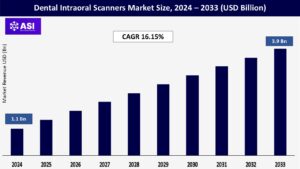
The global dental industry is experiencing a major shift as it embraces digital dentistry, transforming how diagnoses and treatments are carried out. At the heart of this evolution are intraoral scanners, which allow dentists to capture highly accurate 3D digital images of the mouth. By 2024, more than 42% of dental clinics worldwide had already integrated these scanners into their practices, greatly improving workflows in diagnosis, treatment planning, and the creation of dental prosthetics. Interestingly, nearly 57% of new dental clinics opened in 2024 opted for digital scanners over traditional impression trays highlighting a strong preference for digital tools among newer practices.
Leading companies like Align Technology, known for Invisalign, rely heavily on these scanners to offer personalized care. In the U.S., intraoral scanner adoption has crossed the 50% mark, and dental schools across the country have started training future dentists with this technology, underscoring a deep-rooted change in how dentistry is taught and practiced. This trend signals more than just a passing phase it marks a generational shift. As new dentists enter the field already trained and comfortable with digital tools, they’re more likely to seek or establish practices that are fully digital. This not only accelerates dental intraoral scanners market growth but also positions intraoral scanners as essential rather than optional, securing their place as a standard in modern dental care.
Growing public awareness regarding oral health is a significant factor contributing to the demand for dental intraoral scanners. This is compounded by the increasing prevalence of dental disorders and a growing aging population, particularly those experiencing tooth loss, which has fueled demand in dental hospitals and clinics. For instance, data from April 2022 indicated that 9 out of 10 people aged 20 to 64 in the United States had experienced tooth decay in the preceding two years. Similarly, projections from the United Nations Population Fund in 2022 suggested that approximately 19% of Canada’s population would be 65 or older, leading to an increased burden of dental disorders and driving dental intraoral scanners market expansion. Globally, the prevalence of dental disease among individuals aged 60 years or older stands at 23%.
One of the biggest challenges facing dental clinics—especially smaller practices and those in rural areas—is the steep price tag of intraoral scanners. These high-tech devices often cost between $20,000 and $30,000, with top-tier models climbing as high as $42,900. Even by 2024, the average system still hovered above $18,000, making it a tough investment for many. And the costs don’t stop there—maintenance contracts and regular software upgrades can tack on another 12–15% every year. For many dental professionals, this level of financial commitment is a major deterrent, often prompting them to stick with conventional methods or delay transitioning to digital workflows altogether.
Despite the high precision that intraoral scanners promise, real-world use reveals some frustrating hurdles. Capturing full-arch scans or navigating tricky intraoral angles often proves more difficult than expected. In fact, more than 31% of users in 2024 experienced accuracy-related problems issues like scanner calibration mishaps and scan stitching glitches that can compromise final restoration quality.
Additionally, for many dental professionals, the shift to digital scanning isn’t plug-and-play. About 24% cited the steep learning curve and training demands as significant challenges. These devices require a deep understanding of their operation and careful integration into existing clinical workflows, meaning teams often need substantial time and support to get fully comfortable. The promise of innovation is there, but so is the reality of adaptation.
| Report Metric | Details |
|---|---|
| Segmentations | |
| By Product Type |
Powder-Free Scanners (dominant) Powder-Based Scanners |
| By Modality Type |
Standalone (cart-based) Portable (hand-held) |
| By Application |
Orthodontics Prosthodontics Implantology Endodontics |
| By End-User |
Dental Clinics Hospitals Dental Labs Academic & Research Institutes |
| Key Players |
Align Technology Dentsply Sirona 3Shape Medit Corp. Planmeca Envista Holdings Corporation Shining 3D Guangdong Launca Medical Device Technology Co., Ltd. (Launca) Condor Technologies NV (Condor) Densys Ltd. (Densys3D) Institut Straumann AG (Straumann Group) Carestream 3M ESPE Dental Wings Meyer FREQTY FUSSEN Vatech Ivoclar Vivadent GC Corporation Zimmer Biomet BLZ Dental Co. (BLZ Technology) Midmark Corporation Owandy Radiology 3Disc Changzhou Sifary Medical Technology AlliedStar Medical Equipment Neoss AG Intelliscan 3D Runyes Medical Instrument Amann Girrbach AG Imes-icore GmbH Jiangsu Weiyun Artificial Intelligence (AI Smile) Acteon Group J. Morita Agfa KaVo Air Techniques Kulzer Apixia MyRay Belmont Cefla Group Orixscan Chicago X-ray Systems Panoramic Cieos Patterson Dental Supply Corix Cruxell PreXion Cyber Medical Imaging Dental Imaging Technologies Corporation |
| Geographies Covered | |
| North America |
U.S. |
| Europe |
U.K. |
| Asia Pacific |
China |
| Middle East & Africa |
Saudi Arabia |
| Latin America |
Brazil |
The Dental intraoral scanners market is categorized by product type, by modality, by application and by end-user. Each segment is rapidly evolving, with different areas of the industry growing at their own pace and shifting in how much of the market they represent. Each segment provide a comprehensive understanding of its dynamics and growth opportunities. Dental Intraoral Scanners Market is highly dynamic and segmented to provide a comprehensive understanding of its various facets.
In 2024, wired intraoral scanners continued to dominate the dental market, largely due to their reputation for being stable, reliable, and more budget-friendly—especially when compared to their advanced wireless counterparts. Many clinics still favor the consistency of these devices, making them a trusted workhorse in daily practice. That said, the landscape is shifting. Wireless scanners are quickly gaining ground and are expected to experience the fastest growth over the coming years.
Their ability to offer smoother mobility and greater flexibility during procedures makes them especially appealing to dental professionals. Not only do they allow for more comfortable interactions with patients, but powder-free models—almost all of which are wireless accounted for roughly 85% of new installations in 2024. The convenience they offer is hard to ignore, and it’s clear that wireless technology is carving out its space in modern dentistry.
In 2024, wired intraoral scanners held the lion’s share of the market, mainly because they’re viewed as the reliable workhorses of digital dentistry. They offer stability during procedures and are often more affordable than their wireless counterparts, making them an attractive choice for budget-conscious practices. But times are changing fast. Wireless scanners are gaining serious momentum, and for good reason. Their freedom of movement not only streamlines the scanning process but also makes clinical procedures more comfortable for both dentist and patient. A new wave of compact, battery-powered models—led by innovations from companies like Medit and VATECH—is shaping the future of intraoral imaging.
Powder-free wireless scanners, which eliminate messy preparation steps, made up a whopping 85% of new installations in 2024. It’s clear: clinics are increasingly shifting toward sleek, user-friendly devices that save time, improve workflow, and deliver top-tier patient experiences.
Orthodontics is the largest and fastest-growing application for intraoral scanners, driven by the shift to fully digital workflows. These scanners are critical for capturing highly accurate 3D images of patients’ teeth, making it easier to design and customize clear aligners, braces, and retainers. Companies like Align Technology rely heavily on this technology for their Invisalign system, which has helped achieve a 29% improvement in first-time fit success rates. In prosthodontics, intraoral scanners are widely used for creating precise restorations, often enabling same-day, chairside solutions.
They help record detailed bite relationships and support the use of virtual articulators, though complex cases—like multispan implant restorations—still pose challenges. Here, photogrammetry is emerging as a promising alternative for scanning fully edentulous arches. Implantology also benefits from intraoral scanners, enabling faster, more accurate chairside planning and placement of implants. In general dentistry, adoption is on the rise as scanners enhance everyday diagnostic and restorative work. Meanwhile, cosmetic dentistry has seen particularly strong benefits, with a 36% increase in same-day crown fabrication, reflecting growing patient demand for fast, high-quality aesthetic treatments and greater awareness of dental health overall.
Dental hospitals and clinics are expected to remain the largest users of intraoral scanners through 2028. In 2023, hospitals led the dental intraoral scanners market in revenue thanks to their growing investment in advanced digital technologies within their dental departments. At the same time, dental clinics are projected to see the fastest growth, reflecting the rapid adoption of digital solutions in private and group practices. Dental academic and research institutes also play an important role in driving dental intraoral scanners market growth, supported by stronger industry partnerships and increased funding for research. More than 45 dental schools worldwide have now made intraoral scanning a core part of their curriculum, ensuring that new dentists are trained to use this technology from the start.
Other end users include a range of practice models, from solo practices to large Dental Service Organizations (DSOs) and group practices, all of which are steadily adopting intraoral scanners to improve patient care and streamline workflows.
The global dental intraoral scanners market shows clear regional differences shaped by healthcare infrastructure, technology adoption, government support, and economic conditions. In Asia-Pacific, there’s strong growth in the use of wireless, powder-free scanners, which are popular for their user-friendly design and ability to shorten chairside time.
North America leads the way in integrating CAD/CAM systems and AI-powered scanning, with more than 18,000 clinics reportedly using intraoral scanners every day. In Europe, cloud-based workflows and same-day restorations are becoming increasingly common, and scanner training is now a standard part of dental education. Meanwhile, emerging markets are seeing gains from government-backed oral health programs, mobile dental clinics, and more affordable scanner models designed to meet the needs of cost-sensitive practices.
North America is currently the leading region in the dental intraoral scanners market. In 2024, it accounted for around 36% of global sales, with the U.S. alone contributing an estimated USD 210 million. Adoption of intraoral scanners in the U.S. has surpassed 50%, thanks to a strong culture of technological innovation, early uptake by dental practices, the presence of major industry players, and a well-established healthcare system that supports advanced digital tools. The U.S. market is expected to continue growing steadily, with a projected CAGR of 8.5% over the forecast period.
Europe the intraoral scanners market in revenue in 2023, thanks to its strong uptake of advanced dental technologies and a well-developed healthcare system. Germany is expected to see particularly solid growth, with a projected CAGR of 7.5%, driven by its reliable healthcare infrastructure, commitment to technological innovation, supportive government policies encouraging healthcare digitization, and rising demand for restorative and cosmetic dental treatments. The UK market is also poised for steady growth, with an anticipated CAGR of 7.2% over the forecast period.
This region is expected to experience the fastest growth during the forecast period, with its market share projected to climb to over 20% by 2024. Much of this expansion is being fueled by government-led efforts to modernize healthcare systems and the growing popularity of dental tourism, as patients seek high-quality, cost-effective dental treatments in these markets.
Although this region currently has a smaller share of the market, it offers significant potential for future growth. Emerging countries in particular are seeing improvements in healthcare infrastructure and a rise in dental tourism, creating new opportunities for expanding access to advanced dental technologies like intraoral scanners.
The dental intraoral scanners market was valued at USD 1.1 billion in 2024.
The dental intraoral scanners market is projected to grow at a CAGR of 16.15% from 2025 to 2033.
Dental Clinics segment holds the largest market share.
Asia-Pacific region is expected to witness the highest growth rate.
Major players include Align Technology, 3Shape, Dentsply Sirona, Medit, and Envista Holdings Corporation.
1.1 Summary
1.2 Research methodology
2.1 Research Objectives
2.2 Market Definition
2.3 Limitations & Assumptions
2.4 Market Scope & Segmentation
2.5 Currency & Pricing Considered
3.1 Drivers
3.2 Geopolitical Impact
3.3 Human Factors
3.4 Technology Factors
4.1 Porters Five Forces Analysis
4.2 Value Chain Analysis
4.3 Average Pricing Analysis
4.4 M & A, Agreements & Collaboration Analysis
5.1 Dental Intraoral Scanners Market, By Product Type
5.1.1 Introduction
5.1.2 Market Size & Forecast
5.2 Dental Intraoral Scanners Market, By Modality Type
5.3 Dental Intraoral Scanners Market, By Application
5.4 Dental Intraoral Scanners Market, By End-Users
6.1 North America Dental Intraoral Scanners Market, By Country
6.1.1 Dental Intraoral Scanners Market, By Product Type
6.1.2 Dental Intraoral Scanners Market, By Modality Type
6.1.3 Dental Intraoral Scanners Market, By Application
6.1.3 Dental Intraoral Scanners Market, By End User
6.2 U.S.
6.2.1 Dental Intraoral Scanners Market, By Product Type
6.2.2 Dental Intraoral Scanners Market, By Modality Type
6.2.2 Dental Intraoral Scanners Market, By Application
6.2.3 Dental Intraoral Scanners Market, By End-User
6.3 Canada
7.1 U.K.
7.2 Germany
7.3 France
7.4 Spain
7.5 Italy
7.6 Russia
7.7 Nordic
7.8 Benelux
7.9 The Rest of Europe
8.1 China
8.2 South Korea
8.3 Japan
8.4 India
8.5 Australia
8.6 Taiwan
8.7 South East Asia
8.8 The Rest of Asia-Pacific
9.1 UAE
9.2 Turkey
9.3 Saudi Arabia
9.4 South Africa
9.5 Egypt
9.6 Nigeria
9.7 Rest of MEA
10.1 Brazil
10.2 Mexico
10.3 Argentina
10.4 Chile
10.5 Colombia
10.6 Rest of Latin America
11.1 Global Market Share (%) By Players
11.2 Market Ranking By Revenue for Players
11.3 Competitive Dashboard
11.4 Product Mapping