

Buzzer Market
Buzzer Market Share & Trends Analysis Report, By Type (Piezoelectric Buzzers, Magnetic Buzzers, Electromechanical Buzzers, Others), By Sound Output (Below 75 dB, 75–90 dB, Above 90 dB), By Application (Consumer Electronics, Automotive, Industrial Equipment, Medical Devices, Security Systems, Others), By End User (Electronics Manufacturers, Automotive OEMs, Healthcare Providers, Industrial Users, Others) Industry Analysis Report, Regional Outlook, Growth Potential, Price Trends, Competitive Market Share & Forecast, 2025–2033.

Historical Period: 2019-2024
Forecast Period: 2025-2033
Report Code :
CAGR: 6.8%
Last Updated : October 29, 2025
The global Buzzer Market was valued at USD 2.3 billion in 2024 and is projected to reach USD 4.1 billion by 2033, growing at a CAGR of 6.8% during the forecast period (2025–2033).
Buzzers are audio signaling devices that convert electrical energy into sound, used for alerts, alarms, notifications, and feedback mechanisms in electronic systems. They play a vital role in consumer electronics, automobiles, household appliances, industrial machines, medical devices, and security systems. Buzzers are available in piezoelectric, magnetic, and electromechanical types, each optimized for specific applications depending on sound level, frequency, durability, and cost.
The market is being driven by rising demand for smart home devices, electric vehicles, advanced medical equipment, and industrial automation systems. Increasing integration of compact, low-power, high-sound output buzzers into portable electronics and IoT devices is further expanding market opportunities.
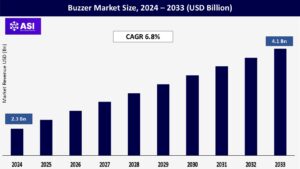
The growth of consumer electronics, including smartphones, wearables, laptops, gaming consoles, and smart home appliances, is a major driver of buzzer demand. Buzzers provide critical haptic and audio feedback in these devices, enhancing user interaction. With the continued expansion of IoT ecosystems and connected devices, buzzer integration is becoming more widespread.
Automotive and industrial sectors are key consumers of buzzers, where they are used in warning alarms, seatbelt reminders, parking sensors, and machine alerts. The rise of electric vehicles (EVs), advanced driver assistance systems (ADAS), and autonomous driving technologies is fueling demand for reliable, energy-efficient buzzers. Similarly, in industrial environments, buzzers ensure operator safety and equipment reliability by providing instant audio alerts.
The buzzer market is highly cost-sensitive, as it caters to consumer electronics and mass-production industries. Intense competition and low switching costs result in strong pricing pressures. Furthermore, alternatives such as LED indicators, vibration motors, and advanced speaker modules may replace buzzers in certain applications, particularly in premium devices, limiting growth potential in some market segments.
| Report Metric | Details |
|---|---|
| Segmentations | |
| By Type |
Piezoelectric Buzzers Magnetic Buzzers Electromechanical Buzzers Others |
| By Sound Output |
Below 75 dB 75–90 dB Above 90 dB |
| By Application |
Consumer Electronics Automotive Industrial Equipment Medical Devices Security Systems Others |
| By End User |
Electronics Manufacturers Automotive OEMs Healthcare Providers Industrial Users Others |
| Key Players |
|
| Geographies Covered | |
| North America |
U.S. |
| Europe |
U.K. |
| Asia Pacific |
China |
| Middle East & Africa |
Saudi Arabia |
| Latin America |
Brazil |
The Buzzer Market is segmented by Type, Sound Output, Application, and End User.
North America holds a significant position in the global buzzer market, driven by strong demand from automotive, consumer electronics, industrial automation, and healthcare industries. The United States is the primary contributor, with widespread use of buzzers in vehicles for alarms, seatbelt reminders, and parking assistance systems.
The region’s thriving consumer electronics sector, particularly in smart home devices, wearables, and household appliances, further supports buzzer adoption. Industrial automation and robotics also utilize buzzers for alerts, safety indicators, and operational notifications.
Healthcare applications—such as medical monitoring devices, infusion pumps, and diagnostic equipment—rely on piezoelectric buzzers for reliable audio feedback. Canada contributes steadily, particularly in industrial and telecommunications applications.
The region benefits from strong R&D, a mature electronics supply chain, and rising integration of IoT-enabled devices, all of which drive demand for compact, energy-efficient buzzers with advanced acoustic performance.
Europe’s buzzer market is shaped by its strong automotive industry, stringent safety regulations, and robust industrial sector. Germany leads demand, given its dominance in automobile manufacturing, where buzzers are essential in safety systems, driver assistance features, and electric vehicle alerts.
France, Italy, and the U.K. also contribute significantly, with applications spanning consumer electronics, aerospace, and healthcare devices. European industries emphasize compliance with safety and environmental standards, such as RoHS and REACH, which is encouraging the adoption of energy-efficient and environmentally friendly buzzer technologies.
Industrial automation, a key strength in Europe, drives additional demand for buzzers as warning and signaling devices. In the healthcare sector, buzzers are widely used in patient monitoring systems and surgical instruments. Furthermore, Europe’s growing focus on renewable energy and smart infrastructure projects supports buzzer adoption in monitoring systems, control panels, and alert mechanisms.
Asia-Pacific is the largest and fastest-growing region in the buzzer market, owing to its vast electronics manufacturing base and rising demand across diverse end-user industries. China leads the region, producing buzzers on a large scale for integration into smartphones, home appliances, toys, and industrial equipment.
Japan and South Korea are technology leaders, using high-performance buzzers in advanced automotive systems, robotics, and consumer electronics. India’s growing automotive and electronics industries are also contributing to rapid adoption, particularly in low-cost consumer products and industrial safety devices.
Southeast Asian countries are emerging as key manufacturing hubs, supporting global supply chains with cost-effective production of piezoelectric and electromagnetic buzzers. The widespread rollout of 5G, smart devices, and connected appliances in APAC further accelerates demand for miniaturized and energy-efficient buzzer components.
Local manufacturers, competitive pricing, and government-backed initiatives to strengthen the electronics industry make APAC a central growth engine for the global buzzer market.
In Latin America, the buzzer market is gradually expanding, with Brazil and Mexico as the leading contributors. The automotive industry in Mexico and Brazil’s electronics and consumer goods sectors are the primary demand drivers.
Buzzers are increasingly used in appliances, industrial equipment, and safety systems, while healthcare applications—particularly patient monitoring devices—are gaining traction. Economic volatility and dependence on imports pose challenges, but modernization of manufacturing facilities and investments in digital infrastructure are creating new opportunities for buzzer adoption.
The Middle East & Africa (MEA) region is an emerging market for buzzers, supported by infrastructure development, automotive demand, and healthcare modernization. GCC countries, including Saudi Arabia, the UAE, and Qatar, are driving adoption through smart city projects, automotive expansion, and industrial automation.
In Africa, South Africa and Nigeria show rising demand for buzzers in industrial safety devices, consumer electronics, and telecommunications equipment. Limited local production and high reliance on imports remain challenges, but growing investments in manufacturing diversification, coupled with increasing consumer electronics penetration, are expected to support steady growth in the buzzer market across MEA.
The market was valued at USD 2.3 billion in 2024.
The market is projected to grow at a CAGR of 6.8% (2025–2033).
Piezoelectric buzzers hold the largest share due to their compactness, reliability, and low power consumption.
The Asia-Pacific region is expected to witness the fastest growth, driven by electronics manufacturing and EV adoption.
Major players include Murata, TDK, Panasonic, Omron, and Sonitron.
1.1 Summary
1.2 Research methodology
2.1 Research Objectives
2.2 Market Definition
2.3 Limitations & Assumptions
2.4 Market Scope & Segmentation
2.5 Currency & Pricing Considered
3.1 Drivers
3.2 Geopolitical Impact
3.3 Human Factors
3.4 Technology Factors
4.1 Porters Five Forces Analysis
4.2 Value Chain Analysis
4.3 Average Pricing Analysis
4.4 M & A, Agreements & Collaboration Analysis
5.1 Buzzer Market, By Type
5.1.1 Introduction
5.1.2 Market Size & Forecast
5.2 Buzzer Market, By Sound Output
5.3 Buzzer Market, By Application
5.4 Buzzer Market, By End User
6.1 North America Buzzer Market, By Country
6.1.1 Buzzer Market, By Type
6.1.2 Buzzer Market, By Sound Output
6.1.3 Buzzer Market, By Application
6.1.4 Buzzer Market, By End User
6.2 U.S
6.2.1 Buzzer Market, By Type
6.2.2 Buzzer Market, By Sound Output
6.2.3 Buzzer Market, By Application
6.2.4 Buzzer Market, By End User
6.3 Canada
7.1 U.K.
7.2 Germany
7.3 France
7.4 Spain
7.5 Italy
7.6 Russia
7.7 Nordic
7.8 Benelux
7.9 The Rest of Europe
8.1 China
8.2 South Korea
8.3 Japan
8.4 India
8.5 Australia
8.6 Taiwan
8.7 South East Asia
8.8 The Rest of Asia-Pacific
9.1 UAE
9.2 Turkey
9.3 Saudi Arabia
9.4 South Africa
9.5 Egypt
9.6 Nigeria
9.7 Rest of MEA
10.1 Brazil
10.2 Mexico
10.3 Argentina
10.4 Chile
10.5 Colombia
10.6 Rest of Latin America
11.1 Global Market Share (%) By Players
11.2 Market Ranking By Revenue for Players
11.3 Competitive Dashboard
11.4 Product Mapping