

Effervescent Tablet Market
Effervescent tablet Market Share & Trends Analysis Report, By Product Type (Prescription-Based, Over-the-Counter (OTC)), By Application (Pain Management, Vitamins and Dietary Supplements, Cough and Cold, Gastrointestinal Disorders, Others), By End User (Hospitals, Home Care, Clinics, Others), By Distribution Channel (Hospital Pharmacies, Retail Pharmacies, Online Pharmacies, Drug Stores)– Industry Analysis Report, Regional Outlook, Growth Potential, Price Trends, Competitive Market Share & Forecast, 2025–2033.

Historical Period: 2019-2024
Forecast Period: 2025-2033
Report Code :
CAGR: 7.35%
Last Updated : August 7, 2026
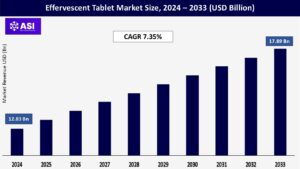
The global Effervescent tablet Market size was valued at approximately USD 12.83 billion in 2024 and is projected to reach USD 17.89 billion by 2033, growing at a CAGR of 7.35% during the forecast period (2025–2033).
The Effervescent Tablet Market refers to the global industry focused on the production and distribution of effervescent dosage forms, which are solid tablets designed to dissolve in water, releasing carbon dioxide to form a fizzy solution. These tablets are commonly used for the delivery of vitamins (like Vitamin C), minerals, pain relievers, and gastrointestinal agents.
Their key advantage lies in enhanced patient compliance due to ease of ingestion and faster absorption compared to traditional tablets or capsules. Effervescent tablets are particularly beneficial for individuals with swallowing difficulties and offer rapid onset of action.
Their properties include high solubility, pleasant taste, improved bioavailability of active ingredients, and stability under moisture-controlled packaging. The market is driven by growing consumer demand for convenient and fast-acting healthcare products, along with advancements in formulation technologies.
As consumers increasingly prioritize ease of use, especially in self-care and over-the-counter (OTC) products, effervescent tablets have gained popularity. These tablets dissolve quickly in water, creating a palatable and easy-to-ingest solution. This makes them ideal for individuals who have difficulty swallowing traditional tablets or capsules, such as children, the elderly, or patients with dysphagia.
Additionally, the rapid disintegration in water facilitates quicker absorption of active ingredients, leading to faster therapeutic effects a crucial benefit for pain relief or electrolyte replenishment. This convenience, combined with the increasing trend of patient-centric drug delivery, is a strong driver of market growth.
The global surge in demand for vitamins, minerals, and dietary supplements—driven by rising health awareness and preventive healthcare practices has significantly contributed to the growth of the effervescent tablet market. Effervescent formulations of Vitamin C, multivitamins, magnesium, and calcium are especially popular among health-conscious consumers seeking immunity boosts and better overall wellness.
Furthermore, the COVID-19 pandemic has accelerated interest in immune-boosting supplements, pushing pharmaceutical and nutraceutical companies to expand their product portfolios in effervescent formats to meet demand.
Effervescent tablets require a more complex and costly manufacturing process compared to conventional solid dosage forms. They are highly sensitive to moisture, and any exposure can lead to premature degradation or loss of effervescence.
As a result, they must be produced and packaged in controlled environments with moisture-resistant materials such as aluminium blisters or airtight tubes with desiccants. These specialized packaging requirements significantly increase production costs.
Additionally, formulating stable effervescent tablets that retain efficacy over time can be technically challenging, especially when combining multiple active ingredients. This cost-intensive process can limit adoption by smaller manufacturers and may make the end product more expensive for consumers, thus restraining market growth in price-sensitive regions.
| Report Metric | Details |
|---|---|
| Segmentations | |
| By Product Type |
Prescription-Based Over-the-Counter (OTC) |
| By Application |
Pain Management Vitamins and Dietary Supplements Cough and Cold Gastrointestinal Disorders Others |
| By End User |
Hospitals Home Care Clinics Others |
| By Distribution Channel |
Hospital Pharmacies Retail Pharmacies Online Pharmacies Drug Stores |
| Key Players |
|
| Geographies Covered | |
| North America |
U.S. |
| Europe |
U.K. |
| Asia Pacific |
China |
| Middle East & Africa |
Saudi Arabia |
| Latin America |
Brazil |
The Effervescent tablet Market is segmented by Product Type, Application, End Users and Distribution Channels. Each factor plays a crucial role in improving patient compliance, enhancing drug absorption, and supporting the development of more convenient and consumer-friendly treatment options in the fields of general wellness, vitamin supplementation, and pharmaceutical care.
As healthcare continues to shift toward personalized and self-directed solutions, effervescent tablets are poised to gain broader acceptance across diverse patient populations.
Prescription-Based Effervescent Tablets: These are formulated for specific therapeutic needs and prescribed by healthcare professionals. They are commonly used for managing chronic conditions such as osteoporosis, cardiovascular diseases, or serious gastrointestinal disorders. The demand is driven by physician trust, clinical efficacy, and growing awareness about better absorption of effervescent formulations.
Over-the-Counter (OTC) Effervescent Tablets: This segment dominates the market owing to increased consumer preference for self-care and preventive healthcare. Popular OTC categories include Vitamin C, multivitamins, electrolytes, and cold & flu medications. The ease of access, rapid onset of action, and pleasant taste significantly contribute to market growth in this segment.
Pain Management: Effervescent formulations of analgesics (e.g., paracetamol, aspirin) are preferred due to faster absorption and quicker relief, especially in cases of fever, muscle aches, and headaches.
Vitamins and Dietary Supplements: A major segment, driven by rising health awareness and immunity-boosting trends, especially post-COVID-19. Effervescent tablets offer better taste and improved compliance for daily supplement intake.
Cough and Cold: Commonly used for symptoms like sore throat, nasal congestion, or minor respiratory discomfort. The effervescent format provides faster relief and is easier to ingest during illness.
Gastrointestinal Disorders: Products such as antacids and digestive enzymes in effervescent form are popular due to their immediate soothing effect and quick disintegration in water.
Others: Includes niche applications such as electrolyte replacement in sports nutrition, urinary tract health, and skin health supplements.
Hospitals: Used in inpatient care for patients who cannot swallow pills or need rapid drug action. Hospitals prefer effervescent forms for pain relief, electrolyte replenishment, and multivitamin supplementation.
Home Care: A rapidly growing segment, fueled by the shift toward at-home wellness and chronic disease management. Elderly and pediatric patients benefit most from easy-to-consume effervescent formulations.
Clinics: Utilized for outpatient treatment in smaller doses. Clinicians may recommend effervescent vitamins or pain relief medications for minor conditions or recovery phases.
Others: Includes wellness centers, fitness clinics, and NGOs providing supplements in rural areas or public health campaigns.
Hospital Pharmacies: Dispense prescription-based effervescent tablets for admitted patients or those treated in outpatient departments. This segment benefits from physician-directed therapy and institutional purchasing.
Retail Pharmacies: A key channel for both prescription and OTC effervescent tablets, especially in urban and semi-urban areas. Retailers often carry a wide range of wellness and nutritional supplements.
Online Pharmacies: This segment is growing rapidly due to digital transformation, consumer convenience, and attractive discounts. The availability of detailed product information and easy doorstep delivery are major growth factors.
Drug Stores: Includes local chemists and convenience stores, often catering to walk-in customers for OTC products like cold remedies or vitamin supplements. These outlets play a strong role in rural or suburban markets.
North America holds a significant share of the effervescent tablet market, driven by high healthcare expenditure, widespread awareness of advanced drug delivery systems, and a strong emphasis on preventive healthcare.
The U.S. and Canada see growing demand for vitamin supplements, OTC pain relievers, and electrolyte tablets in effervescent form. The region also benefits from the presence of leading pharmaceutical and nutraceutical companies, advanced manufacturing infrastructure, and favourable regulatory frameworks for dietary supplements and OTC medications. Rising demand from the aging population and increasing inclination toward convenient dosage forms continue to support market growth.
Europe is a mature and well-established market for effervescent tablets, particularly due to consumer preference for these formulations in countries such as Germany, the UK, France, and Italy. European consumers often favor effervescent products for their superior palatability, faster onset of action, and easy administration.
The strong presence of key players, such as Bayer AG and Hermès Pharma, as well as a proactive population inclined toward dietary supplementation and wellness products, contributes to market expansion. Additionally, stringent regulations ensure high product quality and safety, supporting consumer trust and market stability.
Asia Pacific is the fastest-growing region in the effervescent tablet market due to rapid urbanization, increasing healthcare awareness, and a booming middle-class population. Countries like India, China, Japan, and South Korea are witnessing increased demand for vitamins, minerals, and pain relief medications in effervescent form.
The popularity of self-medication, coupled with expanding e-commerce platforms and the growth of local nutraceutical brands, is driving product adoption. Moreover, the regional dietary supplement industry is expanding, supported by supportive government initiatives, rising disposable income, and a cultural emphasis on preventive health and wellness.
The effervescent tablet market in Latin America is experiencing moderate growth, led by Brazil, Mexico, and Argentina. Growing consumer health awareness and a rising interest in self-care practices are contributing to increased demand for OTC effervescent vitamins and pain relievers.
However, economic volatility and price sensitivity among consumers pose challenges. Despite this, increased availability of imported health supplements and the expansion of online pharmacies are opening up new opportunities in urban centers.
The Middle East & Africa region presents nascent but growing opportunities in the effervescent tablet market. Countries like South Africa, the UAE, and Saudi Arabia are seeing a rise in demand due to greater health consciousness, increased access to global healthcare brands, and improvements in retail pharmacy infrastructure.
However, the market is constrained by lower awareness levels in rural areas and limited product availability. Government-led public health initiatives and the growing penetration of multinational pharmaceutical companies could further accelerate market growth in this region.
The effervescent tablet market was valued at USD 12.83 billion in 2024.
The effervescent tablet market is projected to grow at a CAGR of 7.35% from 2025 to 2033.
Prescription-Based, Over-the-Counter (OTC) hold the largest effervescent tablet market share.
The North America region is expected to witness the highest growth rate.
Major players include Bayer AG, Pfizer Inc. and GlaxoSmithKline plc (GSK).
1.1 Summary
1.2 Research methodology
2.1 Research Objectives
2.2 Market Definition
2.3 Limitations & Assumptions
2.4 Market Scope & Segmentation
2.5 Currency & Pricing Considered
3.1 Drivers
3.2 Geopolitical Impact
3.3 Human Factors
3.4 Technology Factors
4.1 Porters Five Forces Analysis
4.2 Value Chain Analysis
4.3 Average Pricing Analysis
4.4 M & A, Agreements & Collaboration Analysis
5.1 Effervescent Tablet Market, By Product Type
5.1.1 Introduction
5.1.2 Market Size & Forecast
5.2 Effervescent Tablet Market, By Application
5.3 Effervescent Tablet Market, By End User
5.4 Effervescent Tablet Market, By Distribution Channel
6.1 North America Effervescent Tablet Market, By Country
6.1.1 Effervescent Tablet Market, By Product Type
6.1.2 Effervescent Tablet Market, By Application
6.1.3 Effervescent Tablet Market, By End User
6.1.4 Effervescent Tablet Market, By Distribution Channel
6.2 U.S.
6.2.1 Effervescent Tablet Market, By Product Type
6.2.2 Effervescent Tablet Market, By Application
6.2.3 Effervescent Tablet Market, By End User
6.2.4 Effervescent Tablet Market, By Distribution Channel
6.3 Canada
7.1 U.K.
7.2 Germany
7.3 France
7.4 Spain
7.5 Italy
7.6 Russia
7.7 Nordic
7.8 Benelux
7.9 The Rest of Europe
8.1 China
8.2 South Korea
8.3 Japan
8.4 India
8.5 Australia
8.6 Taiwan
8.7 South East Asia
8.8 The Rest of Asia-Pacific
9.1 UAE
9.2 Turkey
9.3 Saudi Arabia
9.4 South Africa
9.5 Egypt
9.6 Nigeria
9.7 Rest of MEA
10.1 Brazil
10.2 Mexico
10.3 Argentina
10.4 Chile
10.5 Colombia
10.6 Rest of Latin America
11.1 Global Market Share (%) By Players
11.2 Market Ranking By Revenue for Players
11.3 Competitive Dashboard
11.4 Product Mapping