

Isotretinoin Drugs Market
Isotretinoin Drugs Market Share & Trends Analysis Report, By Form (Capsules, Injection), By Indication Type (Severe Acne, Neuroblastoma, Cutaneous T-Cell Lymphoma, Harlequin Ichthyosis, Xeroderma Pigmentosum, Fibrodysplasia Ossificans Progressiva, Squamous Cell Skin Cancers, Others), By Distribution Channels (Hospitals Pharmacies, Retail Pharmacies, Online Pharmacies)– Industry Analysis Report, Regional Outlook, Growth Potential, Price Trends, Competitive Market Share & Forecast, 2025–2033.

Historical Period: 2019-2024
Forecast Period: 2025-2033
Report Code :
CAGR: 5.20%
Last Updated : November 20, 2025
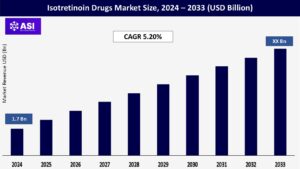
The global Isotretinoin Drugs Market size was valued at approximately USD 1.7 billion in 2024 and is projected to reach USD XX billion by 2033, growing at a CAGR of 5.20% during the forecast period (2025–2033).
Isotretinoin is a strong medicine that doctors give to people with very bad or stubborn acne especially when it causes deep, painful bumps and other treatments haven’t worked. It comes from vitamin A and helps by reducing the amount of oil your skin makes, helping skin renew faster, and lowering swelling.
There are both famous brand-name and cheaper generic versions of this drug, and more people are using it as they learn about better ways to treat acne. Isotretinoin can clear the skin in just a few months, but it also has some serious side effects. These can include very dry skin, changes in mood, and birth defects if taken during pregnancy. Because of these risks, doctors carefully watch anyone using it, and in many countries, there are strict rules to make sure it’s used safely.
An increasing number of people are experiencing severe and hard-to-treat acne, which is a key factor driving the demand for isotretinoin. Acne vulgaris, particularly the nodulocystic type, affects millions globally most commonly teenagers and young adults.
However, adult acne is also on the rise, largely due to hormonal changes, high stress levels, unhealthy diets, and environmental factors. When common treatments like topical creams or antibiotics don’t work, patients turn to stronger options like isotretinoin.
Additionally, the emotional and social impact of acne, including low confidence, anxiety, and depression, motivates people to seek more reliable and lasting treatment. This growing need for advanced skin care solutions is helping to expand the isotretinoin market.
Another important factor boosting the isotretinoin market is the improved access to dermatology services and the growing public awareness of advanced acne treatments. Thanks to stronger healthcare systems, easier access to dermatologists, and the rise of online consultations, more people are getting diagnosed and treated.
Campaigns to educate the public and the influence of social media have also helped people learn about powerful treatments like isotretinoin. Meanwhile, drug manufacturers are making the medicine more widely available by offering both name-brand and cost-effective generic versions.
As awareness grows and more people are willing to spend on skincare for both medical and cosmetic reasons, the isotretinoin drug market continues to grow steadily.
One big challenge for the isotretinoin drug market is how tightly it’s regulated because of its serious side effects. While the drug can be very effective for treating severe acne, it can also cause problems like extremely dry skin, liver issues, high cholesterol levels, and most seriously serious birth defects if used during pregnancy.
To keep patients safe, many countries have put strict safety systems in place. For example, in the U.S., the iPLEDGE program requires patients, doctors, and pharmacists to follow strict steps to make sure pregnant individuals don’t use the drug.
These extra rules can make it harder for people to get the medication, and some doctors may hesitate to prescribe it at all. On top of that, patients need regular blood tests and close checkups while using isotretinoin, which can be time-consuming and stressful both for them and for the healthcare system. All of this makes it harder for the drug to be used widely, even though it can deliver powerful results.
| Report Metric | Details |
|---|---|
| Segmentations | |
| By Form |
Capsules Injection |
| By Indication Type |
Severe Acne Neuroblastoma Cutaneous T-Cell Lymphoma Harlequin Ichthyosis Xeroderma Pigmentosum Fibrodysplasia Ossificans Progressiva Squamous Cell Skin Cancers Others |
| By Distribution Channels |
Hospitals Pharmacies Retail Pharmacies Online Pharmacies |
| Key Players |
|
| Geographies Covered | |
| North America |
U.S. |
| Europe |
U.K. |
| Asia Pacific |
China |
| Middle East & Africa |
Saudi Arabia |
| Latin America |
Brazil |
The Isotretinoin Drugs Market is segmented by Forml, Indication Type and Distribution Channels. Each factor plays a crucial role in driving the growth of the isotretinoin drug market by ensuring effective treatment outcomes, enhancing patient safety, and meeting strict regulatory requirements.
Capsules are the most popular and widely used form of isotretinoin. People prefer them because they’re easy to take by mouth and allow for accurate dosing. They’re mainly prescribed for treating acne and other skin problems, making it simple for patients to stick to their treatment. New capsule designs, like those that release the medicine slowly, help improve results and reduce side effects.
Injections of isotretinoin are less common but are sometimes used in special medical cases or research. This form delivers the drug quickly and directly, which can be helpful in serious or hard-to-treat conditions like certain cancers, such as neuroblastoma or cutaneous T-cell lymphoma.
This is the biggest reason people use isotretinoin. It’s the go-to treatment for really bad acne that doesn’t get better with other medicines. As more people learn about effective acne care, the demand for isotretinoin in this area continues to grow.
Isotretinoin is also used as part of treatment plans for neuroblastoma, a type of cancer mostly found in children. Though this is a smaller market compared to acne, it’s an important use of the drug in fighting cancer.
The drug is sometimes used to help manage this rare type of skin cancer, helping to slow down the disease and relieve symptoms. This is a very rare genetic skin disorder, but isotretinoin can help by improving skin cell growth and function. Even though it’s a small group of patients, this is a critical use of the drug.
People with this rare condition, which makes skin extremely sensitive to sunlight, may use isotretinoin to protect their skin and lower the chance of developing skin cancer. Though very rare, isotretinoin is being studied for treating this condition where bones grow abnormally in muscles and other tissues.
Isotretinoin is sometimes prescribed to prevent or manage this common type of skin cancer, especially for patients who are at high risk. This includes other less common or new uses of isotretinoin, including off-label treatments and ongoing research, which continue to expand how this drug can help people.
Hospitals are a major place where isotretinoin is given out, especially for serious cases that need careful medical supervision, like cancer treatments or severe acne managed by specialists. Hospitals also handle the more complex steps needed to safely prescribe and monitor the drug.
These pharmacies are the main place for patients to get isotretinoin, especially those treating acne. They’re convenient and easy to access, making both brand-name and generic versions available to a wide range of people.
Online stores are becoming more popular for buying isotretinoin because they offer convenience and privacy, especially for younger people who are comfortable with technology. However, it’s important that these platforms follow strict safety rules to make sure the medicine is used properly.
North America is a leading market for isotretinoin drugs, driven by a high prevalence of severe acne and growing awareness about advanced dermatological treatments. The U.S., in particular, holds a large share due to well-established healthcare infrastructure, easy access to dermatologists, and widespread use of isotretinoin under strict regulatory frameworks like the iPLEDGE program.
High healthcare spending, strong pharmaceutical R&D, and the presence of major drug manufacturers also contribute to market growth. Additionally, growing demand for cosmetic and skincare solutions supports continued expansion in this region.
Europe represents another significant market for isotretinoin, fueled by increasing skin health awareness and robust healthcare systems across countries like Germany, the UK, and France. European regulatory agencies enforce strict safety standards, ensuring the drug’s safe use, which builds patient confidence.
Growing adoption of generic versions and increasing accessibility through retail and hospital pharmacies also boost market growth. Public campaigns and dermatology awareness programs encourage timely treatment of severe acne and other indications, driving demand further.
The Asia Pacific region is one of the fastest-growing markets for isotretinoin, thanks to rising population, increasing incidence of skin conditions, and improving healthcare infrastructure in countries such as China, India, Japan, and South Korea. Growing middle-class populations, urbanization, and increased beauty and skincare consciousness are driving demand, especially for acne treatment.
Expansion of dermatology clinics, telemedicine services, and e-commerce platforms also enhance access to isotretinoin. However, regulatory frameworks vary widely across the region, which can impact market dynamics.
Latin America is experiencing steady growth in the isotretinoin market, supported by increasing awareness of acne treatment and improving healthcare services in countries like Brazil and Mexico. The expanding pharmaceutical industry, combined with growing urban populations and higher disposable incomes, is encouraging more patients to seek effective dermatological care. However, challenges such as limited healthcare infrastructure in rural areas and regulatory hurdles still restrict rapid market expansion.
The Middle East and Africa region shows emerging potential for the isotretinoin market as awareness about skin health rises and healthcare access improves, particularly in urban centers of countries like the UAE, Saudi Arabia, and South Africa.
Increasing investments in healthcare infrastructure, rising dermatological clinics, and expanding pharmaceutical distribution channels support market growth. Nonetheless, economic disparities, regulatory complexities, and limited availability in some rural or less-developed areas pose challenges to faster adoption.
The isotretinoin drugs market was valued at USD 1.7 billion in 2024.
The isotretinoin drugs market is projected to grow at a CAGR of 5.20% from 2025 to 2033.
The Capsules hold the largest isotretinoin drugs market share.
The North America region is expected to witness the highest growth rate.
Major players include Roche Holding AG, Mylan N.V. (Viatris Inc.) and Sun Pharmaceutical Industries Ltd.
1.1 Summary
1.2 Research methodology
2.1 Research Objectives
2.2 Market Definition
2.3 Limitations & Assumptions
2.4 Market Scope & Segmentation
2.5 Currency & Pricing Considered
3.1 Drivers
3.2 Geopolitical Impact
3.3 Human Factors
3.4 Technology Factors
4.1 Porters Five Forces Analysis
4.2 Value Chain Analysis
4.3 Average Pricing Analysis
4.4 M & A, Agreements & Collaboration Analysis
5.1 Isotretinoin Drugs Market, By Form
5.1.1 Introduction
5.1.2 Market Size & Forecast
5.2 Isotretinoin Drugs Market, By Indication Type
5.3 Isotretinoin Drugs Market, By Distribution Channels
6.1 North America Isotretinoin Drugs Market , By Country
6.1.1 Isotretinoin Drugs Market, By Form
6.1.2 Isotretinoin Drugs Market, By Indication Type
6.1.3 Isotretinoin Drugs Market, By Distribution Channels
6.2 U.S.
6.2.1 Isotretinoin Drugs Market, By Form
6.2.2 Isotretinoin Drugs Market, By Indication Type
6.2.3 Isotretinoin Drugs Market, By Distribution Channels
6.3 Canada
7.1 U.K.
7.2 Germany
7.3 France
7.4 Spain
7.5 Italy
7.6 Russia
7.7 Nordic
7.8 Benelux
7.9 The Rest of Europe
8.1 China
8.2 South Korea
8.3 Japan
8.4 India
8.5 Australia
8.6 Taiwan
8.7 South East Asia
8.8 The Rest of Asia-Pacific
9.1 UAE
9.2 Turkey
9.3 Saudi Arabia
9.4 South Africa
9.5 Egypt
9.6 Nigeria
9.7 Rest of MEA
10.1 Brazil
10.2 Mexico
10.3 Argentina
10.4 Chile
10.5 Colombia
10.6 Rest of Latin America
11.1 Global Market Share (%) By Players
11.2 Market Ranking By Revenue for Players
11.3 Competitive Dashboard
11.4 Product Mapping