

Microbiome Therapeutics Market
Microbiome Therapeutics Market Share & Trends Analysis Report, By Product Type (Probiotics, Prebiotics, Synbiotics, Postbiotics, Others) By Application (Gastrointestinal Disorders, Metabolic Disorders, Immunological Disorders, Neurological Disorders, Skin Disorders, Others) By Therapeutic Area (Inflammatory Bowel Disease (IBD), Irritable Bowel Syndrome (IBS), Diabetes, Obesity, Cancer, Others) By End User (Hospitals, Clinics, Research Institutes, Others)– Industry Analysis Report, Regional Outlook, Growth Potential, Price Trends, Competitive Market Share & Forecast, 2025–2033.

Historical Period: 2019-2024
Forecast Period: 2025-2033
Report Code :
CAGR: 15.70%
Last Updated : January 22, 2026
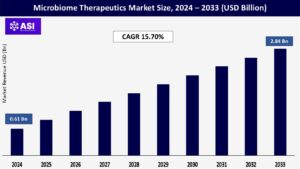
The global microbiome therapeutics market size was valued at approximately USD 0.61 billion in 2024 and is projected to reach USD 2.84 billion by 2033, growing at a CAGR of 15.70% during the forecast period (2025–2033).
The microbiome therapeutics market refers to the sector of the pharmaceutical and biotechnology industry that develops treatments targeting the human microbiome, the diverse community of microorganisms living in and on the human body. These therapeutics aim to restore or modify the microbiome to treat or prevent a variety of diseases, including gastrointestinal disorders, metabolic diseases, neurological conditions, and even cancer, supporting the steady expansion of the microbiome therapeutics market size.
Microbiome therapeutics can take the form of live biotherapeutic products (such as probiotics), prebiotics, synbiotics, or microbial-derived compounds. They offer the unique property of modulating the host’s immune system and metabolic pathways in a natural, targeted manner.
As research continues to uncover links between microbiome imbalances and health conditions, the industry is witnessing growing interest from pharmaceutical companies, startups, and academic institutions, making it a promising area for innovation and personalized medicine.
One of the major drivers of the microbiome therapeutics market is the increasing global burden of chronic diseases such as inflammatory bowel disease (IBD), obesity, diabetes, and neurological disorders. Research has established a strong correlation between imbalances in the gut microbiome (dysbiosis) and these health conditions.
For instance, patients with IBD often show a reduced diversity of gut bacteria, which contributes to inflammation and worsened symptoms. Microbiome-based therapies aim to restore microbial balance, providing a natural and targeted approach to treatment.
As conventional therapies sometimes fail to produce long-term relief or come with side effects, microbiome therapeutics are emerging as safer alternatives, contributing to the growth of the microbiome therapeutics market size.
Significant technological advancements in next-generation sequencing (NGS), metagenomics, and bioinformatics have accelerated the discovery and development of microbiome therapeutics. These tools allow researchers to analyze complex microbial communities in unprecedented detail, identify novel therapeutic targets, and develop personalized microbiome-based interventions.
This scientific progress has enabled the development of live biotherapeutics, engineered probiotics, and microbiome-derived small molecules that are now entering clinical trials.
The ability to manipulate and monitor the microbiome precisely has fueled investment from biotech firms, academic institutions, and pharmaceutical companies, driving market growth and innovation.
One of the most significant restraints in the Microbiome Therapeutics Market is the lack of clear regulatory frameworks and scientific standardization. Unlike traditional pharmaceuticals, microbiome therapeutics, especially live biotherapeutic products (LBPs) involve living organisms, which makes their evaluation, approval, and manufacturing more complex.
Regulatory bodies such as the U.S. FDA and EMA are still in the process of developing specific guidelines for these novel treatments. This regulatory ambiguity creates uncertainty for companies trying to bring products to market.
Additionally, there are scientific hurdles in identifying which specific microbial strains or communities are responsible for therapeutic effects. The human microbiome is highly variable across individuals due to genetics, diet, environment, and lifestyle, which complicates the development of standardized, one-size-fits-all treatments.
Challenges in proving causal relationships between microbiome changes and clinical outcomes further hinder clinical trial design and product validation. As a result, these regulatory and scientific uncertainties delay product approvals, increase development costs, and act as a major restraint on the growth of the microbiome therapeutics market.
| Report Metric | Details |
|---|---|
| Segmentations | |
| By Product Type |
Probiotics Prebiotics Synbiotics Postbiotics Others |
| By Application |
Gastrointestinal Disorders Metabolic Disorders Immunological Disorders Neurological Disorders Skin Disorders Others |
| By Therapeutic Area |
Inflammatory Bowel Disease (IBD) Irritable Bowel Syndrome (IBS) Diabetes Obesity Cancer Others |
| By End User |
Hospitals Clinics Research Institutes Others |
| Key Players |
|
| Geographies Covered | |
| North America |
U.S. |
| Europe |
U.K. |
| Asia Pacific |
China |
| Middle East & Africa |
Saudi Arabia |
| Latin America |
Brazil |
The microbiome therapeutics market is segmented by Product type, Application, Therapeutic Area and End User. Each factor plays a crucial role in improving patient outcomes, increasing the adoption of microbiome-based therapies, and supporting the development of more targeted, safe, and personalized treatment options for managing gastrointestinal, metabolic, and neurological disorders.
Probiotics dominate the market and account for the largest microbiome therapeutics market share due to their established use in improving gut health and their availability in various forms (capsules, powders, drinks). They consist of live microorganisms that confer health benefits when administered in adequate amounts. Probiotics are increasingly being studied for not just gastrointestinal health but also for metabolic and immune-related conditions.
Prebiotics: These are non-digestible food ingredients that promote the growth of beneficial microorganisms in the intestines. As a supportive agent to probiotics, prebiotics are gaining attention for their role in enhancing gut flora and improving overall digestive and metabolic health.
Synbiotics: Combining probiotics and prebiotics, synbiotics are designed to synergistically improve the survival and implantation of live beneficial microorganisms. They are particularly useful in chronic gastrointestinal and metabolic conditions, offering dual-action therapeutic benefits.
Postbiotics, the metabolic byproducts of probiotic bacteria, are an emerging segment. They offer the advantage of biological activity without the viability issues of live organisms. This makes them easier to store, transport, and regulate, which is accelerating interest in their commercial development.
This includes microbiome-derived small molecules, genetically engineered microbes, and fecal microbiota transplants (FMT). These novel approaches are under clinical investigation for complex conditions like cancer and neurological disorders.
Gastrointestinal Disorders: This is the largest application segment due to the direct link between the gut microbiome and GI health. Conditions like IBD, IBS, and Clostridium difficile infections are primary targets for microbiome therapies.
Metabolic Disorders: Obesity, diabetes, and dyslipidemia are increasingly being linked to gut microbiota imbalances. Therapies targeting microbial modulation to improve insulin sensitivity and reduce inflammation are driving growth in this area.
Immunological Disorders: Microbiome-based interventions are being explored to manage autoimmune diseases and enhance immune response, particularly in relation to allergies, asthma, and inflammatory diseases.
Neurological Disorder: The gut-brain axis has opened a promising frontier for microbiome therapeutics in neurological conditions like autism, Parkinson’s disease, and depression. Though still in early stages, this segment holds high potential.
Skin Disorders: Microbiome products are emerging in dermatology, targeting acne, eczema, and psoriasis. Topical probiotics and microbiome-balancing creams are being developed to restore skin health.
Others: This includes cardiovascular diseases, liver disorders, and respiratory conditions, where microbiome therapy is in early research or pilot studies.
Inflammatory Bowel Disease (IBD): A core focus of current microbiome therapy development. Therapies aim to reduce inflammation, restore gut flora, and reduce dependence on steroids and biologics.
Irritable Bowel Syndrome (IBS): Microbiome modulation offers an alternative to symptom-based treatments, focusing on restoring microbial balance for long-term relief.
Diabetes: Therapeutics targeting the microbiome aim to improve glucose metabolism and reduce systemic inflammation, addressing Type 2 diabetes in particular.
Obesity: By influencing gut bacteria associated with fat storage, appetite, and energy regulation, microbiome-based therapies aim to support sustainable weight loss.
Cancer: Microbiome therapies are being developed as adjuncts to immunotherapy and chemotherapy, enhancing treatment response and reducing side effects. FMT and microbial adjuvants are in advanced research stages.
Others: Covers applications in liver disease, cardiovascular disease, and mental health disorders all linked to microbiome imbalances through systemic inflammation or gut permeability.
Hospitals are key settings for advanced microbiome therapies, particularly for in-patient treatments like FMT or live biotherapeutics in clinical trials. Hospitals also play a central role in post-approval therapy administration.
Clinics: Outpatient clinics increasingly prescribe probiotic, prebiotic, and synbiotic therapies for chronic conditions. They serve as major distribution channels for consumer-accessible microbiome products.
Research Institutes: Academic and private research institutes drive innovation in microbiome science. They are involved in clinical trials, product testing, and the discovery of novel microbial strains and therapeutic targets.
Others: This includes wellness centers, personalized medicine platforms, and online retailers that distribute microbiome-based nutraceuticals and dietary supplements, especially in preventive health and lifestyle management.
North America dominates the microbiome therapeutics market, holding a significant market share driven by advanced biotechnology capabilities, strong funding for R&D, and a high prevalence of chronic diseases such as IBD, diabetes, and cancer.
The region has a well-established regulatory framework, with the U.S. FDA offering guidance for live biotherapeutic products. A strong presence of key players, clinical trials, and early adoption of innovative therapies continue to drive market growth in this region.
Europe holds the second-largest share of the market, supported by increasing government investment in healthcare innovation and research. Countries like Germany, France, and the UK are key contributors, with numerous academic and industrial collaborations focused on microbiome-based solutions.
The European Medicines Agency (EMA) has shown interest in developing clear guidelines for microbiome therapeutics, which is encouraging growth. Rising awareness of gut health and personalized medicine also supports market expansion.
Asia Pacific is the fastest-growing region in the microbiome therapeutics market. The growing incidence of gastrointestinal and metabolic disorders, large patient population, and rising healthcare expenditure are major growth drivers.
Countries such as China, Japan, South Korea, and India are investing heavily in microbiome research and the development of probiotics and functional foods. Increased interest in personalized medicine and advancements in biotechnology are fueling further growth.
Latin America is an emerging market with moderate growth prospects. Countries like Brazil, Mexico, and Argentina are seeing a rise in chronic and gastrointestinal diseases, which is driving demand for alternative therapies such as microbiome therapeutics.
However, the market faces challenges such as limited awareness, economic instability, and underdeveloped research infrastructure. Despite this, improving healthcare access and increasing investments in biotech may support long-term market potential.
The Middle East & Africa region is in the early stages of adopting microbiome-based therapies. Growth is primarily seen in the more developed countries such as the UAE, Saudi Arabia, and South Africa, where healthcare infrastructure is improving and chronic diseases are rising.
While the potential is significant, the region faces barriers such as low awareness, limited clinical research capacity, and slower adoption of novel therapeutics. Nevertheless, ongoing healthcare reforms and investments in precision medicine may gradually boost market growth.
The microbiome therapeutics market was valued at USD 0.61 billion in 2024.
The microbiome therapeutics market is projected to grow at a CAGR of 15.70% from 2025 to 2033.
The Probiotics hold the largest microbiome therapeuticsmarket share.
The North America region is expected to witness the highest growth rate.
Major players include Seres Therapeutics Vedanta Biosciences and Finch Therapeutics.
1.1 Summary
1.2 Research methodology
2.1 Research Objectives
2.2 Market Definition
2.3 Limitations & Assumptions
2.4 Market Scope & Segmentation
2.5 Currency & Pricing Considered
3.1 Drivers
3.2 Geopolitical Impact
3.3 Human Factors
3.4 Technology Factors
4.1 Porters Five Forces Analysis
4.2 Value Chain Analysis
4.3 Average Pricing Analysis
4.4 M & A, Agreements & Collaboration Analysis
5.1 Microbiome Therapeutics Market, By Product Type
5.1.1 Introduction
5.1.2 Market Size & Forecast
5.2 Microbiome Therapeutics Market, By Application
5.3 Microbiome Therapeutics Market, By Therapeutic Area
5.4 Microbiome Therapeutics Market, By End User
6.1 North America Microbiome Therapeutics Market, By Country
6.1.1 Microbiome Therapeutics Market, By Product Type
6.1.2 Microbiome Therapeutics Market, By Application
6.1.3 Microbiome Therapeutics Market, By Therapeutic Area
6.1.4 Microbiome Therapeutics Market, By End User
6.2 U.S.
6.2.1 Microbiome Therapeutics Market, By Product Type
6.2.2 Microbiome Therapeutics Market, By Application
6.2.3 Microbiome Therapeutics Market, By Therapeutic Area
6.2.4 Microbiome Therapeutics Market, By End User
6.3 Canada
7.1 U.K.
7.2 Germany
7.3 France
7.4 Spain
7.5 Italy
7.6 Russia
7.7 Nordic
7.8 Benelux
7.9 The Rest of Europe
8.1 China
8.2 South Korea
8.3 Japan
8.4 India
8.5 Australia
8.6 Taiwan
8.7 South East Asia
8.8 The Rest of Asia-Pacific
9.1 UAE
9.2 Turkey
9.3 Saudi Arabia
9.4 South Africa
9.5 Egypt
9.6 Nigeria
9.7 Rest of MEA
10.1 Brazil
10.2 Mexico
10.3 Argentina
10.4 Chile
10.5 Colombia
10.6 Rest of Latin America
11.1 Global Market Share (%) By Players
11.2 Market Ranking By Revenue for Players
11.3 Competitive Dashboard
11.4 Product Mapping