

Pain Management Drugs Market
Pain Management Drugs Market Share & Trends Analysis Report, By Drug Class (Opioids, Nonsteroidal Anti-Inflammatory Drugs (NSAIDs), Anaesthetics, Anticonvulsants, Antidepressants, Others) By Indication ( Neuropathic Pain, Fibromyalgia, Chronic Back Pain, Arthritic Pain, Migraine, Post-Operative Pain, Cancer Pain, Others) By Mode of Administration (Oral, Parenteral, Topical, Transdermal) By Distribution Channel (Hospital Pharmacies, Retail Pharmacies, Online Pharmacies) By End User (Hospitals, Clinics, Homecare, Others)– Industry Analysis Report, Regional Outlook, Growth Potential, Price Trends, Competitive Market Share & Forecast, 2025–2033.

Historical Period: 2019-2024
Forecast Period: 2025-2033
Report Code :
CAGR: 4.37%
Last Updated : March 27, 2026
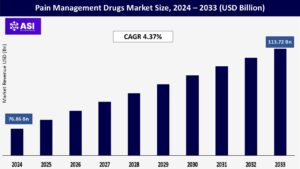
The global Pain Management Drugs Market was valued at approximately USD 76.86 billion in 2024 and is projected to reach USD 113.72 billion by 2033, growing at a CAGR of 4.37% during the forecast period (2025–2033).
The Pain Management Drugs Market refers to the global industry focused on the development, production, and distribution of medications designed to alleviate or manage various types of pain, ranging from acute to chronic conditions. These drugs are commonly used to treat pain associated with arthritis, cancer, postoperative recovery, neuropathy, and musculoskeletal disorders.
Pain management drugs include opioids, nonsteroidal anti-inflammatory drugs (NSAIDs), anticonvulsants, antidepressants, and anaesthetics, each offering different mechanisms of action to target specific pain pathways.
The key properties of these drugs include analgesic effectiveness, duration of action, potential side effects, and risk of dependence, particularly in the case of opioids. The market is driven by the growing prevalence of chronic pain conditions, rising elderly population, and advancements in drug delivery systems, while also facing challenges like regulatory scrutiny and the need for non-addictive alternatives.
One of the primary drivers of the pain management drugs market is the growing number of people suffering from chronic diseases that lead to long-term pain. Conditions such as cancer, osteoarthritis, rheumatoid arthritis, diabetic neuropathy, fibromyalgia, and migraine are becoming increasingly common due to lifestyle changes, stress, and aging.
Chronic pain affects millions globally and significantly reduces quality of life, creating a strong demand for effective and sustained pain relief options. As healthcare providers aim to improve patient outcomes and daily functioning, the demand for reliable pain management drugs continues to rise. This trend is further supported by greater awareness of pain treatment options and an increasing focus on early diagnosis and intervention.
The global population is aging rapidly, with a significant increase in the number of individuals aged 60 and above. Older adults are more susceptible to chronic health issues that involve persistent pain, such as arthritis, spinal degeneration, and post-surgical pain.
As life expectancy increases, so does the need for long-term healthcare solutions, particularly in pain management. This demographic shift is pushing pharmaceutical companies to innovate and expand their portfolios to include safer and more effective pain relief medications tailored to elderly patients, including non-opioid alternatives with lower risks of dependency or side effects.
Consequently, the growing elderly population is a major driver accelerating the expansion of the pain management drugs market worldwide.
The significant restraint in the meningococcal vaccine market is the high cost associated with vaccine development, production, and distribution. Developing vaccines involves substantial investment in research and clinical trials, which can be financially burdensome for manufacturers.
This financial strain often leads to elevated production expenses, resulting in higher prices for end consumers. Consequently, the affordability of meningococcal vaccines becomes a concern, particularly in low-income countries where healthcare budgets are limited. The high costs can hinder widespread adoption and accessibility of these vaccines, ultimately impacting the market’s growth potential.
| Report Metric | Details |
|---|---|
| Segmentations | |
| By Drug Class |
Opioids Nonsteroidal Anti-Inflammatory Drugs (NSAIDs) Anaesthetics Anticonvulsants Antidepressants Others |
| By Indication |
Neuropathic Pain Fibromyalgia Chronic Back Pain Arthritic Pain Migraine Post-Operative Pain Cancer Pain Others |
| By Mode of Administration |
Oral, Parenteral Topical Transdermal |
| By Distribution Channel |
Hospital Pharmacies Retail Pharmacies Online Pharmacies |
| By End User |
Hospitals Clinics Homecare Others |
| Key Players |
|
| Geographies Covered | |
| North America |
U.S. |
| Europe |
U.K. |
| Asia Pacific |
China |
| Middle East & Africa |
Saudi Arabia |
| Latin America |
Brazil |
The Pain Management Drugs Market is segmented by Drug class, Indication, Mode of administration, Distribution Channels and End User. Each factor plays a crucial role in improving patient quality of life, boosting the adoption of pain relief therapies, and supporting the advancement of safer, more effective, and accessible treatment options for managing acute and chronic pain across diverse medical conditions.
Opioids These are potent analgesics widely used for severe acute and chronic pain, especially in post-operative and cancer-related pain. Despite their effectiveness, their usage is under scrutiny due to risks of addiction, dependency, and regulatory limitations. However, they remain a major revenue contributor.
Nonsteroidal Anti-Inflammatory Drugs (NSAIDs) NSAIDs like ibuprofen and naproxen are commonly used for mild to moderate pain such as arthritis and musculoskeletal conditions. They are widely available over-the-counter, driving high consumer usage despite risks like gastrointestinal side effects.
Anaesthetics Local and general anaesthetics, such as lidocaine and bupivacaine, are crucial for surgical and dental procedures. They also find use in chronic pain through nerve blocks and topical formulations.
Anticonvulsants Initially developed for epilepsy, drugs like gabapentin and pregabalin are now standard for treating neuropathic pain. Their market share has increased with the rise in diabetic neuropathy and fibromyalgia cases.
Antidepressants Tricyclic antidepressants and SNRIs (e.g., amitriptyline, duloxetine) are used for chronic pain syndromes like fibromyalgia and neuropathic pain. Their dual action on pain and mood disorders makes them increasingly relevant.
Others Includes muscle relaxants, cannabinoids, and combination drugs. Innovations in these segments are supporting non-opioid pain relief trends.
Neuropathic Pain A growing segment driven by rising diabetes, chemotherapy-induced neuropathy, and post-herpetic neuralgia. Non-opioid therapies are gaining ground here.
Fibromyalgia Increasing awareness and diagnosis are fueling demand for centrally acting drugs like pregabalin and duloxetine.
Chronic Back Pain A widespread condition influencing a large portion of the working-age population, contributing significantly to the demand for NSAIDs, muscle relaxants, and sometimes opioids.
Arthritic Pain Aging populations and increasing osteoarthritis prevalence push demand for long-term NSAID and corticosteroid therapies.
Migraine A well-established segment with both acute and preventive treatments. Growth is supported by newer classes like CGRP inhibitors alongside traditional triptans and NSAIDs.
Post-Operative Pain A major indication for short-term opioid use. The trend is shifting toward multimodal and opioid-sparing approaches.
Cancer Pain Chronic and often severe, requiring strong analgesics and palliative care medications. Opioids dominate this segment, though alternative therapies are being explored.
Others Includes sports injuries, dental pain, and menstrual pain, all contributing to over-the-counter and prescription drug sales.
Oral The most preferred route due to ease of use and patient compliance. Includes tablets, capsules, and liquid formulations.
Parenteral Used in hospital settings for rapid relief and in cases where oral administration is not feasible. Important for emergency and surgical care.
Topical Gaining traction for localized pain with fewer systemic side effects. Includes gels, creams, and patches.
Transdermal Offers controlled release and steady drug levels, especially useful for chronic pain management. Fentanyl patches are a notable example.
Hospital Pharmacies Major distributors of prescription pain drugs, particularly injectable and strong analgesics. Important for inpatient care and surgeries.
Retail Pharmacies A dominant channel for OTC drugs like NSAIDs and low-dose opioids. Widely accessible and influential in consumer choices.
Online Pharmacies A rapidly growing channel due to convenience, price discounts, and increased digital adoption. Particularly important in chronic pain therapy and homecare settings.
Hospitals Primary centers for acute pain treatment, surgeries, and post-operative care. High usage of injectable drugs and anaesthetics.
Clinics Important for outpatient pain management and follow-up care, especially in conditions like arthritis and back pain.
Homecare Growing segment driven by aging populations and increased preference for at-home treatment of chronic pain. Non-invasive and oral therapies dominate here.
Others Includes rehabilitation centers, nursing homes, and ambulatory surgical centers contributing to steady demand across drug categories.
North America, the market holds the largest share globally, primarily driven by a high incidence of chronic pain conditions such as arthritis, cancer, and post-operative pain. The region benefits from advanced healthcare facilities, strong insurance coverage, and a well-established pharmaceutical industry.
However, rising concerns around opioid addiction have led to tighter regulations, encouraging a shift toward non-opioid alternatives.
Europe also represents a mature market, with steady demand for pain management solutions fueled by its aging population and growing awareness of chronic pain management. Countries like Germany, the UK, and France are at the forefront of adopting new therapies.
Nevertheless, stringent drug approval policies and cost-containment measures in public healthcare systems can limit market expansion.
The Asia-Pacific region is experiencing the fastest growth in the pain management drugs market. Factors such as a large and growing population, increasing prevalence of lifestyle-related conditions, and expanding healthcare access in countries like China, India, and Japan are driving demand. However, challenges such as uneven healthcare access and limited affordability in rural areas persist.
In Latin America, the market is growing steadily, driven by improving healthcare infrastructure and rising awareness of pain relief options.
Countries such as Brazil, Mexico, and Argentina are witnessing higher demand for both prescription and over-the-counter pain medications. Still, economic instability and disparities in healthcare access can hinder consistent growth.
The Middle East & Africa region, though currently holding a smaller market share, shows promising potential. Growth is supported by increasing government investment in healthcare, rising burden of chronic diseases, and improving access to medications. However, infrastructure gaps and limited availability of advanced pain therapies remain key challenges in the region.
The market was valued at USD 76.86 billion in 2024.
The market is projected to grow at a CAGR of 4.37% from 2025 to 2033.
Opioids, Nonsteroidal Anti-Inflammatory Drugs (NSAIDs hold the largest market share.
The North America, Europe region is expected to witness the highest growth rate.
Major players include Pfizer Inc., Johnson & Johnson and Eli Lilly and Company.
1.1 Summary
1.2 Research methodology
2.1 Research Objectives
2.2 Market Definition
2.3 Limitations & Assumptions
2.4 Market Scope & Segmentation
2.5 Currency & Pricing Considered
3.1 Drivers
3.2 Geopolitical Impact
3.3 Human Factors
3.4 Technology Factors
4.1 Porters Five Forces Analysis
4.2 Value Chain Analysis
4.3 Average Pricing Analysis
4.4 M & A, Agreements & Collaboration Analysis
5.1 Pain Management Drugs Market, By Drug Class
5.1.1 Introduction
5.1.2 Market Size & Forecast
5.2 Pain Management Drugs Market, By Indication
5.3 Pain Management Drugs Market, By Mode of Administration
5.4 Pain Management Drugs Market, By Distribution Channel
5.5 Pain Management Drugs Market, By End User
6.1 North America Pain Management Drugs Market , By Country
6.1.1 Pain Management Drugs Market, By Drug Class
6.1.2 Pain Management Drugs Market, By Indication
6.1.3 Pain Management Drugs Market, By Mode of Administration
6.1.4 Pain Management Drugs Market, By Distribution Channel
6.1.5 Pain Management Drugs Market, By End User
6.2 U.S.
6.2.1 Pain Management Drugs Market, By Drug Class
6.2.2 Pain Management Drugs Market, By Indication
6.2.3 Pain Management Drugs Market, By Mode of Administration
6.2.4 Pain Management Drugs Market, By Distribution Channel
6.2.5 Pain Management Drugs Market, By End User
6.3 Canada
7.1 U.K.
7.2 Germany
7.3 France
7.4 Spain
7.5 Italy
7.6 Russia
7.7 Nordic
7.8 Benelux
7.9 The Rest of Europe
8.1 China
8.2 South Korea
8.3 Japan
8.4 India
8.5 Australia
8.6 Taiwan
8.7 South East Asia
8.8 The Rest of Asia-Pacific
9.1 UAE
9.2 Turkey
9.3 Saudi Arabia
9.4 South Africa
9.5 Egypt
9.6 Nigeria
9.7 Rest of MEA
10.1 Brazil
10.2 Mexico
10.3 Argentina
10.4 Chile
10.5 Colombia
10.6 Rest of Latin America
11.1 Global Market Share (%) By Players
11.2 Market Ranking By Revenue for Players
11.3 Competitive Dashboard
11.4 Product Mapping