

Automotive Fuel Tank Market
Automotive Fuel Tank Market Size, Share & Industry Analysis, By Capacity Type (Less than 45L, 45L-75L, and Greater than 75L), By Material Type (Plastic and Metal), By Vehicle Type (Passenger Car, Light Commercial Vehicle, and Heavy Commercial Vehicle) Industry Analysis Report, Regional Outlook, Growth Potential, Price Trends, Competitive Market Share & Forecast, 2025–2033.

Historical Period: 2019-2024
Forecast Period: 2025-2033
Report Code :
CAGR: 7.49%
Last Updated : December 16, 2025
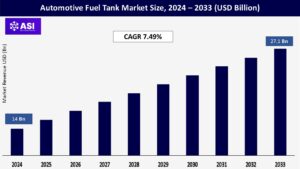
Automotive Fuel Tank Market Size was valued at USD 14 Billion in 2023. The Automotive Fuel Tank market industry is projected to grow from USD 15.20 Billion in 2025 to USD 27.1 Billion by 2033, exhibiting a compound annual growth rate (CAGR) of 7.49% during the forecast period (2025 – 2033).
Escalating demand for fuel-efficient lightweight automobiles, rising vehicle manufacturing, and quickening urbanization are the key market drivers enhancing the market growth.
The automotive industry has witnessed steady growth in vehicle production and sales in the past few years. According to the Organization Internationale des Constructeurs d’Automobiles (OICA), the global vehicle production was estimated to be 92.2 million units in 2019.
The growth in vehicle production can be attributed to increasing population, improved socio-economic conditions, economic growth, and development of infrastructure. An increase in disposable income of the middle class, particularly in developing nations such as India and Mexico, has also contributed to the increase in vehicle production and demand.
Alongwith, the demand for two wheelers is subsequently increasing, due to preference for individual mobility and two wheelers being a cost effective mode of transport.
One of the major restraints in the fuel tank market is the increasing market penetration of electric vehicles. The increasing demand for zero emission vehicles is also likely to enhance electric vehicle sales in the future. Electric vehicle technologies have become affordable over time with several governments promoting the adoption of electric vehicles by providing tax subsidies and other incentives.
A significant increase in financial support from governments in the form of tax rebates and subsidies and regulations to promote eco-friendly vehicles have led to an increase in the adoption rate of electric vehicles.
Additionally, improvements in battery and charging technology and reduction in battery price have fueled the demand for electric vehicles. Therefore, increased production and sales of electric vehicles may lead to a decline in the automotive fuel tank market.
Currently, the impact of these vehicles on the fuel tank market may be negligible. However, these vehicles are expected to have a huge impact on the fuel tank market in the future.
| Report Metric | Details |
|---|---|
| Segmentations | |
| By Material Type |
Steel Aluminum Plastic |
| By Vehicle Type |
Passenger Cars Light Commercial Vehicles Heavy Commercial Vehicles |
| By Capacity Type |
Below 45L 45-70L Above 70L |
| Key Players |
|
| Geographies Covered | |
| North America |
U.S. |
| Europe |
U.K. |
| Asia Pacific |
China |
| Middle East & Africa |
Saudi Arabia |
| Latin America |
Brazil |
The plastic tank holds the maximum 67% share of the global market in 2024 and is expected to maintain its leading position in the market during the forecast period. Most of the manufacturing companies across the globe are replacing metal tanks with plastic tanks to meet the increasing demand as well as satisfy the changing customer requirements.
Plastic tanks are made up of High-Density Polyethylene (HDPE). These tanks are lighter in weight and are easily moldable, therefore customized tanks can be provided according to the requirement of the OEMs.
The global metal fuel tank market was valued at approximately USD 9.5 billion in 2024. The market is driven by the increasing demand for automobiles and industrial machinery, alongside the growing need for fuel-efficient and durable fuel storage solutions.
The automotive sector remains the largest contributor to the market, with metal fuel tanks being widely used in vehicles due to their strength, safety features, and ability to withstand high pressure.
Additionally, the growth of electric vehicles (EVs) is expected to influence the demand for traditional fuel tanks, as hybrid vehicles continue to rely on metal fuel tanks for their gasoline storage needs.
Passenger vehicles lead the market with around 65.8% of market share in 2024, reflecting the significant demand for personal transportation solutions. The growing global population and increasing urbanization have led to a surge in the number of passenger vehicles on the road, driving the need for efficient fuel tank solutions.
Automakers are focusing on enhancing the performance and safety of fuel tanks in passenger vehicles, ensuring compliance with stringent regulations while meeting consumer expectations for reliability.
The light commercial vehicle (LCV) to exhibit global automotive fuel tank market growth, exponentially. The increase in urbanization, development in road infrastructure, the rapid expansion of industrial sectors such as construction, logistics, and transportation is boosting the demand for light commercial vehicles across the globe.
Heavy-duty trucks, the backbone of long-haul transportation and industrial operations, demand fenders that can endure extreme conditions and heavy loads. The fenders for these vehicles must offer the highest levels of durability, impact resistance, and corrosion protection.
As global supply chains become more complex and demanding, the importance of reliable heavy-duty truck components like fenders cannot be overstated.
The less than 45 liters capacity holds the maximum share in the global market. The majority of the passenger cars such as hatchbacks and sedans fall under the category with a fuel tank capacity of less than 45 liters.
The sales and production of passenger cars is growing tremendously across the globe owing to the urbanization, high demographic rate, improvement in the standard of living, and advancement in automotive technologies. The rise in disposable income is increasing people’s inclination towards purchasing a new vehicle.
45-75 Liters Hold Major Market Share. The majority of new vehicle models released by automobile manufacturers in the last five years have a minimum tank capacity of 45 liters due to the increasing demand for vehicles suitable for long journeys and with a greater mileage range.
Additionally, larger fuel tanks help utilize the dead space available within the vehicle’s chassis. The extra weight also adds to the car’s stability and dynamics. Most compact cars have a fuel tank capacity of 45 liters, while sedans usually have a capacity of 45-75 liters.
On the other hand, SUVs require fuel tanks that can hold more than 75 liters of fuel. Countries like Japan, China, India, Germany, France, and Spain are experiencing an increase in demand for sedans, which means that the 45-75 liter capacity range is expected to be the largest market.
The above 75L segment will hold significant growth in the market. This growth is because of the demand for heavy commercial vehicles, such as trucks, buses, and vans which have fuel tanks generally above 75L as they must travel longer distances to carry logistics for E-commerce and industries. The growing E-commerce market is boosting demand for heavy commercial vehicle which further increases the growth of 75L segment.
Asia Pacific holds the largest share 34% of the global market and is expected to maintain its leading position during the forecast period. Some of the developed and developing economies such as India, China, Japan, and South Korea are the leading countries that hold the maximum number of sales and production of automobiles thus propelling the growth of the fuel tank market in this region.
The rapid urbanization, expansion in industrialization, improvement in the infrastructure, and rise in disposable income is promoting the growth of the market in this region.
Europe has a 28% share of the market. The Europe automotive fuel tank market is strongly supported by the surge in new car sales and production across the region. According to ACEA, EU new car sales increased by nearly 14%, totaling 10.5 million units in 2023. Moreover, the region is positioned as the second-largest car producer in the world, with production accounting for 12.1 million units, indicating over 11% growth.
The more vehicles produced, the higher the demand for automotive fuel tanks because every new vehicle needs an efficient, safe, and reliable fuel storage solution. The increased trend of fuel-efficient and eco-friendly vehicles, including electric and hybrid models, is also creating a demand for innovative fuel tank technologies.
North America holds the second-largest 30% share in the global market owing to the high volume of commercial vehicles in this region. The stringent government norms about fuel emission and the increasing customer base are fueling the growth of the market.
North America plays a pivotal role in the global automotive fuel tank market, driven by a robust automotive industry and a strong consumer base. The region is characterized by the presence of major automotive manufacturers and suppliers, fostering innovation in fuel tank technology.
MEA is acquired the 8% only shares of the global markets. according to an industrial report, Saudi Arabia has around nearly 8 million passenger cars on the road and at least 650,000 new vehicles every year; it is one of the biggest automotive markets in the Middle East.
Such an enormous vehicle fleet demands increasingly more automotive fuel tanks for the market. With Saudi Arabia’s automotive industry on an upward trend, especially through the sales of passenger cars, the demand for efficient fuel storage solutions is also rising.
The current size of the market 15.20 Billions in 2025.
The expected CAGR is 7.49% from 2025 to 2033.
Asia Pacific currently holds the largest market shares.
Plastic Omnium, Kautex Textron, Yapp Automotive, TI Automotive, Yachiyo Industries Co. Limited, Magna International, Martinrea International Inc,Unipres Corporation.
1.1 Summary
1.2 Research methodology
2.1 Research Objectives
2.2 Market Definition
2.3 Limitations & Assumptions
2.4 Market Scope & Segmentation
2.5 Currency & Pricing Considered
3.1 Drivers
3.2 Geopolitical Impact
3.3 Human Factors
3.4 Technology Factors
4.1 Porters Five Forces Analysis
4.2 Value Chain Analysis
4.3 Average Pricing Analysis
4.4 M & A, Agreements & Collaboration Analysis
5.1 Automotive Fuel Tank Market, By Material Type
5.1.1 Introduction
5.1.2 Market Size & Forecast
5.2 Automotive Fuel Tank Market, By Vehicle Type
5.3 Automotive Fuel Tank Market, By Capacity Type
6.1 North America Automotive Fuel Tank Market, By Country
6.1.1 Automotive Fuel Tank Market, By Material Type
6.1.2 Automotive Fuel Tank Market, By Vehicle Type
6.1.3 Automotive Fuel Tank Market, By Capacity Type
6.2 U.S.
6.2.1 Automotive Fuel Tank Market, By Material Type
6.2.2 Automotive Fuel Tank Market, By Vehicle Type
6.2.3 Automotive Fuel Tank Market, By Capacity Type
6.3 Canada
7.1 U.K.
7.2 Germany
7.3 France
7.4 Spain
7.5 Italy
7.6 Russia
7.7 Nordic
7.8 Benelux
7.9 The Rest of Europe
8.1 China
8.2 South Korea
8.3 Japan
8.4 India
8.5 Australia
8.6 Taiwan
8.7 South East Asia
8.8 The Rest of Asia-Pacific
9.1 UAE
9.2 Turkey
9.3 Saudi Arabia
9.4 South Africa
9.5 Egypt
9.6 Nigeria
9.7 Rest of MEA
10.1 Brazil
10.2 Mexico
10.3 Argentina
10.4 Chile
10.5 Colombia
10.6 Rest of Latin America
11.1 Global Market Share (%) By Players
11.2 Market Ranking By Revenue for Players
11.3 Competitive Dashboard
11.4 Product Mapping