

Two-Wheeler Suspension Market
Two-Wheeler Suspension Market Size, Share & Trends Analysis Report By Product Type (Front Telescopic Suspension, Spring Loaded Hydraulic Suspension), By Application (OEM, Aftermarket) market Analysis Report, Regional Outlook, Growth Potential, Price Trends, Competitive Market Share & Forecast, 2025–2033.

Historical Period: 2019-2024
Forecast Period: 2025-2033
Report Code :
CAGR: 7.3%
Last Updated : June 3, 2026
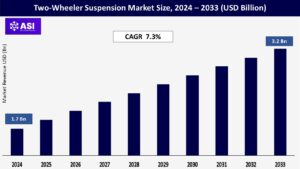
The global Two-wheeler Suspension Market size revenue was valued at USD 1.7 billion in 2024 and is projected to reach USD 3.2 billion by 2033, registering a CAGR of 7.3% during the forecast period (2025-2033).
The expansion of OEM production units in the motorcycle suspension systems market is expected to increase the two-wheeler suspension industry share. Two-wheeler suspension is the mechanism in motorcycles and scooters that absorbs shocks and maintains stability, improving rider comfort and control.
It consists of components such as forks, shock absorbers, and springs that work together to reduce the impact of uneven terrain, resulting in a smoother and safer riding experience.
The growing global demand for motorcycles and scooters, particularly in emerging regions, drives the Two-wheeler suspension market trend. As the world’s urban population grows, there will be an increased demand for convenient and economical ways of transportation.
Motorcycles and scooters meet this need, especially in highly populated places where traffic congestion is an issue. Based on registration data from the 84 countries we cover, global 2-wheeler (scooters + motorcycles) sales in 2022 were 60.4 million (+2.6%), the second-highest level ever.
As more people use two-wheelers for daily transportation, dependable and innovative suspension systems are required to assure safety, comfort, and overall vehicle performance. Furthermore, emerging economies such as India, China, Southeast Asian countries, and parts of Africa are experiencing significant growth in the two-wheeler industry.
Motorcycles and scooters, for example, are popular modes of transportation in India because they are affordable and easy to maneuver in congested urban areas. According to the Society of Indian Automobile Manufacturers (SIAM), two-wheeler sales in India were 1,34,70,570 units from April to December 2023.
SIAM announced that two-wheeler sales were 87,39,406 units between April and September 2023. SIAM recorded a total of 18,95,799 two-wheeler sales in October 2023. This stems from the rural market’s recovery and the broader economy’s robust expansion.
The cost-sensitive aspect of the two-wheeler business presents a challenge, as consumers frequently favor affordability over complex suspension systems, limiting the adoption of cutting-edge technologies. An all-in-one motorcycle air suspension kit typically costs between USD 1,200 and USD 2,500.
Adding components such as pump covers, complex controllers, and other improvements can raise the price by several hundred dollars. In India, where economic concerns heavily affect purchasing decisions, the commuter segment accounts for the vast bulk of two-wheeler sales.
In November 2023, the motorcycle segment of the Indian two-wheeler market accounted for 66% of overall sales. This is due to increased demand for commuter bikes returning from rural India. These customers are frequently more concerned with budget and fuel efficiency than advanced amenities like high-end suspension systems.
Similarly, in Southeast Asian markets, entry-level scooters sell the most. Consumers in nations like Indonesia and Vietnam value affordable and practical transportation options. This desire hinders the adoption of modern suspension systems since manufacturers frequently prioritize price in this competitive market area.
The cost sensitivity of these markets presents a barrier for makers of complex suspension systems, as consumers may be reticent to pay a premium for features beyond essential operation. This constraint necessitates a careful balance between improving performance and minimizing production costs to maintain competitive pricing.
| Report Metric | Details |
|---|---|
| Segmentations | |
| By Product Type |
Front Telescopic Suspension Spring Loaded Hydraulic Suspension |
| By Application Type |
OEM Aftermarket |
| Key Players |
|
| Geographies Covered | |
| North America |
U.S. |
| Europe |
U.K. |
| Asia Pacific |
China |
| Middle East & Africa |
Saudi Arabia |
| Latin America |
Brazil |
Front Telescopic Suspension, often known as telescopic or front forks, is a popular motorcycle suspension type. It consists of two telescoping tubes or forks that compress and extend to absorb shocks and keep the front wheel in contact with the road surface. These forks often include a coil spring and a dampening mechanism.
When the motorcycle hits bumps or uneven terrain, the telescopic forks compress and absorb the shock, resulting in a smoother ride. This design is popular because it is simple, long-lasting, and effective in various riding circumstances.
Front telescopic suspension systems are widespread on commuter bikes, cruisers, and some sports motorcycles, providing an excellent blend of performance and cost-effectiveness.
Spring-loaded hydraulic suspension is a system that uses coil springs and hydraulic dampening to produce a stable and comfortable ride. The suspension incorporates a coil spring that supports the motorcycle’s weight and compresses or expands depending on the road conditions.
Furthermore, hydraulic dampening mechanisms limit the rate at which the spring compresses and rebounds, delivering a progressive and regulated response to bumps and shocks. This design enables a more adaptable and tunable suspension, which caters to different riding styles and situations.
Spring-loaded hydraulic suspensions are commonly found on performance motorcycles, off-road bikes, and those built for riders who want more adjustability and responsiveness.
In 2024, OEMs dominated the market in volume, with most two-wheeler suspensions utilized in vehicle manufacture. The OEM segment of the two-wheeler suspension market refers to the direct integration of suspension systems during motorcycle and scooter manufacturing by original equipment manufacturers.
In this context, motorcycle and scooter manufacturers work with suspension system suppliers to smoothly integrate these components into their manufacturing processes. OEM suspension systems are built to match the motorbike manufacturers’ specific design and performance criteria.
This area is critical for ensuring that motorcycles are equipped with high-quality suspension components right out of the box, which affects the whole riding experience, safety, and performance.
OEM relationships are essential in defining the basic suspension features available to consumers at purchase. The high use of older vehicles fuels the aftermarket industry, increases the need to repair and upgrade trucks, and increases traffic accidents.
The aftermarket segment sells suspension components and systems as replacement or upgrade parts, apart from the manufacturer’s original equipment. Aftermarket suspension systems are designed for customers who want to improve performance, customize their vehicle, or replace worn-out parts.
Riders frequently turn to the aftermarket to customize their motorcycles, improve handling, or satisfy unique riding preferences. Aftermarket suspension choices may include innovative technology, customizable features, and specialized systems not found in standard OEM setups.
This category promotes a competitive market in which numerous manufacturers provide a variety of suspension components to fulfill the diverse needs of users who want to repair or enhance their motorcycles after the initial purchase.
Asia-Pacific’s two-wheeler suspension market share is estimated to grow at a CAGR of 7.8% over the forecast period. One of the primary causes for the rapid growth of the two-wheel suspension system market is the strong demand for low-power and economical motorcycles.
In developing nations such as India, this development is primarily attributable to increased ownership of two-wheelers. Due to the favorable investment climate, various manufacturers in these countries are expected to help drive growth.
China’s market enjoys the top position in the area. The presence of multiple manufacturers and their vast manufacturing capacities for vehicle components drives the development.
Europe is anticipated to exhibit a CAGR of 7.5% over the forecast period. Europe has a decent market share. Germany will have a significant market share in 2024. With strong FDI investment policies and remarkable industrial growth, leading automobile component makers are implementing and developing business model strategies.
It leads to the expansion of repair facilities all over the world. In recent years, there has been a significant increase in demand for two-wheeler suspension systems and related components from various automotive industries.
With a rising automobile industry, demand for luxury components is predicted to rise, increasing demand for two-wheeler suspension systems.
North America holds a significant market share. The two-wheeler suspension system market in the United States has the largest market share in the North American region. The growth is linked to increased motor vehicle manufacturing, which drives up demand for suspension systems.
The country has many automotive OEM and aftermarket manufacturers and dealers, resulting in a high demand for two-wheeler suspension systems. The growing number of start-ups offering electric and natural gas-powered automobiles also drives market expansion.
The market is expected to grow CAGR of 7.3 % from 2025 to 2033.
The current market size is USD 1.7 Billions in 2024.
Asia Pacific currently holds the largest market shares.
Top prominent players in Two-Wheeler Suspension Market are, DuroShox Pvt. Ltd., BMW Motorrad, Gabriel India Ltd., KYB Corporation, Progressive Suspension Inc., Nitron Racing Shocks, ZF Friedrichshafen AG, SHOWA Corporation, K-Tech Suspension INC., WP-Group, Ohlins USA, Nitron Racing Shocks, BITUBO S.r.l., Tractive Suspension, ABE Bike Engineering, RST Suspension, Traxxion Dynamics, Mupor Srl, Marzocchi Moto, etc.
1.1 Summary
1.2 Research methodology
2.1 Research Objectives
2.2 Market Definition
2.3 Limitations & Assumptions
2.4 Market Scope & Segmentation
2.5 Currency & Pricing Considered
3.1 Drivers
3.2 Geopolitical Impact
3.3 Human Factors
3.4 Technology Factors
4.1 Porters Five Forces Analysis
4.2 Value Chain Analysis
4.3 Average Pricing Analysis
4.4 M & A, Agreements & Collaboration Analysis
5.1 Two-Wheeler Suspension Market, By Product Type
5.1.1 Introduction
5.1.2 Market Size & Forecast
5.2 Two-Wheeler Suspension Market, By Application Type
6.1 North America Two-Wheeler Suspension Market, By Country
6.1.1 Two-Wheeler Suspension Market, By Product Type
6.1.2 Two-Wheeler Suspension Market, By Application Type
6.2 U.S.
6.2.1 Two-Wheeler Suspension Market, By Product Type
6.2.2 Two-Wheeler Suspension Market, By Application Type
6.3 Canada
7.1 U.K.
7.2 Germany
7.3 France
7.4 Spain
7.5 Italy
7.6 Russia
7.7 Nordic
7.8 Benelux
7.9 The Rest of Europe
8.1 China
8.2 South Korea
8.3 Japan
8.4 India
8.5 Australia
8.6 Taiwan
8.7 South East Asia
8.8 The Rest of Asia-Pacific
9.1 UAE
9.2 Turkey
9.3 Saudi Arabia
9.4 South Africa
9.5 Egypt
9.6 Nigeria
9.7 Rest of MEA
10.1 Brazil
10.2 Mexico
10.3 Argentina
10.4 Chile
10.5 Colombia
10.6 Rest of Latin America
11.1 Global Market Share (%) By Players
11.2 Market Ranking By Revenue for Players
11.3 Competitive Dashboard
11.4 Product Mapping