

Automotive Hydrostatic Fan Drive System Market
Automotive Hydrostatic Fan Drive System Market By Component (Axial Piston Pumps, Fixed Gear Motors, Engine Control Units), Pump Type (Fixed Displacement and Variable Displacement), Vehicle Type (On-Road Vehicles, Off-Road Vehicles) Industry Analysis Report, Regional Outlook, Growth Potential, Price Trends, Competitive Market Share & Forecast, 2025–2033.

Historical Period: 2019-2024
Forecast Period: 2025-2033
Report Code :
CAGR: 6.2%
Last Updated : February 5, 2026
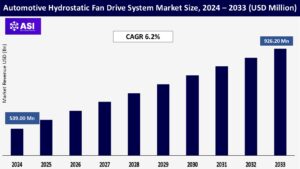
The global automotive hydrostatic fan drive system market size was worth USD 539.00 million in 2024 and is projected to reach from USD 572.41 million in 2025 to USD 926.20 million by 2033, registering a CAGR of 6.2% during the forecast period (2025–2033).
The automotive hydrostatic fan drive system is a crucial part of the car that helps with lubrication, sensors, and control units. When the engine heats up, a fan drive system’s primary function is to remove extra heat and keep the car’s interior at a constant temperature.
As pollution and fuel economy become more of a concern, automobile cooling systems must become more effective. Compared to conventional belt-driven systems, hydrostatic fan drive systems provide greater control over fan speed and cut down on wasteful power usage, increasing fuel efficiency.
The electric vehicle reduces the amount of noise and pollution generated compared to conventional vehicles. Commercial vehicles offer opportunities for more transport work at night, thus reducing the burden on the roads during the day. Therefore, many electric vehicle manufacturing companies are investing in product development to cater to the increasing demand from customers.
With increasingly sophisticated electronics and stringent emission rules, cars are becoming more complex, making efficient thermal management essential. Better engine temperature control is possible with hydrostatic fan drive systems, which improve durability and overall vehicle performance.
Despite lacking conventional internal combustion engines, EVs nevertheless need effective cooling systems to protect their batteries and other parts. As EV usage rises, hydrostatic fan drive systems could be tailored to meet the needs of EV thermal management, offering even more market potential.
Installing hydrostatic fan drive systems requires a substantial out-of-pocket payment, which can discourage certain automakers from using this technology.
It can be difficult and expensive to integrate hydrostatic fan drive systems into current vehicle designs, as it may call for a high level of engineering knowledge.
Hydrostatic fan drive systems have limited acceptance in certain vehicle sectors of the automotive market because, despite their benefits (including increased fuel efficiency and lower emissions), they might not be appropriate for all vehicle types or applications.
Fleet managers and car owners may find it difficult to maintain and service hydrostatic fan drive systems on a regular basis, which can raise the total cost of ownership.
| Report Metric | Details |
|---|---|
| Segmentations | |
| By Pump Type |
Fixed Displacement Pump Variable Displacement Pump |
| By Component Type |
Axial Piston Pumps Fixed Gear Motors Engine Control Units |
| By Vehicle Type |
On Road Vehicles Off Road Vehicles |
| Key Players |
|
| Geographies Covered | |
| North America |
U.S. |
| Europe |
U.K. |
| Asia Pacific |
China |
| Middle East & Africa |
Saudi Arabia |
| Latin America |
Brazil |
Fixed displacement pumps are designed to move a specific volume of hydraulic fluid during each revolution, regardless of the resistance or pressure changes in the system. Due to their simpler construction and fewer moving parts, these pumps are often considered more durable and are generally easier to maintain.
This straightforward design makes them well-suited for applications where a constant flow rate is desirable and where the operational parameters are relatively stable. The commercial vehicles segment is rapidly emerging as the fastest-growing
On the other hand, variable displacement pumps represent another large segment in the automotive hydrostatic fan drive system market. These pumps are engineered to adjust the flow rate and pressure of the hydraulic fluid dynamically, depending on the real-time cooling requirements of the engine.
They offer greater operational flexibility, allowing for precise control of the fan speed. This adaptability makes them particularly useful in scenarios where the cooling needs are variable, such as in buses operating in fluctuating traffic conditions or construction equipment used for diverse tasks.
The off-road vehicles segment commands the largest market share and is poised to exhibit a Compound Annual Growth Rate (CAGR) of 4.6% throughout the forecast period. This category encompasses an array of vehicles, including construction and mining machinery, agricultural vehicles, trains, metro systems, and trams.
Off-road vehicles are purposefully designed for traversing challenging terrains. The impetus driving the expansion of the automotive hydrostatic fan drive market in this sector emanates from multiple sources, including stringent emission regulations, functional requisites of vehicles, and thermal limitations.
On-Road Vehicles: This segment, encompassing passenger cars, light trucks, and heavy-duty vehicles, remains the largest consumer of hydrostatic fan drive systems, with an annual consumption value estimated at $1.2 billion.
Bus: Dedicated bus applications represent a sizable portion of this market segment.
Truck: Similar to buses, the heavy-duty nature of trucks lends itself to the use of these systems.
The Variable Axial Piston Pump segment holds the highest market share and is estimated to grow at a CAGR of 4.3% during the forecast period. Variable axial piston pumps are available with different flange options, and it possesses high volumetric, mechanical, and overall efficiency with a maximum 2500 rpm speed.
The ongoing innovation in axial pumps to reduce noise levels and clockwise or anti-clockwise rotation to cover 180° for high-pressure applications is expected to increase the demand for variable axial piston pumps in the hydrostatic fan drive system market.
This component converts hydraulic power into mechanical power to drive the fan. While seemingly simple, its design and durability contribute significantly to the system’s reliability and longevity. The annual market value for this segment is approximately $400 million.
The ECU is the brain of the system, constantly monitoring engine parameters and adjusting fan speed accordingly. Advancements in ECU technology are pushing the market value towards $300 million annually.
Asia-Pacific is the 25% shareholder in the global Automotive Hydrostatic Fan Drive System Market. The Asia-Pacific region stands at the forefront of driving and nurturing the automotive hydrostatic fan drive systems market, primarily fueled by a convergence of factors that are shaping its ascendancy.
Notably, the robust surge in infrastructural advancements, particularly witnessed in burgeoning economies like China and India, constitutes a significant catalyst for market expansion.
Europe is 28% market share holder of the global markets. As a result of the highest EV sales in recent years, the European market is predicted to expand rapidly over the forecast period.
In addition, the region’s expansion is fueled by stringent emission rules and regulations and the massive investments made by significant vehicle OEMs to meet the region’s demand for fuel-efficient and lightweight automobiles.
In addition, there are a growing number of additional requirements for maintaining air quality and noise pollution as a result of the high volume of traffic in cities. Several European cities have implemented environmental zones that restrict entry to vehicles that do not meet specific emission criteria to protect residents’ health from harmful air pollutants.
North America is the most significant 34% shareholder in the global Automotive Hydrostatic Fan Drive System Market. It is a dominant automotive hydrostatic fan drive system market, owing to significant players such as Parker Hannifin, Hydraforce Hydraulics, and others offering advanced solutions.
Moreover, extensive adoption of advanced coolant technologies in vehicles and an upsurge in demand for automotive vehicles propel the segment growth. Furthermore, heavily weighted commercial vehicles have greater penetration in this region, owing to the increase in production of these vehicles in the region, and are expected to remain the market leader.
The automotive hydrostatic fan drive system market is expected to grow CAGR of 6.2% from 2025 to 2033.
The current automotive hydrostatic fan drive system market size is USD 539 Millions in 2024.
North America currently holds the largest automotive hydrostatic fan drive system market market share.
The growing demand for fuel-efficient vehicles and the increasing adoption of hydrostatic fan drive systems in commercial vehicles are key factors driving the market growth.
Some of the key competitors in the market include Continental AG, Schaeffler AG, JTEKT Corporation, and Nidec Corporation.
1.1 Summary
1.2 Research methodology
2.1 Research Objectives
2.2 Market Definition
2.3 Limitations & Assumptions
2.4 Market Scope & Segmentation
2.5 Currency & Pricing Considered
3.1 Drivers
3.2 Geopolitical Impact
3.3 Human Factors
3.4 Technology Factors
4.1 Porters Five Forces Analysis
4.2 Value Chain Analysis
4.3 Average Pricing Analysis
4.4 M & A, Agreements & Collaboration Analysis
5.1 Automotive Hydrostatic Fan Drive System Market, By Pump Type
5.1.1 Introduction
5.1.2 Market Size & Forecast
5.2 Automotive Hydrostatic Fan Drive System Market, By Component Type
5.3 Automotive Hydrostatic Fan Drive System Market, By Vehicle Type
6.1 North America Automotive Hydrostatic Fan Drive System Market , By Country
6.1.1 Automotive Hydrostatic Fan Drive System Market, By Pump Type
6.1.2 Automotive Hydrostatic Fan Drive System Market, By Component Type
6.1.3 Automotive Hydrostatic Fan Drive System Market, By Vehicle Type
6.2 U.S.
6.2.1 Automotive Hydrostatic Fan Drive System Market, By Pump Type
6.2.2 Automotive Hydrostatic Fan Drive System Market, By Component Type
6.2.3 Automotive Hydrostatic Fan Drive System Market, By Vehicle Type
6.3 Canada
7.1 U.K.
7.2 Germany
7.3 France
7.4 Spain
7.5 Italy
7.6 Russia
7.7 Nordic
7.8 Benelux
7.9 The Rest of Europe
8.1 China
8.2 South Korea
8.3 Japan
8.4 India
8.5 Australia
8.6 Taiwan
8.7 South East Asia
8.8 The Rest of Asia-Pacific
9.1 UAE
9.2 Turkey
9.3 Saudi Arabia
9.4 South Africa
9.5 Egypt
9.6 Nigeria
9.7 Rest of MEA
10.1 Brazil
10.2 Mexico
10.3 Argentina
10.4 Chile
10.5 Colombia
10.6 Rest of Latin America
11.1 Global Market Share (%) By Players
11.2 Market Ranking By Revenue for Players
11.3 Competitive Dashboard
11.4 Product Mapping