

Acetic Acid Market
Acetic Acid Market & Trends Analysis Report, By Product Type (Synthetic Acetic Acid, Acetic Acid Made From Biomass), By Application (Monomer of Vinyl Acetate (VAM), Acid Terephthalic, Acetic Anhydride and Acetate Esters), By End User (Polymers and Plastics, Food and Drink, Chemicals & Pharmaceuticals)– Industry Analysis Report, Regional Outlook, Growth Potential, Price Trends, Competitive Market Share & Forecast, 2025–2033.

Historical Period: 2019-2024
Forecast Period: 2025-2033
Report Code :
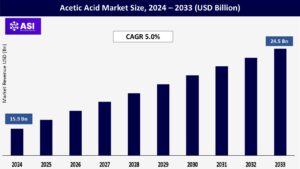
CAGR: 5.0%
Last Updated : March 27, 2026
The global Acetic Acid Market size was valued at approximately USD 15.9 billion in 2024 and is projected to reach USD 24.5 billion by 2033, growing at a CAGR of 5.0% during the forecast period.
Acetic acid, a key chemical reagent, is extensively used in the production of synthetic fibers, plastics, food additives, and industrial solvents. It plays an essential role across multiple industries due to its versatility and cost-effectiveness.
Vinyl acetate monomer (VAM), a crucial raw material for the creation of adhesives, paints, fabrics, and films, is made from acetic acid. The demand for acetic acid worldwide is being driven mostly by the increased demand for flexible packaging options and the rising use of textile chemicals, particularly in emerging nations.
Because of its functions as a pH regulator and preservative, acetic acid is being more and more used in the food and pharmaceutical industries. It is extensively utilized in a variety of pharmaceutical formulations as well as food additives like vinegar. The industry is expanding as a result of shifting eating habits and growing health consciousness in developing nations.
Long-term exposure to acetic acid can cause respiratory and skin irritation, among other health problems. Strict laws governing its handling, storage, and emissions—especially in developed areas like North America and Europe—are thus putting pressure on producers and may restrict its ability to be used widely and produced.
Methanol is a crude oil derivative that is essential to the manufacturing of synthetic acetic acid. The erratic nature of crude oil prices causes methanol prices to fluctuate, which impacts acetic acid producers’ overall production costs and profit margins.
| Report Metric | Details |
|---|---|
| Segmentations | |
| By Product Type |
Synthetic Acetic Acid Acetic Acid Made From Biomass |
| By Application |
Monomer of Vinyl Acetate (VAM) Acid Terephthalic Acetic Anhydride and Acetate Esters |
| By End-User |
Polymers and Plastics Food and Drink Chemicals & Pharmaceuticals |
| Key Players |
|
| Geographies Covered | |
| North America |
U.S. |
| Europe |
U.K. |
| Asia Pacific |
China |
| Middle East & Africa |
Saudi Arabia |
| Latin America |
Brazil |
The Acetic Acid Market is segmented by By Product Type (Synthetic Acetic Acid, Acetic Acid Made From Biomass), By Application (Monomer of Vinyl Acetate (VAM), Acid Terephthalic, Acetic Anhydride and Acetate Esters), By End User (Polymers and Plastics, Food and Drink, Chemicals & Pharmaceuticals).
Each factor plays a crucial role in enhancing patient safety, increasing the adoption of self-administered anticoagulant therapies, and supporting the development of more convenient, prefilled drug delivery systems that streamline treatment in the management of thromboembolic and cardiovascular conditions.
Synthetic Acetic Acid (Dominant Segment)
The majority of synthetic acetic acid produced worldwide is derived mostly from methanol carbonylation. It is the go-to option for industrial applications due to its affordability, scalability, and reliable supply.
Acetic acid made from biomass
Bio-based acetic acid is currently a niche market, but growing environmental consciousness and government-supported green programs are drawing attention to it. As companies move toward sustainable chemical alternatives, its demand is anticipated to increase gradually.
Monomer of Vinyl Acetate (VAM)
VAM, the most widely used application segment, is an essential precursor in the manufacturing of paints, adhesives, coatings, and packaging materials. Significant acetic acid usage is driven by its high demand in the packaging and building industries.
Acid Terephthalic
utilized to create PET (polyethylene terephthalate) plastics, which are necessary for food and drink containers. The increase in packaged meals and bottled beverages worldwide helps this market.
Acetic anhydride and acetate esters
These compounds are widely utilized in the production of paints, printing inks, medications, and dyes, and they are essential to many different industrial processes.
Polymers and Plastics
a leading end-use industry, propelled by the use of acetic acid in the production of films, resins, and polymers, especially for building and packaging.
Food and Drink
supports consistent demand worldwide by acting as a preservative and acidity regulator (E260) in a variety of food products, such as vinegar and sauces.
Chemicals & Pharmaceuticals
widely employed as an intermediary and solvent in chemical synthesis and drug development, particularly in APIs (Active Pharmaceutical Ingredients).
Because of its strong production capacity, quick industrialization, and high demand from the food, packaging, and textile industries, Asia-Pacific—especially China and India—dominates the global market.
Exhibits consistent growth, propelled by the needs of the chemical, packaging, and healthcare sectors. The regional market is supported by technical innovation and regulatory compliance.
The need for green chemistry and sustainable materials drives Europe’s growth. High production costs and stringent environmental laws provide difficulties, though.
becoming high potential areas with expanding food processing industries and increasing industrial production. Future expansion is anticipated to be driven by strategic investments in chemical infrastructure.
The estimated market size of acetic acid in 2024 was USD 15.9 billion.
The projected CAGR for 2025–2033 is 5.0%.
The key producers in the acetic acid market are Celanese, Eastman, LyondellBasell, Daicel, GNFC.
The Vinyl Acetate Monomer (VAM) production segment holds the largest market share.
1.1 Summary
1.2 Research methodology
2.1 Research Objectives
2.2 Market Definition
2.3 Limitations & Assumptions
2.4 Market Scope & Segmentation
2.5 Currency & Pricing Considered
3.1 Drivers
3.2 Geopolitical Impact
3.3 Human Factors
3.4 Technology Factors
4.1 Porters Five Forces Analysis
4.2 Value Chain Analysis
4.3 Average Pricing Analysis
4.4 M & A, Agreements & Collaboration Analysis
5.1 Acetic Acid Market, By Product Type
5.1.1 Introduction
5.1.2 Market Size & Forecast
5.2 Acetic Acid Market, By Application
5.3 Acetic Acid Market, By End-Use
6.1 North America Acetic Acid Market , By Country
6.1.1 Acetic Acid Market, By Product Type
6.1.2 Acetic Acid Market, By Application
6.1.3 Acetic Acid Market, By End-Use
6.2 U.S.
6.2.1 Acetic Acid Market, By Product Type
6.2.2 Acetic Acid Market, By Application
6.2.3 Acetic Acid Market, By End-Use
6.3 Canada
7.1 U.K.
7.2 Germany
7.3 France
7.4 Spain
7.5 Italy
7.6 Russia
7.7 Nordic
7.8 Benelux
7.9 The Rest of Europe
8.1 China
8.2 South Korea
8.3 Japan
8.4 India
8.5 Australia
8.6 Taiwan
8.7 South East Asia
8.8 The Rest of Asia-Pacific
9.1 UAE
9.2 Turkey
9.3 Saudi Arabia
9.4 South Africa
9.5 Egypt
9.6 Nigeria
9.7 Rest of MEA
10.1 Brazil
10.2 Mexico
10.3 Argentina
10.4 Chile
10.5 Colombia
10.6 Rest of Latin America
11.1 Global Market Share (%) By Players
11.2 Market Ranking By Revenue for Players
11.3 Competitive Dashboard
11.4 Product Mapping