

Hexamethylphosphoramide Market
Hexamethylphosphoramide Market & Trends Analysis Report, By Purity (≥99% Purity, <99% Purity), By Application (Polymer Synthesis, Agrochemicals, Pharmaceuticals, Others), By End Use (Chemical Manufacturing, Research Laboratories, Pharmaceuticals)– Industry Analysis Report, Regional Outlook, Growth Potential, Price Trends, Competitive Market Share & Forecast, 2025–2033.

Historical Period: 2019-2024
Forecast Period: 2025-2033
Report Code :
CAGR: 5.0%
Last Updated : March 16, 2026
The global Hexamethylphosphoramide (HMPA) Market size was valued at approximately USD 120 million in 2024 and is projected to reach USD 185 million by 2033, growing at a CAGR of 5.0% during the forecast period.
HMPA is a highly polar, aprotic solvent widely used in polymer synthesis, organometallic chemistry, agrochemical formulation, and pharmaceuticals. It offers exceptional solvating power for anions and is valued for facilitating complex chemical transformations. Despite its utility, concerns over toxicity and environmental impact have led to regulatory restrictions in several countries, influencing its usage patterns.
Market growth is supported by demand in specialty chemical production, advanced material synthesis, and niche pharmaceutical applications, particularly in research and development environments.
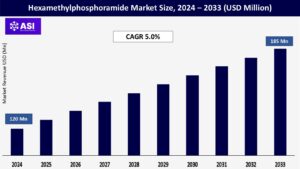
Because it may speed up reaction speeds, increase yields, and stabilize reactive intermediates, hexamethylphosphoramide (HMPA) is essential to the production of specialized chemicals.
It supports the synthesis of high-performance materials, specialty polymers, and resins and is especially useful in the chemistry of organolithium and Grignard reagents. It is a favored option in applications involving sophisticated material synthesis because of these qualities.
HMPA improves formulation stability and distribution efficiency in the agrochemical business by acting as a co-solvent and stabilizer for specific pesticides and herbicides.
In areas where regulatory frameworks still permit its controlled use, demand is expected to increase moderately, especially for specialized, high-value crop protection products.
| Report Metric | Details |
|---|---|
| Segmentations | |
| By Purity |
≥99% Purity <99% Purity |
| By Application |
Polymer Synthesis Agrochemicals Pharmaceuticals Others |
| By End-Use |
Chemical Manufacturing Research Laboratories Pharmaceuticals |
| Key Players |
|
| Geographies Covered | |
| North America |
U.S. |
| Europe |
U.K. |
| Asia Pacific |
China |
| Middle East & Africa |
Saudi Arabia |
| Latin America |
Brazil |
The Hexamethylphosphoramide Market is segmented by Purity (≥99% Purity, <99% Purity), By Application (Polymer Synthesis, Agrochemicals, Pharmaceuticals, Others), By End Use (Chemical Manufacturing, Research Laboratories, Pharmaceuticals).
Each factor plays a crucial role in enhancing patient safety, increasing the adoption of self-administered anticoagulant therapies, and supporting the development of more convenient, prefilled drug delivery systems that streamline treatment in the management of thromboembolic and cardiovascular conditions.
≥99% Purity (Largest Segment):
Mostly used in advanced polymer synthesis and high-precision laboratory research, where even little contaminants can have a big impact on material quality, product yield, and reaction efficiency. Manufacturers of high-performance materials and specialized chemicals have a significant demand for this market.
<99% Purity
99% purity is frequently used in industrial operations, such as bulk chemical synthesis and some agrochemical formulations, where trace contaminants have no effect on performance. Applications requiring less purity can benefit from this grade’s lower cost.
Polymer Synthesis (Largest Market)
The largest market is polymer synthesis, which is widely employed as a solvent in the manufacturing of specialty resins, polyamides, and polyurethanes. The growing need for lightweight, high-strength materials in the electronics, automotive, and aerospace sectors helps this market.
Agrochemicals
By increasing the solubility and stability of complex pesticide formulations, agro chemicals improve crop protection by increasing the effectiveness and distribution of active ingredients.
Pharmaceuticals
Pharmaceuticals: Especially in research-intensive drug development settings, they are used in the synthesis of active pharmaceutical ingredients (APIs) and intermediates.
Others
Discusses specialized uses in advanced material testing, coatings, and electronics where HMPA’s special solvating qualities offer process benefits.
Chemical Manufacturing (Largest Segment)
Leads the market due to extensive utilization in specialty chemical production, advanced polymerization processes, and high-performance material synthesis.
Research Laboratories
Maintains steady demand from academic institutions, industrial R&D centers, and government laboratories for small-scale synthesis and experimental applications.
Pharmaceuticals
Witnessing growing adoption in complex drug synthesis pathways, particularly where alternative solvents fail to deliver comparable efficiency or yield.
China, India, and Japan lead production and consumption, driven by robust chemical manufacturing and polymer industries. Lower regulatory restrictions in parts of the region support wider use compared to Western markets.
Moderate growth supported by specialty polymer synthesis, R&D, and niche pharmaceutical manufacturing. U.S. regulations encourage safer handling practices, but HMPA remains in use for applications requiring its unique properties.
A mature and highly regulated market, with usage restricted to controlled research environments due to stringent safety laws. Demand is sustained in specialized applications.
Steady demand from agrochemical and specialty chemical sectors, particularly in Brazil, Mexico, and Gulf countries.
The global HMPA market size was valued at USD 120 million in 2024.
The global HMPA market is projected at a CAGR of 5.0%.
The Polymer synthesis application dominates the market.
Asia-Pacific, due to expanding chemical manufacturing and fewer regulatory restrictions
1.1 Summary
1.2 Research methodology
2.1 Research Objectives
2.2 Market Definition
2.3 Limitations & Assumptions
2.4 Market Scope & Segmentation
2.5 Currency & Pricing Considered
3.1 Drivers
3.2 Geopolitical Impact
3.3 Human Factors
3.4 Technology Factors
4.1 Porters Five Forces Analysis
4.2 Value Chain Analysis
4.3 Average Pricing Analysis
4.4 M & A, Agreements & Collaboration Analysis
5.1 Hexamethylphosphoramide Market, By Purity
5.1.1 Introduction
5.1.2 Market Size & Forecast
5.2 Hexamethylphosphoramide Market, By Application
5.3 Hexamethylphosphoramide Market, By End-Use
6.1 North America Hexamethylphosphoramide Market , By Country
6.1.1 Hexamethylphosphoramide Market, By Purity
6.1.2 Hexamethylphosphoramide Market, By Application
6.1.3 Hexamethylphosphoramide Market, By End-Use
6.2 U.S.
6.2.1 Hexamethylphosphoramide Market, By Purity
6.2.2 Hexamethylphosphoramide Market, By Application
6.2.3 Hexamethylphosphoramide Market, By End-Use
6.3 Canada
7.1 U.K.
7.2 Germany
7.3 France
7.4 Spain
7.5 Italy
7.6 Russia
7.7 Nordic
7.8 Benelux
7.9 The Rest of Europe
8.1 China
8.2 South Korea
8.3 Japan
8.4 India
8.5 Australia
8.6 Taiwan
8.7 South East Asia
8.8 The Rest of Asia-Pacific
9.1 UAE
9.2 Turkey
9.3 Saudi Arabia
9.4 South Africa
9.5 Egypt
9.6 Nigeria
9.7 Rest of MEA
10.1 Brazil
10.2 Mexico
10.3 Argentina
10.4 Chile
10.5 Colombia
10.6 Rest of Latin America
11.1 Global Market Share (%) By Players
11.2 Market Ranking By Revenue for Players
11.3 Competitive Dashboard
11.4 Product Mapping