

Immunoglobulins Market
Immunoglobulins Market Share & Trends Analysis Report, By Product Type (IgG, IgA, IgM, IgE, IgD), By Type (Intravenous Immunoglobulins (IVIG), Subcutaneous Immunoglobulins (SCIG), Others), By Application (Primary Immunodeficiency, Chronic Inflammatory Demyelinating Polyneuropathy (CIDP), Guillain–Barré Syndrome, Hypogammaglobulinemia, Myasthenia Gravis, Others), By End User (Hospitals, Clinics, Homecare, Others), By Distribution Channel (Hospital Pharmacies, Retail Pharmacies, Online Pharmacies)- Industry Analysis Report, Regional Outlook, Growth Potential, Price Trends, Competitive Market Share & Forecast, 2025–2033.

Historical Period: 2019-2024
Forecast Period: 2025-2033
Report Code :
CAGR: 7.06%
Last Updated : November 22, 2025
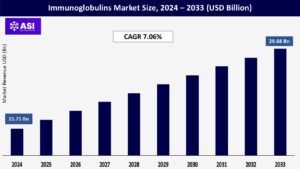
The global immunoglobulins market size was valued at approximately USD 15.75 billion in 2024 and is projected to reach USD 29.68 billion by 2033, growing at a CAGR of 7.06% during the forecast period (2025–2033).
The Immunoglobulins Market involves the global production and sale of immunoglobulins (antibodies), which are proteins made by B cells to identify and neutralize harmful pathogens like bacteria and viruses. These are used to treat immune deficiencies, autoimmune disorders, and infections such as PIDD, CIDP, and Kawasaki disease.
Key properties include high antigen specificity and immune activation. The market is growing due to rising disease prevalence, better diagnostic awareness, and advances in plasma technologies. Immunoglobulins are available in intravenous (IVIG), subcutaneous (SCIG), and intramuscular forms for various clinical needs.
One of the most significant drivers of the immunoglobulins market is the increasing incidence of primary and secondary immunodeficiency disorders as well as autoimmune diseases worldwide. Conditions such as Primary Immunodeficiency Diseases (PIDD), Chronic Inflammatory Demyelinating Polyneuropathy (CIDP), multiple sclerosis, and myasthenia gravis require immunoglobulin therapy for effective treatment and management.
With more accurate diagnosis and growing awareness among healthcare professionals and patients, the demand for long-term immunoglobulin therapy has grown substantially. Additionally, the aging global population more prone to weakened immune systems has led to increased susceptibility to such diseases, further fueling market growth.
Technological progress in plasma collection, fractionation, and purification techniques has significantly enhanced the efficiency, safety, and yield of immunoglobulin production. Innovations such as automated plasma separation, viral inactivation methods, and recombinant antibody development have made immunoglobulin therapies safer and more scalable.
These advancements not only improve production capacities but also reduce the risk of contamination and transmission of infectious agents, ensuring higher-quality products. As a result, pharmaceutical companies can meet growing global demand, expand therapeutic indications, and enter new markets, collectively contributing to the market’s robust growth.
One of the major restraints impacting the growth of the Immunoglobulins Market is the high cost of treatment coupled with the limited availability of plasma-derived products. Immunoglobulin therapies are expensive due to the complex and resource-intensive process involved in plasma collection, fractionation, purification, and quality testing.
On average, thousands of plasma donations are required to produce a single dose of immunoglobulin for a patient annually, making it a labor and time intensive process. This results in high treatment costs, often ranging in the thousands of dollars per month, which can be unaffordable for many patients especially in low- and middle-income countries with limited healthcare reimbursement systems.
Additionally, the global supply of human plasma is constrained, leading to supply-demand imbalances, particularly during times of increased need or disrupted plasma collection (e.g., during pandemics). Regulatory challenges and logistical hurdles related to donor recruitment, screening, and plasma processing further contribute to the limited availability.
These factors not only restrict market growth but also delay treatment access for patients in need, thereby acting as a significant barrier to the expansion of immunoglobulin-based therapies globally.
| Report Metric | Details |
|---|---|
| Segmentations | |
| By Product Type |
IgG IgA IgM IgE IgD |
| By Type |
Intravenous Immunoglobulins (IVIG) Subcutaneous Immunoglobulins (SCIG) Others |
| By Application |
Primary Immunodeficiency Chronic Inflammatory Demyelinating Polyneuropathy (CIDP) Guillain–Barré Syndrome Hypogammaglobulinemia Myasthenia Gravis Others |
| By End User |
Hospitals Clinics Homecare Others |
| By Distribution Channel |
Hospital Pharmacies Retail Pharmacies Online Pharmacies |
| Key Players |
|
| Geographies Covered | |
| North America |
U.S. |
| Europe |
U.K. |
| Asia Pacific |
China |
| Middle East & Africa |
Saudi Arabia |
| Latin America |
Brazil |
The Immunoglobulins Market is segmented by product Type, Type, Application Route of administration, Application, Distribution Channels and End User. Each factor plays a crucial role in improving patient outcomes, driving the adoption of immunoglobulin therapies, and supporting the development of safer, more efficient, and accessible treatment options for managing immunodeficiency, autoimmune, and inflammatory conditions.
IgG holds the dominant share due to its broad therapeutic use in treating immune deficiencies and autoimmune disorders, while IgA, IgM, IgE, and IgD have more limited or specialized applications, primarily in research or niche therapies.
Intravenous Immunoglobulins (IVIG) lead the market owing to their effectiveness in acute and chronic conditions and widespread hospital use, whereas Subcutaneous Immunoglobulins (SCIG) are rapidly gaining traction for home-based treatments due to their convenience and lower risk of systemic reactions.
primary immunodeficiency represents the largest segment, followed by CIDP, Guillain–Barré Syndrome, hypogammaglobulinemia, and myasthenia gravis, all of which rely heavily on immunoglobulin therapies for management and symptom relief.
hospitals remain the primary centers for immunoglobulin administration, especially IVIG, but clinics and homecare settings are expanding in importance, particularly with the rise in SCIG usage.
hospital pharmacies account for the largest share due to centralized purchasing and administration, while retail and online pharmacies are growing steadily, driven by increased demand for outpatient and homecare delivery models. Each segment reflects evolving patient needs, treatment advancements, and shifting healthcare delivery trends that are shaping the future of the immunoglobulins market.
North America holds the largest share of the global immunoglobulins market, primarily driven by the United States. This dominance is attributed to a well-established healthcare infrastructure, high awareness of immunological disorders, and robust reimbursement systems.
The region benefits from strong regulatory support and widespread use of advanced plasma fractionation and manufacturing technologies. The growing prevalence of autoimmune and immunodeficiency diseases, especially Primary Immunodeficiency Diseases (PIDD) and CIDP, further fuels demand. Additionally, a large number of clinical trials and the presence of key market players like Grifols, CSL Behring, and Takeda contribute to North America’s leadership.
Europe is the second-largest market, with countries such as Germany, France, the UK, and Italy being major contributors. The region benefits from increasing government funding for rare and chronic disease treatments, a growing elderly population, and improved diagnostic capabilities.
IVIG therapies are widely accepted and reimbursed in many European countries, while SCIG is increasingly used for home-based treatments. The European Medicines Agency (EMA) also supports innovation and access, making the region attractive for both local and global pharmaceutical players. Rising demand is particularly noted in Eastern Europe, where awareness and access to therapy are expanding.
The Asia-Pacific region is witnessing the fastest growth in the immunoglobulins market, fueled by increasing healthcare expenditure, improving access to medical services, and rising prevalence of immunological conditions.
Countries such as China, Japan, South Korea, and India are key markets. Japan has a mature immunoglobulin therapy landscape, while China and India are expanding rapidly due to increasing investments in plasma collection infrastructure and local production capabilities.
However, challenges such as high treatment costs and limited awareness in rural areas still pose constraints. Government initiatives to improve rare disease treatment and local biotech growth are expected to support future market expansion.
In Latin America, the market is growing steadily, with Brazil, Mexico, and Argentina leading in terms of demand. Growth is driven by improving healthcare systems, greater awareness of immunodeficiencies, and the gradual introduction of reimbursement programs.
However, the market faces challenges such as uneven access to advanced therapies, reliance on imports, and regulatory variability. Despite these, international partnerships and expansion of public health initiatives are creating opportunities for wider access to immunoglobulin treatments.
The Middle East & Africa region holds a smaller market share but shows potential for future growth. Countries like Saudi Arabia, UAE, and South Africa are investing in healthcare infrastructure and specialty care, which is expected to boost immunoglobulin demand.
Limited awareness, high treatment costs, and low diagnostic rates of immune disorders currently restrict market penetration in some areas. However, increasing focus on rare disease management and partnerships with global healthcare providers are gradually improving access and driving awareness in this region.
The Immunoglobulins market was valued at USD 15.75 billion in 2024.
The Immunoglobulins market is projected to grow at a CAGR of 7.06% from 2025 to 2033.
Intravenous Immunoglobulins (IVIG) hold the largest market share.
The North America, Europe region is expected to witness the highest growth rate.
Major players include CSL Behring, Grifols, S.A. and Takeda Pharmaceutical Company Limited.
1.1 Summary
1.2 Research methodology
2.1 Research Objectives
2.2 Market Definition
2.3 Limitations & Assumptions
2.4 Market Scope & Segmentation
2.5 Currency & Pricing Considered
3.1 Drivers
3.2 Geopolitical Impact
3.3 Human Factors
3.4 Technology Factors
4.1 Porters Five Forces Analysis
4.2 Value Chain Analysis
4.3 Average Pricing Analysis
4.4 M & A, Agreements & Collaboration Analysis
5.1 Immunoglobulins Market, By Product Type
5.1.1 Introduction
5.1.2 Market Size & Forecast
5.2 Immunoglobulins Market, By Type
5.3 Immunoglobulins Market, By Application
5.4 Immunoglobulins Market, By End User
5.5 Immunoglobulins Market, By Distribution Channel
6.1 North America Immunoglobulins Market , By Country
6.1.1 Immunoglobulins Market, By Product Type
6.1.2 Immunoglobulins Market, By Type
6.1.3 Immunoglobulins Market, By Application
6.1.4 Immunoglobulins Market, By End User
6.1.5 Immunoglobulins Market, By Distribution Channel
6.2 U.S.
6.2.1 Immunoglobulins Market, By Product Type
6.2.2 Immunoglobulins Market, By Type
6.2.3 Immunoglobulins Market, By Application
6.2.4 Immunoglobulins Market, By End User
6.2.5 Immunoglobulins Market, By Distribution Channel
6.3 Canada
7.1 U.K.
7.2 Germany
7.3 France
7.4 Spain
7.5 Italy
7.6 Russia
7.7 Nordic
7.8 Benelux
7.9 The Rest of Europe
8.1 China
8.2 South Korea
8.3 Japan
8.4 India
8.5 Australia
8.6 Taiwan
8.7 South East Asia
8.8 The Rest of Asia-Pacific
9.1 UAE
9.2 Turkey
9.3 Saudi Arabia
9.4 South Africa
9.5 Egypt
9.6 Nigeria
9.7 Rest of MEA
10.1 Brazil
10.2 Mexico
10.3 Argentina
10.4 Chile
10.5 Colombia
10.6 Rest of Latin America
11.1 Global Market Share (%) By Players
11.2 Market Ranking By Revenue for Players
11.3 Competitive Dashboard
11.4 Product Mapping