

North America Clinical Trial Imaging Market
North America Clinical Trial Imaging Market Share & Trends Analysis Report, By Modality (Computed Tomography (CT), Magnetic Resonance Imaging (MRI), Ultrasound, Positron Emission Tomography (PET), X‑Ray, Optical Coherence Tomography (OCT), Other Modalities), By Therapeutic Area (Oncology, NASH, Cardiovascular Disease, Chronic Kidney Disease, Diabetes, Neurovascular Diseases, Orthopedics & Musculoskeletal, Ophthalmology, Other), By Service Type (Clinical Trial Design & Consultation, Reading & Analytical Services, Operational Imaging Services, System & Technology Support, Project & Data Management), By End‑User (Contract Research Organizations (CROs), Biotechnology & Pharmaceutical Companies, Medical Device Manufacturers, Academic & Government Research Institutes, Other)– Industry Analysis Report, Regional Outlook, Growth Potential, Price Trends, Competitive Market Share & Forecast, 2025–2033.

Historical Period: 2019-2024
Forecast Period: 2025-2033
Report Code :
CAGR: 8.35%
Last Updated : January 23, 2026
The global North America clinical trial imaging market size was valued at approximately USD 0.99 billion in 2024 and is projected to reach USD 1.66 billion by 2033, growing at a CAGR of 8.35% during the forecast period (2025–2033).
The North American Clinical Trial Imaging Market refers to the sector within the pharmaceutical and biotechnology industries that leverages advanced imaging technologies, such as Magnetic Resonance Imaging (MRI), Computed Tomography (CT), Positron Emission Tomography (PET), ultrasound, and X-rays, to support clinical research.
These imaging tools are integrated into various phases of clinical trials to provide visual and measurable evidence of the biological effects of investigational drugs or therapies. The primary use of imaging in clinical trials is to assess drug efficacy and safety, track disease progression or regression, identify biomarkers, and offer non-invasive diagnostic insights that enhance the credibility of trial results.
Imaging is especially vital in oncology, neurology, and cardiology trials, where internal visual changes are critical indicators. One of the key properties of this market is the involvement of centralized imaging core labs, which ensure standardization, blinded image reviews, and regulatory compliance with bodies such as the FDA and Health Canada.
Additionally, the growing use of AI and machine learning in image analysis, combined with cloud-based image sharing platforms, enables real-time access, remote monitoring, and enhanced data accuracy across multi-center trials. The North American market is driven by the region’s strong regulatory frameworks, technological advancements, and the high volume of clinical research activities. These capabilities are strengthening data reliability across trials and supporting the steady expansion of the market size.
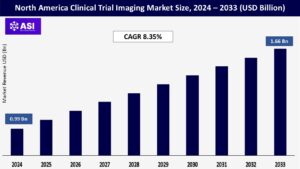
One of the primary drivers of the North America Clinical Trial Imaging Market is the growing number of clinical trials across therapeutic areas, especially in oncology, neurology, and cardiology, where imaging plays a pivotal role in monitoring disease progression and treatment response.
Pharmaceutical and biotechnology companies are increasingly using imaging as a non-invasive, precise, and quantitative tool to assess biological activity, enabling faster and more informed decision-making. In the U.S. alone, thousands of trials are underway at any given time, many of which are phase II or III studies where imaging endpoints are crucial for FDA and Health Canada submissions.
The rise of personalized medicine and immuno-oncology therapies further increases the demand for sophisticated imaging biomarkers to predict and track responses in heterogeneous patient populations. This sustained increase in trial activity directly contributes to the expansion of the North America clinical trial imaging market size.
Another significant growth factor is the integration of artificial intelligence (AI) and cloud-based imaging systems into clinical trial workflows. AI-powered image analysis helps in automating the detection of disease markers, reducing human error, and significantly speeding up data interpretation.
Meanwhile, cloud-based platforms allow for remote and centralized image storage, review, and sharing, making it easier for stakeholders across different sites to collaborate in real time. These technologies enable decentralized and hybrid trial models, which are increasingly favored post-COVID-19 for their flexibility and patient-centric approach.
The result is faster trial timelines, improved data integrity, and lower operational costs, key value propositions for sponsors and CROs in North America. These technologies enable decentralized trial models and faster timelines, accelerating the North American clinical trial imaging market growth.
A major restraint in the North America Clinical Trial Imaging Market is the high cost and complexity associated with imaging infrastructure and services, which may limit short-term expansion of the market size. Conducting clinical trials that incorporate imaging modalities such as MRI, CT, PET, and advanced ultrasound requires significant investment not only in equipment but also in trained radiologists, image analysis software, data storage systems, and centralized imaging core labs.
These costs can escalate rapidly, especially in multi-site or global trials, making it difficult for small or mid-sized pharmaceutical and biotech firms to integrate imaging endpoints. Moreover, imaging data must comply with strict regulatory requirements (e.g., FDA 21 CFR Part 11, GCP, HIPAA), adding layers of complexity to trial management.
The lack of standardization in imaging protocols across trial sites can lead to variability in data quality and interpretation, requiring additional quality control resources. This complexity increases trial timelines and operational burdens, discouraging some sponsors from adopting imaging despite its benefits.
| Report Metric | Details |
|---|---|
| Segmentations | |
| By Modality |
Computed Tomography (CT) Magnetic Resonance Imaging (MRI) Ultrasound Positron Emission Tomography (PET) X‑Ray Optical Coherence Tomography (OCT) Other Modalities |
| By Therapeutic Area |
Oncology NASH Cardiovascular Disease Chronic Kidney Disease Diabetes Neurovascular Diseases Orthopedics & Musculoskeletal Ophthalmology Other |
| By Service Type |
Clinical Trial Design & Consultation Reading & Analytical Services Operational Imaging Services System & Technology Support Project & Data Management |
| By End-User |
Contract Research Organizations (CROs) Biotechnology & Pharmaceutical Companies Medical Device Manufacturers Academic & Government Research Institutes Other |
| Key Players |
|
| Geographies Covered | |
| North America |
U.S. |
The North America Clinical Trial Imaging Market is segmented by Modality, Therapeutic Area, Service Type and End User. Each factor plays a crucial role in enhancing the accuracy and reliability of clinical research, accelerating drug development timelines, and supporting regulatory compliance in the evaluation of advanced therapies.
The integration of imaging technologies in clinical trials not only strengthens the scientific validity of outcomes but also fosters innovation in precision medicine and remote trial management.
The North America Clinical Trial Imaging Market is dominated by Computed Tomography (CT) and Magnetic Resonance Imaging (MRI) due to their widespread availability, non-invasive nature, and high-resolution imaging capabilities that are critical in oncology and neurological studies. CT scans are particularly valued for their rapid acquisition times and ability to assess disease progression in solid tumors, while MRI is preferred for soft-tissue contrast and functional imaging, making it essential in central nervous system (CNS) and musculoskeletal trials.
Positron Emission Tomography (PET) is gaining traction, especially in oncology and neurology trials, for its molecular imaging capabilities that allow real-time monitoring of metabolic changes. Ultrasound is commonly used in cardiovascular and prenatal studies due to its safety and cost-effectiveness. Although X-ray remains relevant in orthopedic trials, its overall share is lower due to limited soft-tissue resolution. Optical Coherence Tomography (OCT), though more niche, is expanding within ophthalmology trials, while other modalities like nuclear imaging and hybrid systems (PET-CT/MRI) are seeing growth through precision medicine initiatives.
Oncology holds the largest North America clinical trial imaging market share, as cancer trials rely heavily on imaging to evaluate tumor size, metastasis, and treatment efficacy according to RECIST and iRECIST criteria. Neurovascular diseases and cardiovascular disease follow closely, leveraging MRI and PET for stroke and heart failure studies.
Trials targeting Non-Alcoholic Steatohepatitis (NASH) and chronic kidney disease are on the rise, with imaging increasingly used for fibrosis staging and organ function tracking. Diabetes-related complications, such as diabetic retinopathy, are driving demand for OCT and ultrasound-based assessments.
Other emerging segments include orthopedics, musculoskeletal imaging, and ophthalmology, as imaging biomarkers become more integrated into protocol design. The “other” category includes autoimmune, infectious, and rare diseases where advanced imaging plays a supplementary yet growing role.
Reading and analytical services form the backbone of the market, driven by the need for centralized, blinded, and consistent image interpretation across multicenter trials. Operational imaging services, including image collection, anonymization, and quality control, are vital to ensuring compliance with Good Clinical Practice (GCP) and regulatory standards.
System and technology support services are increasingly important due to the integration of AI tools, image repositories, and cloud platforms that enable remote access and real-time collaboration. Project and data management services are essential for handling large volumes of imaging data across diverse geographies.
Meanwhile, clinical trial design and consultation services are growing as sponsors seek imaging expertise early in protocol development to optimize trial design and endpoint selection.
Biotechnology and pharmaceutical companies are the primary consumers of imaging services, particularly those conducting oncology and CNS trials. Contract Research Organizations (CROs) represent a significant share, often acting as intermediaries that outsource imaging to specialized vendors for large-scale, global trials.
Medical device manufacturers utilize imaging to evaluate device safety, placement, and performance, especially in cardiovascular and orthopedic trials.
Academic and government research institutes contribute to innovation and early-phase studies, often partnering with federal initiatives and public-private research consortia. The “others” category includes nonprofit research organizations and specialty clinical trial networks.
The North America Clinical Trial Imaging Market is shaped by a high number of ongoing clinical trials, a mature biopharmaceutical ecosystem, and access to advanced medical imaging infrastructure across the United States and Canada. The region benefits from strong collaboration between pharmaceutical companies, contract research organizations (CROs), imaging service providers, and research institutions, which supports consistent demand for imaging services in clinical research.
Within the North America Clinical Trial Imaging Market, the United States plays a central role. Government-backed research funding, including grants from organizations such as the National Institutes of Health (NIH), continues to support clinical development activities. In parallel, imaging workflows are increasingly supported by AI-based tools for image analysis, data management, and trial monitoring, helping sponsors improve efficiency and data quality. The regulatory environment also provides a structured framework that supports clinical research while maintaining compliance standards, making the region conducive for long-term investment in clinical trial imaging capabilities.
The North America clinical trial imaging market is projected to reach USD 1.66 billion in 2024.
The North America clinical trial imaging market is projected to grow at a CAGR of 8.35% from 2025 to 2033.
The Computed Tomography (CT) holds the largest North America clinical trial imaging market share.
The rising number of Clinical Trials, especially in Oncology and Neurology is one of the growth factors of the North America clinical trial imaging market
Major players include BioTel Research, ICON plc and Medpace Holdings, Inc.
1.1 Summary
1.2 Research methodology
2.1 Research Objectives
2.2 Market Definition
2.3 Limitations & Assumptions
2.4 Market Scope & Segmentation
2.5 Currency & Pricing Considered
3.1 Drivers
3.2 Geopolitical Impact
3.3 Human Factors
3.4 Technology Factors
4.1 Porters Five Forces Analysis
4.2 Value Chain Analysis
4.3 Average Pricing Analysis
4.4 M & A, Agreements & Collaboration Analysis
6.1 North America Clinical Trial Imaging Market, By Country
6.1.1 North America Clinical Trial Imaging Market, By Modality
6.1.2 North America Clinical Trial Imaging Market, By Therapeutic Area
6.1.3 North America Clinical Trial Imaging Market, By Service Type
6.1.4 North America Clinical Trial Imaging Market, By End-User
6.2 U.S.
6.2.1 North America Clinical Trial Imaging Market, By Modality
6.2.2 North America Clinical Trial Imaging Market, By Therapeutic Area
6.2.3 North America Clinical Trial Imaging Market, By Service Type
6.2.4 North America Clinical Trial Imaging Market, By End-User
6.3 Canada
11.1 Global Market Share (%) By Players
11.2 Market Ranking By Revenue for Players
11.3 Competitive Dashboard
11.4 Product Mapping