

North America Home Infusion Therapy Market
North America Home Infusion Therapy Market Share & Trends Analysis Report, By Product Type (Infusion Pumps, Intravenous Sets, IV Cannulas, Needleless Connectors), By Application (Anti-Infective Therapy, Hydration, Chemotherapy, Enteral Nutrition, Parenteral Nutrition, Specialty Pharmaceuticals, Others), By Route of Administration (Intramuscular, Subcutaneous, Epidural, Intravenous), By End User (Hospitals, Clinics, Home Care Service Providers), By Distribution Model (Direct-to-Patient, Pharmacy-Led, Hospital-Based)– Industry Analysis Report, Regional Outlook, Growth Potential, Price Trends, Competitive Market Share & Forecast, 2025–2033.

Historical Period: 2019-2024
Forecast Period: 2025-2033
Report Code :
CAGR: 8.30%
Last Updated : December 15, 2025
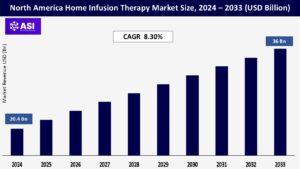
The global North America Home Infusion Therapy Market size was valued at approximately USD 20.4 billion in 2024 and is projected to reach USD 36 billion by 2033, growing at a CAGR of 8.30% during the forecast period (2025–2033).
The North America Home Infusion Therapy Market encompasses the administration of drugs and nutritional therapy directly into a patient’s bloodstream or body through intravenous (IV) or subcutaneous methods all from the comfort of the patient’s home.
This form of therapy is prescribed when ongoing treatment is needed for chronic illnesses, infections, or immune system disorders and traditionally includes antibiotics, chemotherapy, hydration therapy, total parenteral nutrition (TPN), and biologics. The primary use of home infusion therapy is to improve patient quality of life by reducing or eliminating hospital stays, lowering the risk of hospital-acquired infections, and offering more flexible and cost-effective treatment options.
It is especially beneficial for patients undergoing long-term treatment for conditions like cancer, Crohn’s disease, multiple sclerosis, and immune deficiencies. The key properties of this market include a combination of services such as infusion pharmacy compounding, equipment provision (e.g., infusion pumps and catheters), nursing support, and 24/7 patient monitoring.
Advances in wearable infusion pumps and remote patient monitoring technologies have enhanced the safety and efficiency of home-based care. The North American market is fueled by high healthcare costs, growing demand for decentralized care, technological innovations, and strong support from insurance providers and Medicare for home-based treatment alternatives.
One of the core drivers of the home infusion therapy market is the increasing burden of chronic illnesses such as cancer, diabetes, immune disorders, and gastrointestinal diseases that require long-term or recurrent treatment.
At the same time, North America, particularly the U.S. and Canada, has a rapidly aging population—a demographic that is more likely to need intravenous therapy and also prefers the comfort of receiving care at home.
According to the U.S. Census Bureau, by 2030, over 20% of the U.S. population will be aged 65 and above. These trends fuel demand for home-based care models that allow safe, cost-effective, and continuous treatment outside of traditional healthcare settings.
The high cost of inpatient care in North American hospitals is pushing healthcare systems, payers, and patients toward more cost-effective alternatives like home infusion therapy. Home-based treatment not only reduces hospitalization costs but also decreases the risk of hospital-acquired infections and enhances patient comfort and compliance.
As healthcare policy increasingly emphasizes value-based care and outcomes, insurers and Medicare are expanding coverage for home infusion services.
In addition, the COVID-19 pandemic accelerated the shift toward decentralized healthcare, making home infusion a strategic priority for hospitals and providers looking to maintain continuity of care while minimizing patient exposure and operational burden.
A significant restraint in the North America Home Infusion Therapy Market is the inconsistent reimbursement landscape, particularly in the United States. Although Medicare and private insurers have expanded support for home-based care, not all drugs, equipment, or nursing services are fully reimbursed especially under Medicare Part B, which traditionally only covers the drug cost but not associated infusion services or supplies in the home setting.
This fragmented coverage creates financial uncertainty for providers and patients, often leading to out-of-pocket expenses or treatment delays. Additionally, the complexity of insurance billing and documentation discourages some physicians from recommending home infusion, even when clinically appropriate.
Smaller home infusion providers also struggle with maintaining profitability due to delayed reimbursements and administrative burdens related to compliance and pre-authorization. These systemic issues limit broader adoption and scalability, particularly for underserved and rural populations who could benefit most from home-based care.
| Report Metric | Details |
|---|---|
| Segmentations | |
| By Product Type |
Infusion Pumps Intravenous Sets IV Cannulas Needleless Connectors |
| By Application |
Anti-Infective Therapy Hydration Chemotherapy Enteral Nutrition Parenteral Nutrition Specialty Pharmaceuticals Others |
| By Route of Administration |
Intramuscular Subcutaneous Epidura Intravenous |
| By End User |
Hospitals Clinics Home Care Service Providers |
| By Distribution Model |
Direct-to-Patient Pharmacy-Led Hospital-Based |
| Key Players |
|
| Geographies Covered | |
| North America |
U.S. |
The North America Home Infusion Therapy Market is segmented by Product Type, Application, Route of administration, End User and Distribution Model. Each factor plays a crucial role in expanding access to care, improving patient comfort, and optimizing healthcare resource utilization through decentralized treatment delivery.
The growing emphasis on cost-effective, patient-centric models and technological advancements in infusion devices continue to drive the adoption of home-based therapies.
The market is segmented into infusion pumps, intravenous (IV) sets, IV cannulas, and needleless connectors. Infusion pumps both ambulatory and stationary hold a significant share due to their precision in delivering controlled dosages of medications such as chemotherapy agents and pain management drugs.
These devices are increasingly preferred for their portability, safety features, and compatibility with home-based care. IV sets, comprising tubing, connectors, and flow regulators, form a critical part of the delivery system and are widely used across multiple therapies.
IV cannulas are essential for venous access, particularly in long-term treatments, while needleless connectors are gaining adoption due to their ability to reduce the risk of needlestick injuries and catheter-related bloodstream infections, thereby supporting safer and more hygienic home care environments.
The market is driven predominantly by anti-infective therapy, which includes intravenous antibiotics and antifungals commonly administered at home for conditions like osteomyelitis or post-surgical infections. Hydration therapy also constitutes a large share, especially for patients recovering from surgeries, gastrointestinal disorders, or undergoing chemotherapy.
Chemotherapy administered at home is growing rapidly, offering cancer patients more convenience and quality of life. Enteral and parenteral nutrition are critical for patients with malabsorption issues or severe gastrointestinal conditions, often requiring long-term home care.
Specialty pharmaceuticals, including biologics and immunoglobulin therapies, are one of the fastest-growing segments, driven by treatments for autoimmune diseases, rare disorders, and chronic inflammatory conditions. The “others” category includes pain management and hormone therapy.
Intravenous (IV) infusion dominates the market, as it is the most efficient method for rapid drug delivery, commonly used in anti-infective, hydration, and chemotherapy regimens. Subcutaneous administration is rising, especially for biologics and immunotherapy, due to ease of use and minimal training requirements.
Intramuscular injections are used less frequently but remain relevant for certain hormone and vitamin therapies. Epidural infusions, though niche, are primarily employed in home-based palliative care for pain relief in end-stage cancer patients.
Home care service providers are the central drivers of the market, offering integrated services that include nurse-administered infusions, patient training, and equipment provision. Hospitals play a key role in initiating infusion therapy and transitioning patients to home settings through discharge planning and coordination with infusion providers.
Clinics, especially specialty and outpatient clinics, are essential intermediaries in recommending and overseeing home infusion for chronic and stable conditions.
Direct-to-patient, pharmacy-led, and hospital-based models. The direct-to-patient model is expanding rapidly due to technological advances in remote monitoring, portable pumps, and self-administration kits, allowing patients to receive therapy directly at home with minimal provider intervention.
Pharmacy-led models, spearheaded by specialty pharmacies, compound and deliver medications, coordinate with prescribers, and offer telehealth support, playing a vital role in biologics and specialty drug distribution.
Hospital-based models continue to be important for complex therapies requiring more clinical oversight or for patients transitioning from acute to home care.
North America dominates the global home infusion therapy market and is expected to maintain its leadership due to a well-developed healthcare infrastructure, rising chronic disease burden, and a strong emphasis on decentralized, patient-centric care.
The United States leads the region with the presence of major home infusion service providers, specialty pharmacies, and extensive payer networks including Medicare and private insurers, which have gradually expanded reimbursement for home-based infusion services.
The growing aging population, increasing prevalence of cancer, immune deficiencies, and gastrointestinal disorders, and high healthcare costs are prompting a shift from hospital to home care settings.
Europe holds a significant share of the market and is experiencing steady growth driven by an aging population, rising incidence of chronic conditions, and an increasing preference for cost-effective care models outside of hospital settings.
Countries like Germany, the United Kingdom, France, and the Netherlands are at the forefront, where national health systems and insurance plans increasingly recognize the economic and patient-centric benefits of home infusion therapy.
The European market is also benefiting from advancements in infusion device safety, standardization of home care protocols, and the presence of regional home healthcare companies.
The Asia-Pacific region is the fastest-growing market for home infusion therapy, driven by rapid urbanization, increasing healthcare expenditures, and a rising prevalence of cancer, diabetes, and autoimmune disorders. Countries such as Japan, China, India, South Korea, and Australia are seeing increased demand for home healthcare services due to growing middle-class populations, improved access to medical technology, and government efforts to relieve hospital overcrowding.
Japan, with its advanced aging population and focus on geriatric care, is leading the adoption of home infusion. In India and China, the private sector is driving growth through investments in home healthcare startups and remote patient management solutions.
Latin America represents an emerging market with growing potential in countries such as Brazil, Mexico, Chile, and Argentina, where public and private healthcare systems are increasingly exploring alternatives to inpatient care.
Economic pressures and hospital bed shortages are accelerating interest in home infusion therapy, especially for antibiotic administration, hydration therapy, and oncology support. However, the region faces significant hurdles, including underdeveloped home care infrastructure, lack of trained personnel, and uneven reimbursement systems.
The Middle East & Africa (MEA) region currently accounts for the smallest market share, but gradual improvements in healthcare infrastructure, increasing incidence of chronic diseases, and growing awareness of home-based care benefits are creating new opportunities.
In the Middle East, countries like Saudi Arabia, the UAE, and Qatar are making strides in integrating home infusion services into broader home healthcare initiatives, supported by government healthcare modernization plans.
Africa, while still limited by resource constraints, low healthcare access, and minimal home care infrastructure, is seeing early-stage development in South Africa and select North African countries.
The market was valued at USD 20.4 billion in 2024.
The market is projected to grow at a CAGR of 8.30% from 2025 to 2033.
Infusion Pumps hold the largest market share.
The North America region is expected to witness the highest growth rate.
Major players include Option Care Health, Inc., CVS Health Corporation (Coram CVS) and Baxter International Inc.
1.1 Summary
1.2 Research methodology
2.1 Research Objectives
2.2 Market Definition
2.3 Limitations & Assumptions
2.4 Market Scope & Segmentation
2.5 Currency & Pricing Considered
3.1 Drivers
3.2 Geopolitical Impact
3.3 Human Factors
3.4 Technology Factors
4.1 Porters Five Forces Analysis
4.2 Value Chain Analysis
4.3 Average Pricing Analysis
4.4 M & A, Agreements & Collaboration Analysis
6.1 North America Home Infusion Therapy Market, By Country
6.1.1 North America Home Infusion Therapy Market, By Product Type
6.1.2 North America Home Infusion Therapy Market, By Application
6.1.3 North America Home Infusion Therapy Market, By Route of Administration
6.1.4 North America Home Infusion Therapy Market, By End User
6.1.5 North America Home Infusion Therapy Market, By Distribution Model
6.2 U.S.
6.2.1 North America Home Infusion Therapy Market, By Product Type
6.2.2 North America Home Infusion Therapy Market, By Application
6.2.3 North America Home Infusion Therapy Market, By Route of Administration
6.2.4 North America Home Infusion Therapy Market, By End User
6.2.5 North America Home Infusion Therapy Market, By Distribution Model
6.3 Canada
11.1 Global Market Share (%) By Players
11.2 Market Ranking By Revenue for Players
11.3 Competitive Dashboard
11.4 Product Mapping