

Sodium Dichromate Market
Sodium Dichromate Market & Trends Analysis Report, By Grade (Technical Grade, Reagent Grade), By Application (Metal Finishing, Pigment Production), By End User (Chemical Manufacturers, Construction & Automotive)– Industry Analysis Report, Regional Outlook, Growth Potential, Price Trends, Competitive Market Share & Forecast, 2025–2033.

Historical Period: 2019-2024
Forecast Period: 2025-2033
Report Code :
CAGR: 4.0%
Last Updated : March 13, 2026
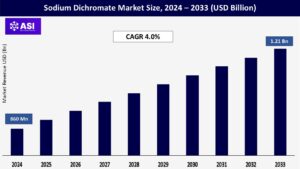
The global Sodium Dichromate Market size was valued at approximately USD 860 million in 2024 and is projected to reach USD 1.21 billion by 2033, growing at a CAGR of 4.0% during the forecast period.
Sodium dichromate (Na₂Cr₂O₇), a powerful oxidizing agent, is primarily used in the production of chromium compounds and as a corrosion inhibitor, wood preservative, and in various industrial processes.
Sodium dichromate is essential to many industrial operations, such as the tanning of leather, the polishing of metal, and the creation of pigment. The need for these applications is being greatly increased by the continuous industrialization in emerging economies, especially in the Asia-Pacific and Latin America.
Furthermore, the demand for chromate-based pigments and anticorrosive coatings is being driven by the boom in global infrastructure and building, which is speeding up the use of sodium dichromate in a variety of industries.
In sectors including automotive, aerospace, marine, and infrastructure, where exposure to moisture, chemicals, and harsh environments is common, high-performance, corrosion-resistant coatings are crucial. A crucial component of these compositions, sodium dichromate provides exceptional durability and protection.
The need for sodium dichromate-based solutions is growing worldwide as regulations drive for more durable, effective coating systems, particularly in regions with high standards of quality and technology.
Because of its known carcinogenic, mutagenic, and environmentally damaging qualities, sodium dichromate is categorized as a hazardous material. Its use contributes to soil and water pollution and presents serious health concerns to employees.
Consequently, strong safety regulations and usage limitations have been put in place by regulatory agencies, especially in North America and Europe. Adherence to these regulations restricts the substance’s use in regulated markets and raises operating expenses for producers.
Environmental responsibility and sustainability are increasingly important factors in industrial decision-making. Industries are increasingly switching to less hazardous, environmentally friendly sodium dichromate substitutes in response to global environmental concerns and regulatory frameworks like the EU’s REACH (Registration, Evaluation, Authorization and Restriction of Chemicals) and the US’s EPA (Environmental Protection Agency) guidelines.
This change is anticipated to spur innovation in green chemistry and sustainable coatings while simultaneously slowing market expansion in environmentally sensitive areas.
| Report Metric | Details |
|---|---|
| Segmentations | |
| By Grade |
Technical Grade Reagent Grade |
| By Application |
Metal Finishing Pigment Production |
| By End-Use |
Chemical Manufacturers Construction & Automotive |
| Key Players |
|
| Geographies Covered | |
| North America |
U.S. |
| Europe |
U.K. |
| Asia Pacific |
China |
| Middle East & Africa |
Saudi Arabia |
| Latin America |
Brazil |
The Sodium Dichromate Market is segmented by Function (Acidulant, Emulsifier, Diuretic), By End-Use (Food & Beverage, Pharmaceuticals, Personal Care, Industrial).
Each factor plays a crucial role in enhancing patient safety, increasing the adoption of self-administered anticoagulant therapies, and supporting the development of more convenient, prefilled drug delivery systems that streamline treatment in the management of thromboembolic and cardiovascular conditions.
Technical Grade (Dominant Segment)
Due to its extensive application in industrial processes such the generation of chromic acid, metal polishing, and pigment manufacturing, technical-grade sodium dichromate commands the biggest market share. It is perfect for large-scale applications where ultra-high purity is not necessary due to its affordability and sufficient purity levels.
This grade is preferred by industries because of its consistent performance and suitability for mass production settings, especially in developing nations with growing manufacturing industries.
Reagent Grade
Reagent grade sodium dichromate is mostly utilized in analytical and laboratory settings and is distinguished by its high purity. In fields where accuracy and safety are crucial, such as regulated chemical production, pharmaceutical testing, and academic research, this grade is crucial. Despite having a smaller market share overall, it is crucial for scientific and regulatory applications that require high standards of quality.
Metal Finishing (Largest Segment)
The most common use of sodium dichromate is in metal polishing. It is widely employed in procedures like anodizing aluminum and giving different metal surfaces resistance to corrosion.
The compound is essential to sectors including aerospace, automotive, and defense because it improves surface aesthetics and durability. These industries’ rapid growth, particularly in Asia-Pacific and North America, is fueling the ongoing need for metal treatment solutions based on sodium dichromate.
Pigment Production
The production of lead chromate pigments, which give paints, polymers, and textiles their vivid and long-lasting hues, requires sodium dichromate as a necessary precursor.
The use of lead-based pigments has been reduced by regulatory limits, especially in North America and Europe, but demand is still stable in emerging nations with laxer environmental regulations. There are still opportunities for niche growth in this market, particularly in the packaging and construction industries.
Chemical Manufacturers
The main enduser group is made up of chemical producers, who mostly use sodium dichromate as an intermediary to make several chromium-based chemicals, such as catalysts, chromic acid, and chromium oxide.
In a variety of applications, including industrial catalysts, ceramics, and electroplating, these downstream products are crucial. Because of the continuous need in both developed and emerging economies, this industry remains a significant global consumer.
Construction & Automotive
Because they depend on corrosion-resistant coatings and surface treatments, the construction and automotive industries are major contributors to the demand for sodium dichromate.
The constant increase in global vehicle production and the expansion of infrastructure, especially in quickly industrializing countries, are driving growth in this market. Sodium dichromate is essential for improving the durability and functionality of metal components because of its use in protective coatings and metal polishing..
Sodium dichromate consumption in North America has declined significantly due to strict environmental and occupational safety regulations imposed by agencies such as the EPA and OSHA. The compound’s classification as a hazardous substance has led to its phased removal from many mainstream applications.
However, limited but consistent demand persists in specialized sectors such as aerospace coatings, research laboratories, and defense-related manufacturing, where performance requirements can justify its controlled use.
Asia-Pacific dominates the global sodium dichromate market, driven by rapid industrialization and expanding end-use sectors such as construction, automotive, textiles, and leather processing.
India and China lead both in production and consumption due to relatively lenient environmental regulations, cost-effective labor, and extensive manufacturing infrastructures. This region continues to experience robust demand growth, fueled by large-scale infrastructure projects and a thriving export-oriented industrial base.
The European market for sodium dichromate has contracted substantially under the influence of stringent environmental laws, including REACH (Registration, Evaluation, Authorization and Restriction of Chemicals).
The substance is subject to tight controls, and many manufacturers have transitioned to safer alternatives. Current usage is largely limited to specialty applications—such as high-performance coatings and regulated chemical synthesis—where alternatives are not yet viable.
In Latin America and Africa, sodium dichromate demand is gradually rising, supported by growing industrial sectors such as mining, textiles, and construction. These regions offer emerging opportunities, particularly in countries with less restrictive regulatory environments.
However, adoption is tempered by challenges such as inadequate infrastructure, environmental compliance issues, and increasing global pressure to shift toward sustainable chemical practices.
USD 860 million
4.0%
Metal Finishing and Pigment Production
Asia-Pacific, led by India and China.
1.1 Summary
1.2 Research methodology
2.1 Research Objectives
2.2 Market Definition
2.3 Limitations & Assumptions
2.4 Market Scope & Segmentation
2.5 Currency & Pricing Considered
3.1 Drivers
3.2 Geopolitical Impact
3.3 Human Factors
3.4 Technology Factors
4.1 Porters Five Forces Analysis
4.2 Value Chain Analysis
4.3 Average Pricing Analysis
4.4 M & A, Agreements & Collaboration Analysis
5.1 Sodium Dichromate Market, By Grade
5.1.1 Introduction
5.1.2 Market Size & Forecast
5.2 Sodium Dichromate Market, By Application
5.3 Sodium Dichromate Market, By End-User
6.1 North America Sodium Dichromate Market , By Country
6.1.1 Sodium Dichromate Market, By Grade
6.1.2 Sodium Dichromate Market, By Application
6.1.3 Sodium Dichromate Market, By End-User
6.2 U.S.
6.2.1 Sodium Dichromate Market, By Grade
6.2.2 Sodium Dichromate Market, By Application
6.2.3 Sodium Dichromate Market, By End-User
6.3 Canada
7.1 U.K.
7.2 Germany
7.3 France
7.4 Spain
7.5 Italy
7.6 Russia
7.7 Nordic
7.8 Benelux
7.9 The Rest of Europe
8.1 China
8.2 South Korea
8.3 Japan
8.4 India
8.5 Australia
8.6 Taiwan
8.7 South East Asia
8.8 The Rest of Asia-Pacific
9.1 UAE
9.2 Turkey
9.3 Saudi Arabia
9.4 South Africa
9.5 Egypt
9.6 Nigeria
9.7 Rest of MEA
10.1 Brazil
10.2 Mexico
10.3 Argentina
10.4 Chile
10.5 Colombia
10.6 Rest of Latin America
11.1 Global Market Share (%) By Players
11.2 Market Ranking By Revenue for Players
11.3 Competitive Dashboard
11.4 Product Mapping