

Wi-Fi Chipset Market
Wi-Fi Chipset Market Share & Trends Analysis Report, By Band (Single Band, Dual Band, Tri Band), By Standard (802.11n, 802.11ac, 802.11ax/Wi-Fi 6 & 6E, Wi-Fi 7), By Application (Smartphones, Laptops & Tablets, Smart Home Devices, Routers, IoT Devices, Others), By End User (Consumer Electronics, Enterprises, Automotive, Industrial, Others) Industry Analysis Report, Regional Outlook, Growth Potential, Price Trends, Competitive Market Share & Forecast, 2025–2033.

Historical Period: 2019-2024
Forecast Period: 2025-2033
Report Code :
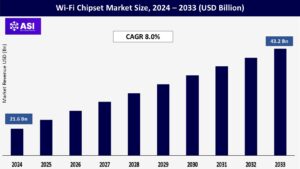
CAGR: 8.0%
Last Updated : December 3, 2025
The global Wi-Fi Chipset Market size was valued at USD 21.6 billion in 2024 and is projected to reach USD 43.2 billion by 2033, expanding at a CAGR of 8.0% during the forecast period (2025–2033).
Wi-Fi chipsets are semiconductor components that enable wireless connectivity across consumer electronics, smart devices, enterprise systems, and industrial equipment. They play a crucial role in powering smartphones, laptops, tablets, routers, IoT devices, AR/VR systems, and connected cars, among others. With the expansion of Wi-Fi 6, Wi-Fi 6E, and the upcoming Wi-Fi 7 standards, the market is witnessing rapid adoption due to demand for higher bandwidth, low latency, and improved network efficiency.
Growing integration of Wi-Fi chipsets into smart homes, smart cities, industrial automation, and automotive connectivity solutions is propelling market growth. Furthermore, increasing demand for high-speed broadband, video streaming, online gaming, and remote work solutions is accelerating deployment across consumer and enterprise domains.
The surge in data traffic, video streaming, online gaming, cloud services, and remote work has increased the need for high-speed, reliable, and low-latency connectivity.
Wi-Fi chipsets supporting Wi-Fi 6/6E and Wi-Fi 7 offer multi-gigabit speeds, enhanced spectrum efficiency, and reduced interference, making them integral for next-gen consumer and enterprise devices.
The proliferation of IoT and smart home ecosystems spanning wearables, home assistants, smart appliances, security systems, and industrial IoT platforms is driving massive demand for Wi-Fi chipsets.
IoT adoption requires low-power, compact, and cost-efficient connectivity solutions, and Wi-Fi chipsets have become the backbone of connected infrastructure.
Despite advancements, Wi-Fi chipsets face challenges of power consumption in battery-operated devices and cybersecurity vulnerabilities in wireless networks.
The need for constant firmware updates, enhanced encryption, and energy-efficient chipsets adds complexity and cost, which may hinder adoption, particularly in low-power IoT applications.
| Report Metric | Details |
|---|---|
| Segmentations | |
| By Band |
Single Band Dual Band Tri Band |
| By Standard |
802.11n 802.11ac (Wi-Fi 5) 802.11ax (Wi-Fi 6 & 6E) Wi-Fi 7 (802.11be) |
| By Application |
Smartphones Laptops & Tablets Smart Home Devices Routers IoT Devices Others |
| By End User |
Consumer Electronics Enterprises Automotive Industrial Others |
| Key Players |
|
| Geographies Covered | |
| North America |
U.S. |
| Europe |
U.K. |
| Asia Pacific |
China |
| Middle East & Africa |
Saudi Arabia |
| Latin America |
Brazil |
The Wi-Fi Chipset Market is segmented by Band, Standard, Application, and End User.
North America holds a dominant position in the global Wi-Fi chipset market, fueled by the region’s advanced digital infrastructure, high internet penetration, and strong adoption of connected devices.
The United States leads the market, with widespread usage of Wi-Fi-enabled smartphones, tablets, laptops, gaming consoles, and IoT devices across both consumer and enterprise segments.
The rapid deployment of Wi-Fi 6 and Wi-Fi 6E technologies is enhancing connectivity in smart homes, offices, and public Wi-Fi networks. Furthermore, the presence of leading chipset manufacturers and technology giants accelerates innovation in areas such as ultra-low latency, higher data throughput, and seamless connectivity for 5G-integrated devices.
Canada also contributes significantly, with demand increasing in sectors such as healthcare, education, and smart city projects. Rising adoption of cloud computing, edge computing, and video streaming services further supports market growth in North America, making it one of the most technologically advanced regions for Wi-Fi chipset deployment.
Europe represents a substantial market for Wi-Fi chipsets, driven by high levels of digitalization, growing IoT ecosystem, and emphasis on 5G-Wi-Fi integration. Major economies such as Germany, the U.K., and France are at the forefront, with strong demand across consumer electronics, enterprise networking solutions, and automotive applications.
Germany’s industrial IoT adoption, especially in manufacturing and logistics, is increasing the integration of advanced Wi-Fi chipsets in connected machinery and robotics. The U.K. demonstrates strong uptake in enterprise and public Wi-Fi deployments, particularly in smart offices and digital learning environments.
France and Italy show rising adoption in residential sectors with the growing popularity of smart appliances and connected home systems. Europe also benefits from strict regulations promoting energy efficiency and low-latency communications, which are fostering the development of next-generation Wi-Fi solutions. The region’s focus on data security and GDPR compliance is shaping innovations in secure Wi-Fi chipset technologies.
Asia-Pacific is the fastest-growing market for Wi-Fi chipsets, supported by massive smartphone penetration, expanding internet connectivity, and government-led digitalization initiatives. China leads the region, with a strong ecosystem of consumer electronics manufacturing and large-scale deployment of Wi-Fi-enabled devices across households, enterprises, and industrial sectors.
Japan and South Korea are highly advanced markets, with strong adoption of Wi-Fi 6 and Wi-Fi 6E in smart homes, automotive, and enterprise solutions. India, driven by its fast-growing smartphone user base and Digital India initiatives, is witnessing a rapid surge in Wi-Fi chipset demand for low-cost devices and public Wi-Fi projects.
Southeast Asian countries such as Indonesia, Vietnam, and Thailand are emerging markets, with growth driven by e-commerce, online gaming, and smart city initiatives. The region also plays a crucial role in the global supply chain, as leading chipset manufacturers and electronics OEMs are concentrated in APAC, making it not only a high-demand but also a major production hub.
Latin America’s Wi-Fi chipset market is expanding steadily, with Brazil and Mexico leading adoption. In Brazil, rising smartphone usage, digital banking adoption, and smart home penetration are fueling demand for Wi-Fi chipsets in consumer devices.
Mexico’s growing IT services sector and expanding e-learning environment are also contributing to market growth. Other countries such as Argentina, Chile, and Colombia are witnessing increasing adoption of Wi-Fi-enabled devices, especially as governments invest in digital inclusion programs and public Wi-Fi networks. Despite challenges such as limited broadband infrastructure in some areas, rising demand for connected devices and growing internet penetration support consistent market expansion.
The Middle East & Africa (MEA) Wi-Fi chipset market is developing rapidly, with demand primarily concentrated in the Gulf Cooperation Council (GCC) countries. The UAE, Saudi Arabia, and Qatar are leading adopters, with large-scale investments in smart cities, digital transformation, and IoT-enabled infrastructure driving chipset demand.
Public Wi-Fi deployment in commercial complexes, airports, and transportation hubs further accelerates growth. In Africa, South Africa is the largest market, supported by urbanization, e-commerce, and rising mobile device penetration.
Other African countries, including Nigeria and Kenya, are gradually expanding their adoption, although challenges such as limited connectivity infrastructure and affordability issues persist. Nonetheless, MEA shows strong growth potential due to increasing investments in broadband expansion and smart infrastructure projects.
The Wi-Fi Chipset market was valued at USD 21.6 billion in 2024.
The Wi-Fi Chipset market is projected to grow at a CAGR of 8.0% (2025–2033).
The Smartphone application segment holds the largest share.
The Asia-Pacific region is expected to witness the fastest growth due to industrialization, digitalization, and manufacturing strength.
Major players include Qualcomm, Intel, Broadcom, MediaTek, and Samsung.
1.1 Summary
1.2 Research methodology
2.1 Research Objectives
2.2 Market Definition
2.3 Limitations & Assumptions
2.4 Market Scope & Segmentation
2.5 Currency & Pricing Considered
3.1 Drivers
3.2 Geopolitical Impact
3.3 Human Factors
3.4 Technology Factors
4.1 Porters Five Forces Analysis
4.2 Value Chain Analysis
4.3 Average Pricing Analysis
4.4 M & A, Agreements & Collaboration Analysis
5.1 Wi-Fi Chipset Market, By Band
5.1.1 Introduction
5.1.2 Market Size & Forecast
5.2 Wi-Fi Chipset Market, By Standard
5.3 Wi-Fi Chipset Market, By Application
5.4 Wi-Fi Chipset Market, By End User
6.1 North America Wi-Fi Chipset Market, By Country
6.1.1 Wi-Fi Chipset Market, By Band
6.1.2 Wi-Fi Chipset Market, By Standard
6.1.3 Wi-Fi Chipset Market, By Application
6.1.4 Wi-Fi Chipset Market, By End User
6.2 U.S.
6.2.1 Wi-Fi Chipset Market, By Band
6.2.2 Wi-Fi Chipset Market, By Standard
6.2.3 Wi-Fi Chipset Market, By Application
6.2.4 Wi-Fi Chipset Market, By End User
6.3 Canada
7.1 U.K.
7.2 Germany
7.3 France
7.4 Spain
7.5 Italy
7.6 Russia
7.7 Nordic
7.8 Benelux
7.9 The Rest of Europe
8.1 China
8.2 South Korea
8.3 Japan
8.4 India
8.5 Australia
8.6 Taiwan
8.7 South East Asia
8.8 The Rest of Asia-Pacific
9.1 UAE
9.2 Turkey
9.3 Saudi Arabia
9.4 South Africa
9.5 Egypt
9.6 Nigeria
9.7 Rest of MEA
10.1 Brazil
10.2 Mexico
10.3 Argentina
10.4 Chile
10.5 Colombia
10.6 Rest of Latin America
11.1 Global Market Share (%) By Players
11.2 Market Ranking By Revenue for Players
11.3 Competitive Dashboard
11.4 Product Mapping